Kamdi Hemant Bhaskar and Sidaramappa
Sometimes, life quietly places you in situations where your first reaction is, “Are you sure you've called the right person?” This was one such occasion.
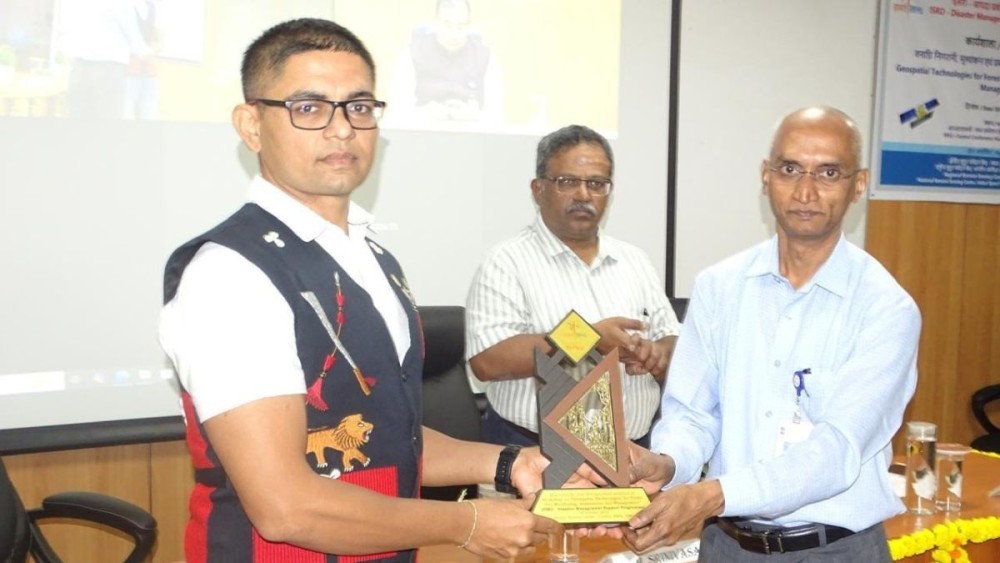
I had the opportunity to be the Guest of Honour at the One-Day Regional Workshop on “Geospatial Technologies for Forest Fire Monitoring, Assessment and Management”, organised by the Regional Remote Sensing Centre of ISRO at Nagpur. The workshop brought together officials from Forest Departments, Central Ministries, State Remote Sensing Centres, NGOs and researchers from across Central India.
The invitation itself came unexpectedly. Scientists Sushil and Amrita met me personally and invited me as the Chief Guest.
I looked at them and asked cautiously, “Do you really mean me?”
“Of course,” they replied.
Naturally, my next question was, “Who else is attending?”
Sushil casually listed the names—Principal Chief Conservator of Forests and Head of Forest Force, Maharashtra, senior officers of NRSC including the CGM and GMs, and several other distinguished participants.
I had to gently explain that the HoFF was nearly one and a half decades senior to me in the same service hierarchy—a fact Sushil was blissfully unaware of. I requested him to kindly downgrade my role from Chief Guest to Guest of Honour!
Even then, sharing the dais with such senior officers was intimidating. More frightening was the fact that the subject was highly technical, and I had little experience in geospatial technologies. But I trusted my preparation and adopted my usual attitude—”Let's see, what's the worst that can happen?”
The next question was: How do I avoid disappearing among so many towering personalities?
My answer was simple—a vibrantly coloured Naga waistcoat studded with cowry shells, worn over a crisp white half-shirt, blue denim, and complemented by a sharp haircut. Sometimes new found fitness gives you just enough confidence to carry such an outfit, especially when you secretly know many people in the audience wish they could.
It was certainly a bold choice for such a formal event. Without equally bold words, it could easily have become a fashion disaster. Fortunately, I had something else planned besides the waistcoat.
On the workshop day, I was pleasantly surprised to find many familiar faces from Madhya Pradesh, Maharashtra, and Chhattisgarh, thanks to my previous acquaintances while working in NTCA. The organisers and delegates were warm and welcoming, and I quickly felt at ease.
After listening to some highly technical talks by experts, my turn arrived. I began by openly admitting my ignorance of geospatial technologies and requested permission to keep my talk as informal as my attire.
Then I narrated the story of fighting one of Nagaland's most famous forest fires—the Dzukou–Japfu fire.
I love trekking. It was January 2014. Dzukou Valley and the adjoining Japfu Mountain lie conveniently close to Kohima, the capital of Nagaland. Thousands of trekkers visit the area every year. Japfu, nearly 10,000 feet high, is home to the world's tallest rhododendron—65 feet tall and listed in the Guinness Book of World Records. Alongside these scarlet flowers of rhododendrons bloom magnificent white magnolia trees, evolutionary veterans that continue to be flowered from the age of dinosaurs.
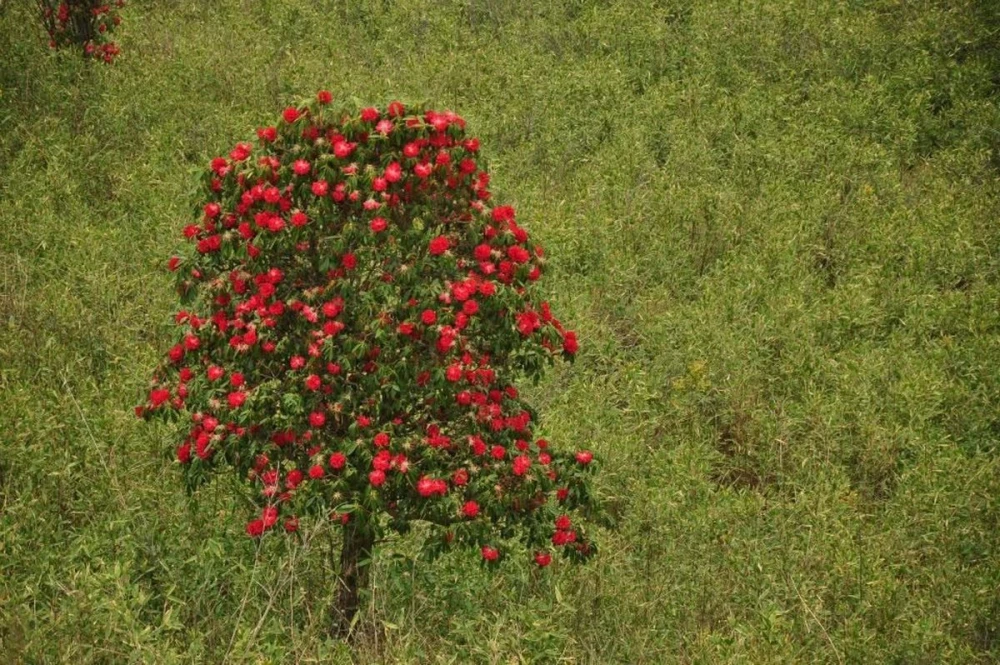
During March and April, scarlet rhododendron petals carpet the forest floor, while centuries of living and dead roots beneath create a delightfully springy sensation under your feet. Occasionally, one may even enroute encounter the semi-domesticated hybrid gaur, the majestic Mithun.
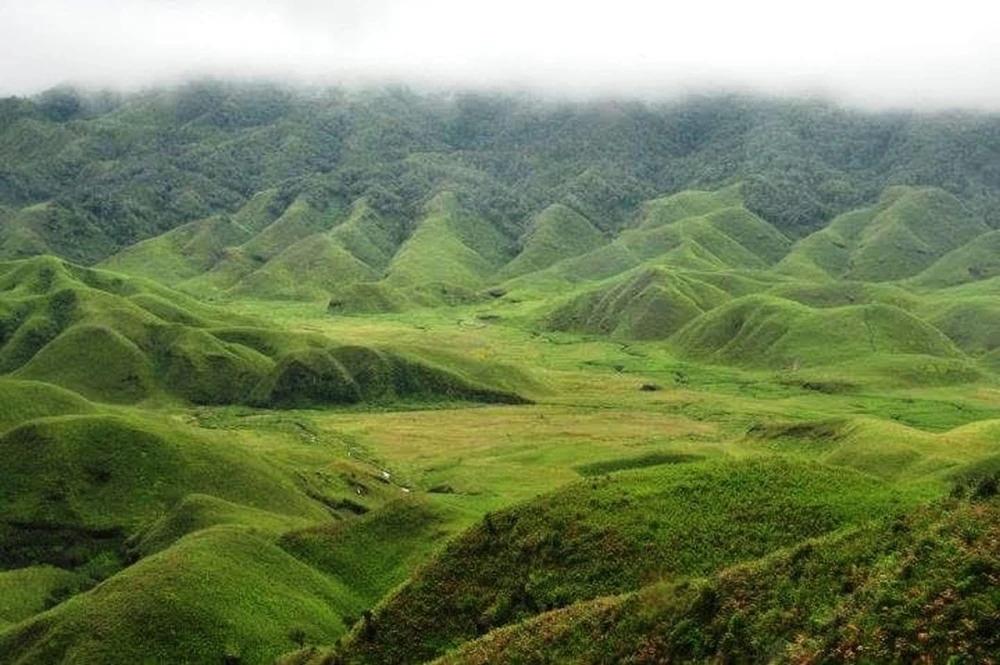
The saucer-shaped Dzukou Valley looks like an enormous, perfectly manicured emerald lawn of bamboo reeds with sparkling streams meandering through it. During the monsoon it bursts into countless flowers, especially the famous endemic Dzukou Lily.
But in winter, this paradise becomes a tinderbox. The dry bamboo burns almost like petrol, while its dense underground roots can keep the fire smouldering for days.
After my seventh trek to Dzukou (yes, I too began feeling like a record holder), I wrote a travel article and conservation appeal for a Sunday edition of local newspaper. Ironically, it was published just when a massive forest fire broke out after careless trekkers left behind an undoused campfire.
Fighting such fires is unlike anything one imagines. There are no roads. One climbs steep mountains on narrow trails, dodging rolling rocks and burning logs before even reaching the fire. In such terrain, the traditional method of beating flames with fresh green branches remains surprisingly effective.
Our Forest Department responded immediately, but we knew our manpower alone would not be enough. DFO Sidaramappa had an excellent network and mobilised support from the Indian Army's Sikh Light Infantry and Jat Regiment. Excellent soldiers, undoubtedly—but fighting forest fires while carrying heavy bulletproof jackets, automatic rifles and 30 kg radio sets on steep mountains was hardly their natural battlefield.
The State Disaster Management Authority, Police, Home Guards, Fire Brigade, and Naga Indian Reserve Battalion adapted much better.
Yet the true heroes were the young soldiers of the Naga Territorial Army and the local volunteers of Angami community.
The Angami community is remarkably organised like all other communities in Nagaland. Every district in Nagaland has its own major tribe, and Kohima belongs to the Angamis. Their social institutions are exceptionally strong. Despite modest incomes, one rarely sees hunger or begging because the community supports its own.
This same social fabric became their greatest strength against the fire.
Every morning, the volunteers from entire community assembled. Younger members climbed ahead to attack the flames with energy, while elders patiently extinguished smouldering patches behind them. Their multipurpose Dao (traditional machete) became the most effective firefighting tool—cutting green branches, clearing fire lines, and beating embers. Day after day. Again and again.
Colonel Govind, commanding the Naga Territorial Army, kept his instructions wonderfully simple:
Travel light. Wear tracksuits and safety shoes. Carry a handheld radio, a small backpack, water, juice, some food, and a machete. Fight the fire with locally available green branches. Return before dark. Repeat tomorrow.
It worked because it suited both the terrain and the people.
Having trekked the area many times and knowing the terrain, my responsibility was to climb nearly 5,000 feet every day, reach Mount Japfu with a handheld radio, observe the surrounding hills, coordinate different teams, and relay instructions. Repeat every day.
Fortunately, the fire was contained within three days.
We all breathed a sigh of relief.
Unfortunately, relief lasted only one year.
The following winter, history repeated itself almost exactly.
This time, in addition, the Eastern Air Command deployed two Mi-17 V5 helicopters carrying Bambi Buckets capable of lifting 3,000 litres of water per sortie. Since I knew the terrain well, I accompanied Wing Commander Rawat during the operations.
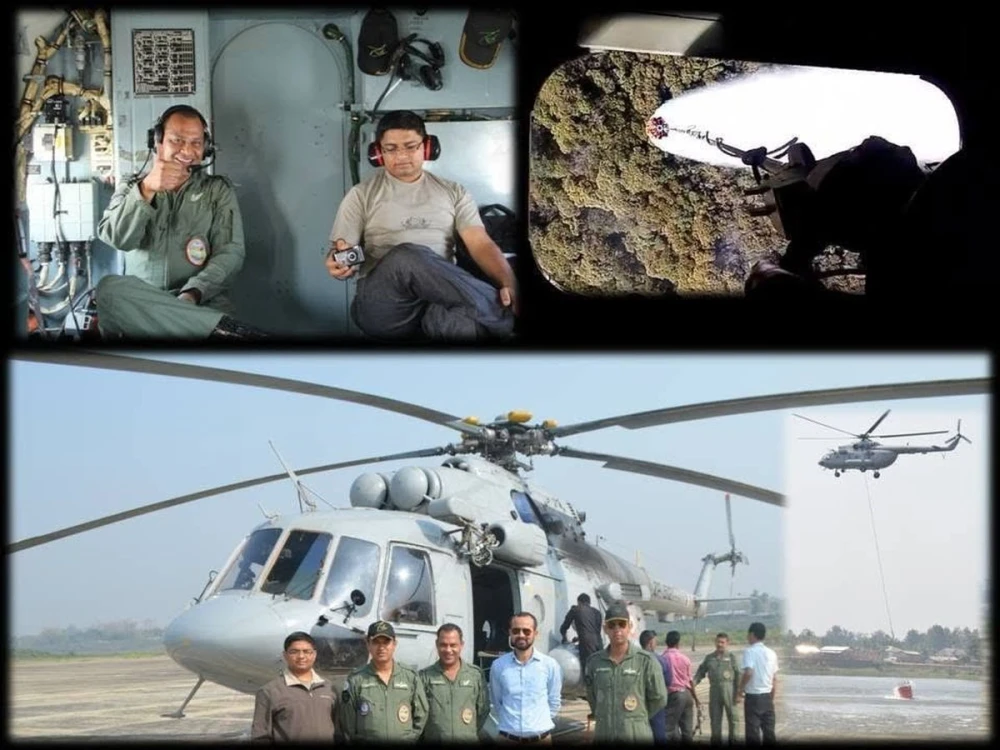
Water was lifted from Dimapur Lake, flown to Dzukou, and released over inaccessible areas. It is quite an experience when a helicopter suddenly shudders while passing over rising columns of hot air from an active forest fire. Even then, 3,000 litres seemed painfully small against a fire spreading across thousands of hectares.
I am still unsure how effective aerial firefighting alone can be in such terrain. My instincts continue to trust the locals the most. Fires may return, but so do they—climbing, beating, coordinating, and repeating the effort every single day without losing heart.
This does not mean people recklessly burn forests. Most fires begin because one careless individual undoes the caution of thousands of responsible trekkers.
Traditional jhum cultivation also involves controlled burning, but local communities are extremely careful because they know the risks. Jhum cultivation is physically demanding, barely profitable, and survives mainly because alternatives are limited and it remains culturally rooted.
Despite community ownership of forests, Northeast India still retains some of the country's richest evergreen forests. That itself speaks volumes about people's commitment towards conservation. Several centuries before governments promoted community conservation, these societies had already established their own community-conserved forests.
I concluded by saying:
“I regret that I knew so little about geospatial technologies. Perhaps they could have helped us fight these fires even better. But it is never too late to learn. I am going to sit through the rest of the workshop as student with my complete attention. Meanwhile, thank you for listening to my story with your attention. Now, let us learn together.”
I realised while retrospection that many of us unknowingly make our surroundings and local people the villains so that we can emerge as heroes or at least justify our failures. Unfortunately, Northeast India has suffered greatly from such narratives. Many people form opinions without ever visiting or understanding the region.
People almost expect a sensational negative story whenever Northeast is mentioned. That is why genuine stories of courage, cooperation and conservation often surprise them pleasantly. For me, even one person left the hall with a better opinion of the Northeast than they had when they entered, then I would consider my speech a success.
I am not sure whether my story of fighting forest fires in Nagaland was the biggest hit that day.
But I can confidently say that my vibrant Naga waistcoat certainly was.
Kamdi Hemant Bhaskar, IFS is Conservator of Forest, SDD, Forest Survey of India, MoEF&CC, GoI, Regional Office, Central Zone, CGO Complex, Seminary Hill, Nagpur.
Sidaramappa is Chief Conservator of Forests, Department of Environment, Forests and Climate Change, Nagaland