Department of Political Science, Tetso College organised a two-day, ICSSR-sponsored national seminar, at Tetso College, Sovima on October 22 and 23.
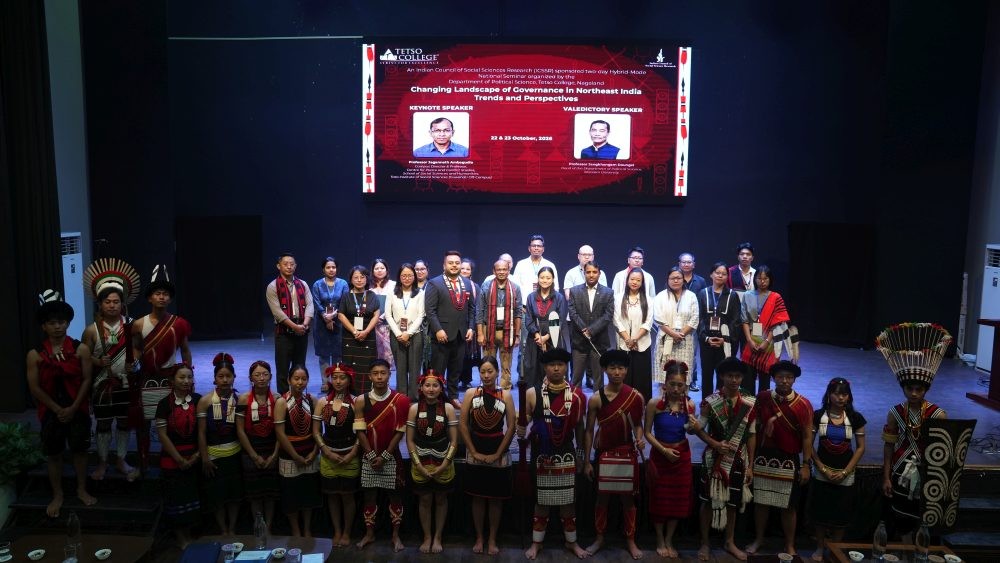
Chümoukedima, October 26 (MExN): The Department of Political Science, Tetso College organised a two-day, ICSSR-sponsored national seminar on “Changing Landscape of Governance in Northeast India: Trends and Perspectives” on October 22 and 23, at Tetso College, Sovima in hybrid mode.
The seminar brought together academicians, scholars, researchers and students to deliberate on governance, traditional institutions, identity politics, conflict, peace processes, democratic participation and development across Northeast India, stated a press release received here.
Delivering the welcome address, Tetso College Principal, Dr Hewasa L Khing, emphasised that academic learning should extend beyond the acquisition of knowledge to the development of core values and practical understanding. She encouraged participants to critically examine governance, question existing development trajectories and bridge the gap between theory and practice. The keynote address was delivered by Prof Jagannath Ambagudia, Campus Director and Professor at the Centre for Peace and Conflict Studies, Tata Institute of Social Sciences (TISS), Guwahati Off-Campus.
Prof Ambagudia mapped the shifting landscape of tribal politics and the historical formation of political identity vis-à-vis the Indian state. His keynote centred on the tension and interplay between traditional customary bodies and modern democratic frameworks, bringing critical focus to autonomy, electoral alliances, political representation, and the role of civil society. He also highlighted the issues of political representation, electoral alliances, autonomy and civil society.
Addressing critical themes, from the Inner Line Permit and Autonomous District Councils to migration, indigeneity and citizenship, he underscored how uneasy the balance remains between the customary and the contemporary.
Dr P Lalpekhlui, convenor of the seminar, highlighted that the seminar had a total of 45 papers being presented from across 11 Indian states, by faculty, research scholars, independent researchers and students (PG and UG).
The first technical session featured parallel discussions on key governance issues in Northeast India, including traditional institutions, identity politics, insurgency, peace processes and state legitimacy.
The sessions examined topics such as riverine commons in Assam, tribal anti-colonial figures, Ao Naga customary authority, traditional land tenure, vernacular democracy and civil society in Nagaland.
Another session focused on the socio-economic and political consequences of conflict, with papers addressing educational and livelihood challenges faced by displaced communities in Manipur, parallel taxation by Naga insurgent groups, and media coverage of the Manipur conflict, and Naga-Kuki conflict.
Discussions also explored constitutional safeguards, legal pluralism, women’s rights, the Frontier Nagaland Territorial Authority (FNTA), women’s political participation and the role of student organisations in promoting political awareness and accountability.
The broader seminar programme covered additional themes, including borderland governance, forest rights, Bodo identity, resource conflicts, cultural change, indigenous political institutions, academic autonomy, digital news consumption and public service delivery amid the digital divide. Together, the presentations highlighted the diverse political, social and institutional challenges shaping governance across Northeast India.
Discussions on the second day included the Act East Policy and connectivity, migration, Sixth Schedule governance, the FNTA, Zo identity and the experiences of students affected by the Manipur conflict. Other papers addressed the Clean Election Movement, e-governance and the digital divide in the Manipur hills, reservation and political representation in Meghalaya and Nagaland, citizenship and indigenous identity in Assam, and community-conserved areas.
The programme also considered climate change and sustainable development, Gram Panchayats in West Tripura, migrant workers in Nagaland, development in Eastern Nagaland and the 2026 Assam floods. Further discussions examined migration and conflict in Bodoland, colonial ethnography and Adivasi identity, urban local governance in Nagaland, and customary law and women’s political representation.
The seminar concluded with a valedictory address by Prof Jangkhongam Doungel, Head of the Department of Political Science, Mizoram University, who traced the evolution of governance in Northeast India from indigenous systems of chieftainship to British colonial administration. He discussed the Treaty of Yandabo, and also highlighted the significance of the Inner Line Regulation of 1873 and constitutional safeguards, including Articles 371A, 371B, 371C, 371F, 371G and 371H, along with the Sixth Schedule, in protecting Northeast India’s distinct identities. He also emphasised the need for adequate development funding, effective utilisation of resources and stronger institutional support to address the region’s developmental priorities.
Highlighting the Northeast’s limited place in national development priorities, Prof Doungel stressed adequate funding and effective monitoring.
Referring to the Free Movement Regime and the region’s relationship with mainland India, he remarked, “Mainland is mainland, Northeast is Northeast,” underscoring the need for governance that respects the region’s history, indigenous institutions and cultural diversity while advancing inclusive development and peace.