Washington, October 20 (IANS) US President Donald Trump has expressed willingness to hold a three-way meeting with Chinese President Xi Jinping and Russian President Vladimir Putin to discuss nuclear arms reductions, potentially during his planned visit to China next month, as Washington seeks to revive arms-control diplomacy among the world's three major nuclear powers.
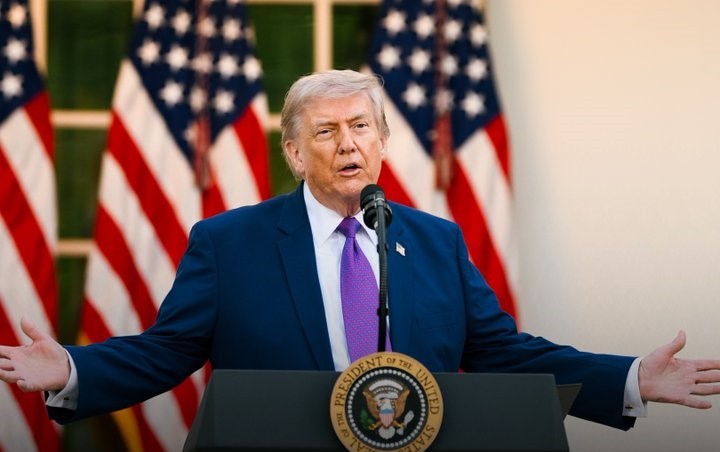
Speaking to reporters before departing the White House on Monday, Trump indicated that he was open to a proposed trilateral meeting but wanted nuclear weapons and denuclearisation to be central to the discussions rather than Russia's continuing war in Ukraine.
"I would do it, not so much for Ukraine, we would have it to talk about denuclearization," Trump said.
The President's comments followed reports that Putin had proposed a meeting involving the leaders of Russia, China and the United States during the Asia-Pacific Economic Cooperation summit in Shenzhen in November.
No formal agreement to hold such a summit has been announced, and the three governments have not confirmed a common agenda or timetable for nuclear negotiations.
Trump said he was prepared to discuss reducing nuclear weapons with both Moscow and Beijing, describing such negotiations as an opportunity to address one of the world's most serious security challenges.
The President has repeatedly expressed interest in a nuclear agreement involving the three countries, although their strategic arsenals differ substantially in size and composition.
The United States and Russia possess the world's largest nuclear stockpiles, while China has been expanding its nuclear capabilities.
Trump said China remained behind the two other powers but was increasing its capabilities.
His latest remarks came days after he said in an October 15 interview that Washington was already discussing denuclearisation with Russia and China.
The President acknowledged that reaching an agreement would be difficult, particularly because Beijing possesses a smaller arsenal and may be reluctant to accept the same limitations as Washington and Moscow.
China has previously opposed proposals for trilateral nuclear disarmament negotiations on the grounds that its arsenal is substantially smaller than those of the United States and Russia.
The Chinese Foreign Ministry reiterated that position last week, saying that expecting Beijing to participate in three-way nuclear disarmament talks at the present stage was neither fair nor realistic.
The possibility of renewed negotiations comes amid growing uncertainty over international nuclear arms-control arrangements.
The New Strategic Arms Reduction Treaty, commonly known as New START, expired earlier this year, leaving Washington and Moscow without the legally binding strategic nuclear limits established under the agreement.
The treaty had limited each country to 1,550 deployed strategic nuclear warheads and imposed restrictions on deployed delivery systems.
Arms-control specialists have warned that the absence of a successor agreement could accelerate competition among nuclear powers and weaken transparency over strategic arsenals.
Daryl Kimball, executive director of the Arms Control Association, said on Monday that meaningful negotiations would require detailed proposals and sustained diplomatic engagement.
Russia has suggested that a meeting involving Trump and Xi could address the conflict, while Ukrainian officials have expressed concern about discussions affecting their country's future without Kyiv's participation.
Trump's remarks indicated that he would prefer to place nuclear arms control at the centre of any three-way meeting.