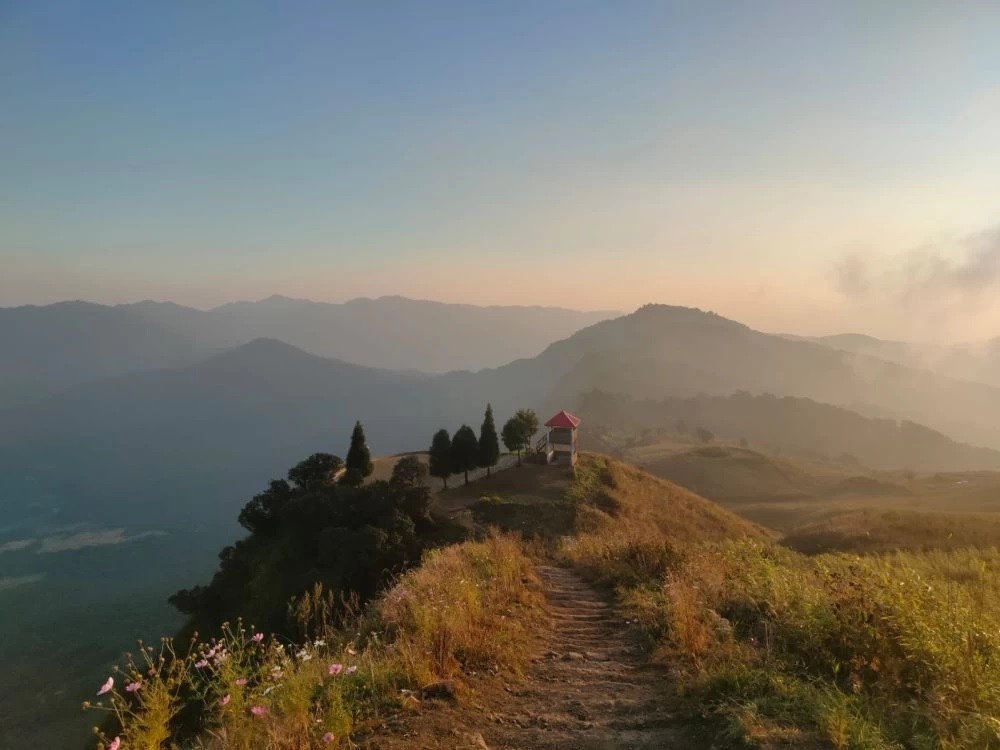
Kapamodzü peak under Zhavame village, Phek district is emerging as a must-visit destination for nature enthusiasts, trekkers and tourists. (Morung File Photo)
Lanukaba Amri
When we speak about tourism in Nagaland, our minds often go to mountains, forest, festivals and beautiful villages. We speak about Dzükou Valley, Hornbill Festival, Khonoma, Saramati Mountain and many places that have slowly found their way onto the travel map. But perhaps there is another way of looking at tourism in Nagaland. What if the most important destination is not a place at all, but the community that has lived there, protected it and carried its stories for generations? For me this is the question worth asking as Nagaland looks towards the future of tourism.
Nagaland’s villages have never been merely settlements scattered across the hills. Traditionally, a village was a social world of its own, complete with the customary institutions, collective responsibilities, agricultural practices, oral traditions and systems through which knowledge was passed from one generation to another. The Morung, for instance, was not simply an architectural structure. It was intimately connected with the social and educational life of the community. Much of what we now call “experiential tourism” already existed in another form within village life: stories we shared, food was prepared form what the land provided, songs and traditions were passed down, young people learnt from elders and knowledge of forest, fields and seasons was part of life. The questions before us, therefore, are not simple about how to bring more tourists to Nagaland. It is how to ensure that tourism grows without disconnecting itself from the very communities that give Nagaland its identity.
The state’s tourism policy already places emphasis on sustainable and community-centered tourism, local participation, village tourism, homestays and community enterprises. It also recognizes that tourism should create economic opportunities for local communities while protecting the natural and cultural heritage of the state. But policy becomes meaningful only when we see what it means on the ground. Take conservation, for example. There are places in Nagaland where communities have protected forest, wildlife and water sources not because they were sources not because these were initially tourism products, but because they were part of the community’s own environment and livelihood. Khonoma is one of the most recognized examples. Its conservation journey has become part of its tourism story and birdwatching has created opportunities for local guides and knowledge-based livelihood. In the Sukhai, Kivikhu and Ghukhuyi area, community-conserved landscapes have similarly demonstrated how biodiversity protection, traditional knowledge and local livelihoods can exist alongside one another. Nokpu village in Mokokchung stands as an example of community led conservation, with the Liangmen Fish Sanctuary reflecting the community’s commitment to conserving aquatic life and protecting its natural resources. These communities have protected important habitats and species, while ecotourism has emerged as valuable avenue for supplementary livelihood. These examples tell us something vital: tourism does not always have to begin with building something. Sometimes it can begin by recognizing something that a community has already protected. This is particularly relevant for Nagaland because our tourism potential extends far beyond scenery. A visitor may be interested in a mountain, but the true story of that mountain lives in the people who know its trails. A visitor may admire a forest, but the deeper story belongs to those who depended upon and protected it. A visitor may enjoy a traditional meal but behind that dish are generations of knowledge about ingredients, preservation, cooking and the land itself. A handwoven textile is not merely a souvenir, it carries knowledge of patterns, identify, skill and the hands of the person who made it. A village field is not simply a landscape for photography, it tells the story of agriculture, food security and a deep-rooted relationship with the land. This is where tourism in Nagaland can become more meaningful. Instead of asking only, “what can tourists see? “Perhaps we should also ask, “what can tourists learn, experience and understand here?” That profound possibilities for rural communities: A homestay becomes more than just a room for the night when a host shares a meal, a story, a farming practice or the history of the village. A young local person becomes more than a driver, with the right training, they become a guide, naturalist, storyteller or cultural interpreter. A farmer becomes part of an immersive agricultural tourism experience. A craftsperson demonstrates a living skill rather than simply selling a finished product. A community conservation area becomes a classroom where visitors learn why protecting a forest or river truly matters. In this model, tourism revenue does not stop with accommodation or an outside operator. It circulates directly through the village among guides, farmers, drivers, home homestays owners and other small businesses. That is when tourism begins to look less like an industry imposed upon a place and more like an opportunity built around the people who already live there. For many young people, tourism is still associated mainly with hotels, travel agencies or conventional hospitality jobs. But tourism of the future can be much broader, it can include photography, guiding, birdwatching, storytelling, food experiences, digital content, handicrafts, cultural interpretation, conservation and local entrepreneurship.
And this is where we must tread carefully. Community tourism should never mean turning our communities into performances, packaging every tradition or treating every visitor as success. Instead, true success means the community retains its voice, fair benefits environmental health and everyday dignity. Responsible tourism requires visitors to respect homes, privacy and local environments, ensuring they leave with understanding rather than just photographs. While Nagaland is making progress through community conservation and homestays, challenges remain in connectivity, basic amenities, waste management and building community capacity. Ultimately our future tourism measures should go beyond arrival numbers to ask how many locals earned an income, kept traditional skills alive and protected our natural landscapes?
The Hornbill Festival puts Nagaland on the map, but our story extends far beyond December into village kitchens, paddy fields, forest trails and local artisan workspaces. The future of Nagaland tourism lies in building with the community not just around it. When communities hold ownership, tourism becomes a meaningful human exchange rather than a simple transaction, preserving our heritage for generations to come.
Perhaps this is why the future of Nagaland tourism is not about discovering new places on a map. It is about recognizing the people who have quietly guarded those places for the generations. When the land has a custodian, a mountain is more than a view and a forest is more than a trail. That is why the true destination has never been the landscape alone. When the community becomes destination, the journey changes from something we consume into something we respect offering the world not just a place to visit, but a living home to understand.