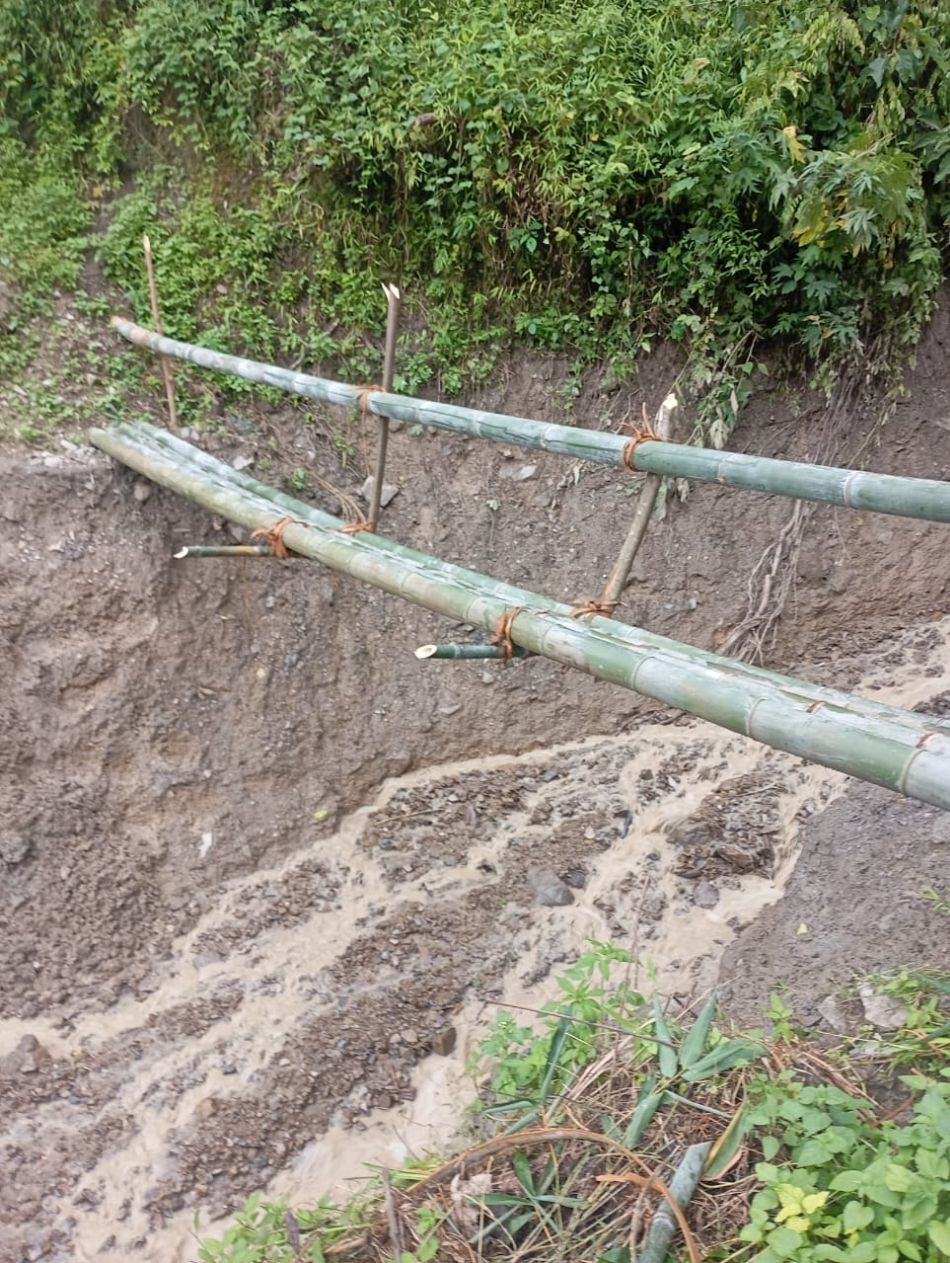
The second temporary bamboo bridge over a deep, rain-eroded channel leading to the jhum fields of Chisholimi. The first makeshift bridge was washed away by rainfall, prompting villagers to construct another one on September 7.
Built with women farmers in mind, the makeshift crossing eases access to fields
Kanili Kiho
Chisholimi | September 9
A narrow bamboo bridge now spans a deep, rain-cut channel on the road to Chisholimi's jhum fields, the second such structure villagers have built after a landslide severed the main access route during heavy rainfall on July 31.
Built by village men on Monday, September 7, the makeshift bridge has brought some relief to farmers, especially women.
The first, built in August, was later washed away by rainfall.
With the main road blocked, farmers began using an alternative, shorter route below the damaged stretch, descending into a rocky riverbed and climbing back up a steep, deeply eroded section on the other side to reach their fields.
The journey is particularly difficult when farmers are carrying agricultural tools and supplies. The riverbed has widened over time due to repeated landslides.
Sharp fragments of broken rock are scattered across the riverbed, farmers said, making the crossing painful even when they wear shoes or boots. Water and mud also make the footing unstable.
“We decided to build another walkway after seeing the difficulties faced by our women making daily trips to the fields,” said Himato, a farmer and Village Council Member (VCM) from Chisholimi. The temporary bridge has made the crossing easier, he said.
Chisholimi falls under the Pughoboto sub-division of Zunheboto district, Nagaland.
Chisholimi Village Council chairman Joseph said the community usually steps in to restore access whenever natural or human-made disasters affect the village.
The villagers had also undertaken road restoration work between Chisholimi and Kilomi in July, after incessant rainfall badly deteriorated the road and made vehicular movement increasingly dangerous.
Following the July 31 landslide, villagers decided to pool contributions to hire a JCB excavator to restore the damaged road. However, the amount collected so far is insufficient, while continued rain has also made it difficult to bring in machinery and begin the work.
The damaged road is the main viable access to the village’s jhum fields this year and also serves some farmers from adjoining Kilomi (Mudutsugho).
The disruption made the July-August harvest particularly arduous for farmers, who had to carry maize, pumpkins, cucumbers, watermelons and other produce from the fields to their homes.
Even after reaching the temporary crossing, they have to walk nearly 2 km to reach the fields, while the distance from the village to the bamboo bridge is another 3 km.
“It is one of the longest distances so far in our jhum cultivation,” said one farmer.
“Agriculture is our only source of income, and the damaged road has made things much more difficult for us this year,” added a woman farmer.
Villagers estimate that more than 95 percent of the village relies on agriculture for its livelihood.
A vehicle has also remained stranded at one of the fields for more than a month.
For now, the second bamboo bridge has eased the burden, particularly for elderly women who have struggled to navigate the steep and rocky crossing.
“It was a welcome sight to see the bridge when we reached the area. We thank this thoughtful group of men,” said Phutoli, a woman farmer.
The crossing, however, is only a temporary solution. With the rice harvest season approaching, villagers hope the main road will be restored in time.