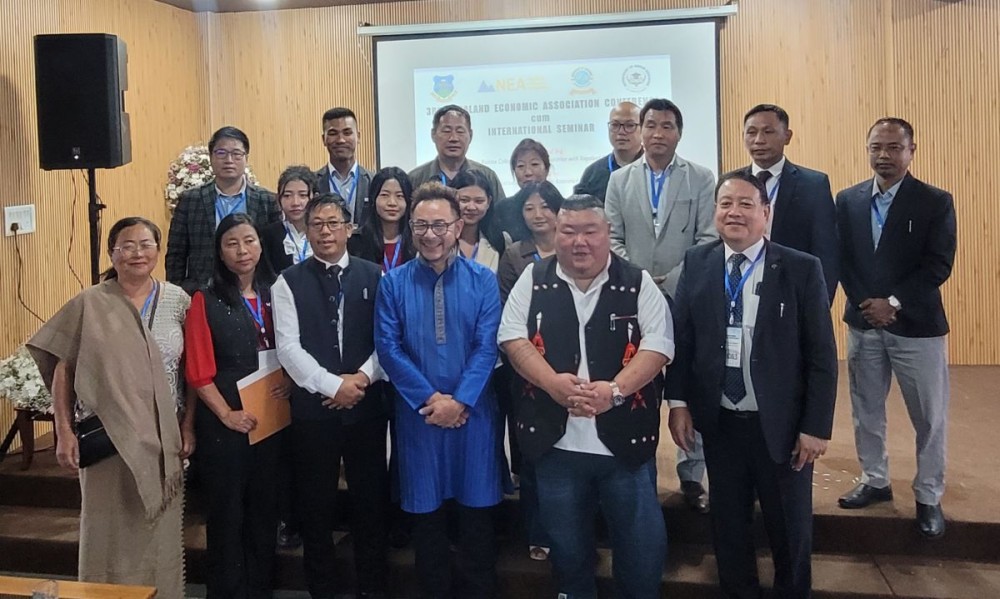
Minsiter Temjen Imna Along, officials of NEA and others at the 3rd Nagaland Economic Association (NEA) conference-cum-international seminar at Kohima College on October 16.
Morung Express News
Kohima | October 16
Nagaland Minister for Higher Education and Tourism, Temjen Imna Along, has called for renewed focus on human capital development, saying the state’s economic progress depends not only on government policies and infrastructure but also on the values, skills, work ethic and social responsibility of its people.
Addressing the 3rd Nagaland Economic Association (NEA) conference-cum-international seminar at Kohima College on October 16 as special guest, Minister Along said Nagaland’s economic potential remained immense, but the state continued to face serious challenges in developing a skilled, productive and socially responsible workforce.
He said economic development should not be measured solely by material possessions, infrastructure or financial prosperity. Investment in human resources must come first, he stressed, cautioning that physical infrastructure and economic resources would have limited value without a corresponding improvement in the quality of people.
“We need everything. We need buildings, infrastructure, roads, good bank balances, good clothes and good mobile phones. But if the human resource of the state is not upgraded, the rest of these things will not be able to give us value,” he said.
He observed that rapid modernisation and the growing influence of technology have encouraged people, particularly the younger generation, to focus more on material possessions and appearances than on acquiring knowledge and developing practical skills. The Minister expressed concern that Nagaland is experiencing a crisis in the quality of its human resources, pointing to social divisions, tribalism, unhealthy competition and a tendency to celebrate wealth and public visibility over hard work and meaningful contributions to society.
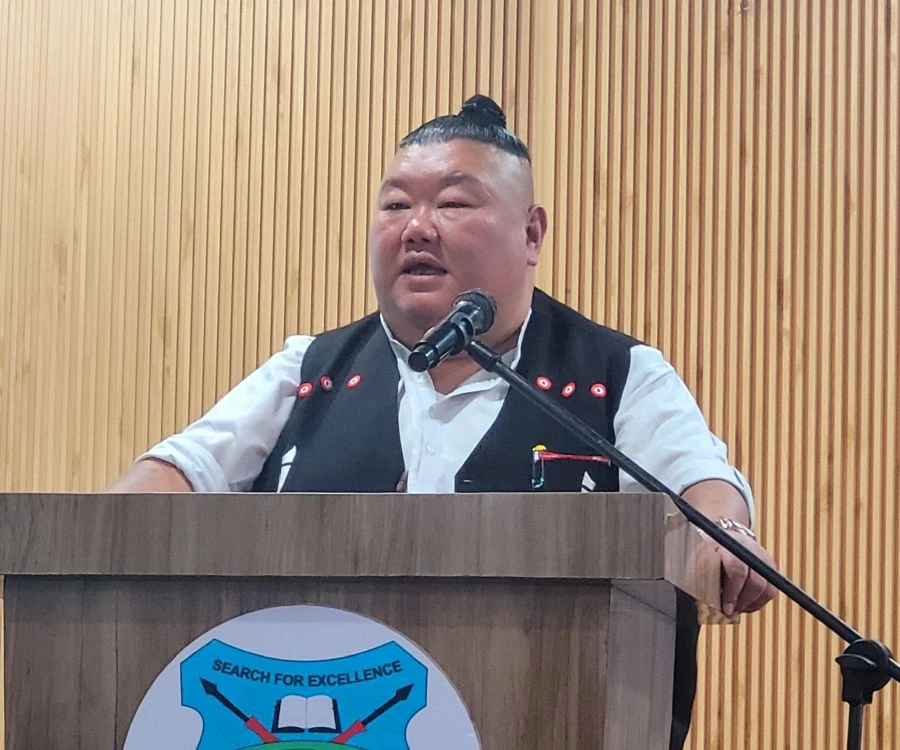
“Civilisation is not only what you can achieve by being opulent. It is also about being sustainable, being able to lift each other up and being able to build each other up,” he said.
Emphasising the role of education, he said Nagaland needed to rethink how learning was approached, without necessarily discarding the existing curriculum. He argued that formal education must be complemented by practical experience, discipline, a willingness to learn from others and a stronger sense of responsibility towards families and communities.
Despite being among the most literate states in the country, the Minister pointed out that Nagaland continues to face high unemployment, adding ‘literacy alone does not guarantee economic sustainability.’
He suggested collegiate education to place greater emphasis on values such as inclusiveness, diligence, family responsibility and practical achievement.
Drawing from traditional Naga society, he said earlier generations had built sustainable communities despite having limited material resources. Their strength, he noted, came from their ability to work the land, support one another and remain resilient.
The Minister further cautioned against allowing tribalism, propaganda and agitation to consume the energy of Nagaland’s younger generation. He referred to instances of inter-community violence, including the burning of homes and loss of lives, as reminders of the consequences of failing to respect and appreciate one another.
He said the state’s future could not be secured through government policies and legislation alone, stressing ‘citizens had an equally important responsibility in shaping Nagaland’s social and economic direction.’
Against this backdrop, he called for greater discipline, accountability and self-reliance, asserting that the state need to strengthen its human resources to make more effective use of the funds and opportunities available to it.
He urged the educational institutions and their faculty members to recognise their responsibility in shaping the state’s future, saying teachers must contribute not only through classroom instruction but also by helping mould responsible, committed and hardworking citizens.
The Minister challenged them to reflect on whether they were contributing to the development of Nagaland’s human resources beyond fulfilling their formal teaching duties.
He said building a sustainable economy must begin with strengthening people themselves, adding that Nagaland’s long-term progress would depend on citizens who were willing to learn, work hard, support one another and contribute to the wider community.
Organised by Department of Economics, Kohima College, in collaboration with Nagaland Economic Association, and supported by Department of Higher Education and college’s Internal Quality Assurance Cell, the seminar sought to critically examine the current state of human capital development in Nagaland.