Chief Engineer, WRD, Er. Thepfusalie Guozi along with resource person, Scientist B, NIH NERC, Siddharth Arora, officials, and trainees during the inaugural programme of the two-week training on 'Earth Observation and GIS in Water Resources Engineering and Management' at WRD, Kohima on September 28. (DIPR Photo)
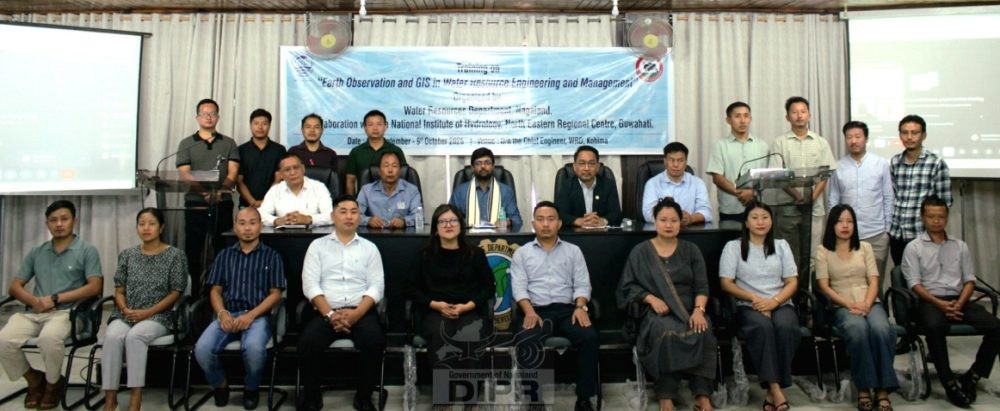
KOHIMA, SEPTEMBER 28 (MExN): A two-week training on “Earth Observation and GIS in Water Resources Engineering and Management” began at the Water Resources Department (WRD), Kohima on September 28. The training is being organised by the Water Resources Department, Nagaland in collaboration with the National Institute of Hydrology (NIH), North Eastern Regional Centre, Guwahati.
The training will focus on applications in water resources and groundwater management, surface water and watershed analysis, hydrological modelling and disasters, and irrigation and infrastructure planning. It will provide spatial data, modelling frameworks and monitoring tools for water resources engineering and management.
Chief Engineer, WRD, Er. Thepfusalie Guozi, in his keynote address, acknowledged the support extended by NIH, Guwahati, describing the institute as a “helper and mentor” that has extended assistance to the department over the years. He also acknowledged the resource persons participating both physically and through hybrid mode.
“Global water resources management is vital for the very survival of every inhabitant of this planet,” Guozi said. He noted that global warming and natural calamities affect everyone and stressed that every action has wider consequences. He advised the trainees to make full use of the training and gain maximum information from the resource persons.
Scientist B, NIH NERC, Siddharth Arora, said the programme marked “the first, the very beginning of a very long collaboration” between the two organisations. He encouraged the participants to gain maximum knowledge from the training and assured them of assistance in resolving their queries.
Arora said the resource persons were committed to providing training in a manner that would enable participants to apply the knowledge in their routine departmental work. He added that with incentives from the Central and State governments to adopt the latest technologies for analysis, the resource persons would demonstrate their use so that the department could undertake such studies independently with assistance from NIH.