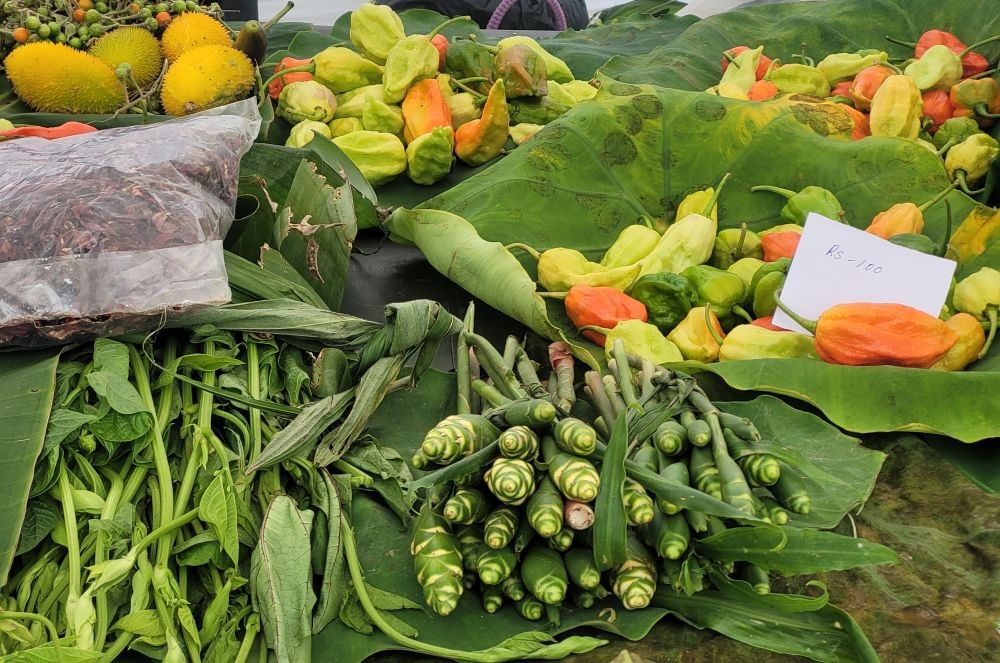
Agricultural produces from Nagaland are seen in this file photo. The Nagaland Cooperative Policy, 2026 envisages cooperative-led economic clusters as a means of developing markets for Nagaland’s rural produce. (Morung File Photo)
Our Correspondent
Kohim | September 13
The Nagaland Cooperative Policy, 2026 sets a 10-year roadmap for expanding the coverage and economic contribution of the cooperative sector in the State, with a focus on promoting a village-anchored cooperative ecosystem and developing a stronger cooperative business environment.
The policy was tabled by Jacob Zhimomi, Minister of Public Health Engineering & Cooperation, during the recent 9th session of the 14th Nagaland Legislative Assembly (NLA) in Kohima.
The policy envisions vibrant and economically self-reliant cooperatives in Nagaland as the support structure for members to earn higher incomes and secure sustainable livelihoods in hill and rural areas.
It identifies the promotion of a village-anchored cooperative ecosystem and its multidimensional expansion as the key pathway to achieve this goal.
As strategies to achieve the objective, the Policy encourages the creation of a vibrant ecosystem for the growth and development of cooperative business in Nagaland by promoting a self-sustainable business support system that is sensitive to the State’s terrain and tribal institutions.
“This system will provide accessible finance, business research and advisory services for marketing, branding, value addition and digital linkages, in collaboration with sectoral development agencies, NABARD, NCDC and Nagaland State Cooperative Bank,” the Policy stated.
It will encourage each district in Nagaland to develop at least one Model Cooperative Village, centred around a multipurpose Primary Agricultural Credit Society (PACS) or Multipurpose cooperative society as the growth engine.

Multipurpose PACS/cooperatives will be supported to adopt good governance, modern accounting systems and sound business management practices for different verticals such as credit, input supply, aggregation, processing, marketing and services, the Policy stated.
Cooperative-led economic clusters for Nagaland’s niche rural produce
The Policy will promote cooperative-led economic clusters for Nagaland’s niche rural produce such as Naga chillies, large cardamom, indigenous rice varieties, oranges, pineapples, honey, bamboo products, medicinal and aromatic plants, silkworms, fruits, mushrooms, floriculture, and poultry and piggery products etc.
Such clusters will be aligned with district development plans and ODOP/Districts as Export Hubs initiatives, wherever applicable.
It will encourage cooperatives in Nagaland to explore marketing opportunities through Geographical Indications (GI), Intellectual Property Rights (IPR) and trademarks for unique Naga products and crafts.
Technical support will be facilitated through specialized agencies to build capacities in branding, packaging and compliance.
The Policy will encourage the branding of organic, agricultural, horticultural and livestock products of Nagaland cooperatives under suitable State umbrella brands.
The State will promote cooperative products through e-commerce, cooperative marts and tie-ups with public distribution and institutional buyers.
It will promote the participation of Nagaland cooperatives in fairs and exhibitions at the international, national, regional and State levels, as well as State-organized “Cooperative Melas” and buyer–seller meets.
This will showcase Naga cooperative brands, foster learning, and provide access to broader markets and technical networks.
Multi-dimensional expansion
To promote multi-dimensional expansion, including access to wider markets, and enhance members’ incomes in Nagaland, the Policy will encourage cooperatives in Nagaland to identify and align export-oriented and premium products (e.g. spices, bamboo, handicrafts, organic produce etc.) with the One District One Product (ODOP) framework in coordination with relevant departments.
It will promote dairy, piggery and poultry cooperatives to spearhead a livestock-based livelihood expansion in Nagaland, generating employment, improving nutrition and enhancing women’s economic empowerment.
The Policy emphasizes the promotion of fishery cooperatives, including fish seed production and cold-water fisheries, in districts where fisheries can be a major livelihood source despite weak basic infrastructure. Convergence with rural development schemes, VDB initiatives and line departments will be actively pursued.
It will position the cooperative sector as a leader in Nagaland’s organic products market by leveraging the State’s natural advantage, existing organic initiatives and community conservation practices. Certification, traceability and branding support will be extended to eligible cooperatives.
Sale of Nagaland cooperative products to national, international markets
The Policy will promote the sale of Nagaland cooperative products to national and international markets, enhancing the share of cooperative enterprises in the State’s overall trade and income. Export facilitation cells and linkages with national cooperative organizations (NAFED, NCCF, etc.) will be used wherever relevant.
It will promote agriculture and horticulture products (eg. traditional Naga millets) through farmer members of primary cooperatives and link these with national agencies such as NAFED and NCCF for procurement, nutrition campaigns and market development.
The Policy will promote the production of pulses, oilseeds and maize suited to Nagaland’s agro-climatic conditions through primary cooperatives, encouraging appropriate cropping pattern changes to reduce dependence on imports and enhance local self-reliance. Suitable buy-back and support price arrangements with national cooperatives and government agencies will be explored.
It will promote enhancement of existing processing capacities for horticulture, spices, livestock and forest-based products, including manufacturing of value-added products through capital infusion and technology upgradation in cooperative units.
District-level common facilities may be promoted on cooperative or federated models to serve multiple primary societies.
The Policy will constitute a State-level Cooperative Sector Task Force to envision and recommend pathways for expanding the coverage and economic contribution of cooperatives in Nagaland over the next 10 years.
The Task Force will set targets for cooperative outreach (villages, members, sectors) and for increasing the cooperative sector’s share in the State economy, and will periodically review progress, the Policy stated.