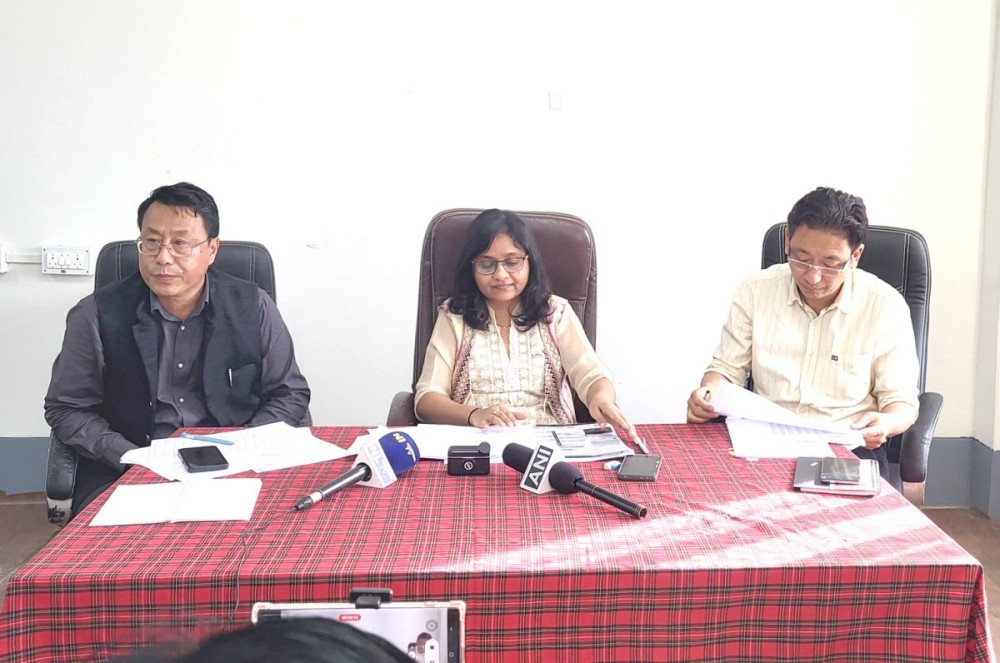
Chief Electoral Officer, Nagaland, Vyasan R (IAS) with Additional CEO Awa Lorin and Deputy CEO Toshimeren Aier addressing a press conference in Kohima on September 21. (Morung Photo)
CEO says electors can seek inclusion, corrections till October 20
Morung Express news
Kohima | September 21
Chief Electoral Officer Nagaland Bhagyshree Banayat, IAS today informed that the 2nd phase of the Special Intensive Revision (SIR) is a crucial period for electors to scrutinize and make necessary rectification before the Final Electoral Roll is published. This was stated during a press conference held in Kohima at the CEO office in the presence of Additional CEO, Awa Lorin and Deputy CEO Toshimeren Aier.
The 2nd phase of the Special Intensive Revision (SIR) had begun on Sunday, September 20 with the official publishing of 'Draft Electoral roll,' and will end on November 22 with the publication of the 'Final Electoral roll.'
The CEO said this exercise will be undertaken for over a month's time, wherein electors whose names have not been added or were unable to submit enumeration forms are allowed to make 'Claims and Objections.' Banayat informed that the claims and objection period runs till October 20.
On how to avail the claims and objections, the CEO informed that the booth wise list of ‘Absent, Shifted, Dead or Duplicate’ electors whose names are not included in the Draft Roll has been displayed on the Notice Board of respective ERO/AERO offices and polling stations. These lists have also been put up on CEO's website.
For comparison, the CEO informed that 13,57,208 voters were listed during the pre-SIR phase. Following the preparation of the draft roll, 11,99,465 electors were included after submitting their Enumeration Forms, accounting for approximately 88% of the pre-SIR electorate.
The exclusions, the CEO said, were due to reasons such as BLOs not finding the electors or not receiving their Enumeration Forms. Some of the primary reasons were that electors had become electors in other States or Union Territories; could not be found in existence; had not submitted the form; or were not willing to register as electors for some reason.
Of the 12%, 9.12% (1,23,749) were found to be absent, permanently shifted or falling under other categories. Another 2.13% (28,944) were deceased, while 5,059 (0.37%) were registered at multiple places.
“Genuine electors can still be added back to the electoral rolls during the claims and objections period (20.09.2026 to 20.10.2026) using Form-6 along with the prescribed Declaration Form,” the CEO said.
“The names of electors found enrolled at multiple places in the electoral rolls will be retained only at one place,” the CEO said. However, electors will have the liberty to choose the place of retention by filing a claim.
The CEO said the exercise was not forced or mandatory, adding that the Election Commission of India (ECI) was implementing the SIR of the Electoral Rolls with clearly defined objectives to ensure maximum participation, complete inclusion of eligible electors and full transparency at every stage of the process.
Further clarifying why the Draft Electoral Roll was published on a Sunday, September 20, despite some church organisations objecting to the move, the CEO said it was an obligation under the schedule issued by the Election Commission of India, adding that the office was unable to defer the date.
After the claims period ends on October 20, the EROs will scrutinise the applications and issue notices where discrepancies arise, including cases where an elector could not be linked to the previous 2005 SIR roll.
The notice and disposal phase will continue until November 18. During this exercise, no name will be deleted from the draft roll without notice, enquiry and a fair opportunity being given to the person concerned.
An aggrieved person can appeal an ERO’s decision to the District Magistrate within 15 days, followed by a second appeal to the CEO within 30 days of the District Magistrate’s order.
The final electoral roll is scheduled for publication on November 22, 2026.
Nearly 5 lakh electors may receive notices
Additional CEO Awa Lorin said the SIR exercise identified 9.33% of electors under the “no-mapping” category and 27.31% as having mapping anomalies, together accounting for 36.64%.
Nearly five lakh electors are expected to receive notices over discrepancies in mapping their details with the 2005 electoral roll.
Electors whose names could not be mapped to the 2005 roll, or who could not establish themselves as progeny of a person included in the 2005 roll, will be issued notices by the EROs/AEROs. Such electors will have to produce prescribed documents, with the number of documents required depending on their date or year of birth.
Lorin clarified that not being registered in the 2005 electoral roll would not automatically mean exclusion from the present roll. Such electors can establish linkage with a person included in the 2005 roll or, where applicable, enrol afresh during the claims and objections period.
He said hearing camps would be conducted by EROs at their headquarters, district headquarters or polling-station level, depending on convenience, to facilitate the notice and verification process. Forms and information related to the SIR are available with BLOs, at election offices and on the CEO’s website, while applications can also be filed online.
The claims and objections period is also available to new eligible voters who attained 18 years of age by the qualifying date of October 1, 2026.
On Aadhaar, Banayat clarified that submission of the Aadhaar number in the SIR enumeration form is optional and that Aadhaar by itself is not proof of citizenship. She said Aadhaar seeding was not being carried out in the electoral roll, and Aadhaar and mobile-number details sought through the enumeration form were voluntary.
District wise figures
As per district-wise statistics provided by the CEO’s office, Dimapur recorded the highest number of electors not included in the draft roll, at 36,629, accounting for 29.14% of its pre-SIR electorate.
It was followed by Chümoukedima with 28,626 exclusions (26.04%) and Kohima with 24,178 (19.76%).
In terms of proportion, Dimapur also recorded the highest share, followed by Chümoukedima and Kohima.
At the other end, Shamator recorded the lowest share at 2.94% (642), followed by Mon at 3.42% and Kiphire at 3.65%.
Among the remaining districts, Zunheboto recorded 15,113 exclusions (11.04%), Tuensang 9,032 (11.23%), Peren 8,267 (13.31%), Mokokchung 7,900 (5.05%), Wokha 6,547 (6.02%) and Phek 6,505 (7.36%).