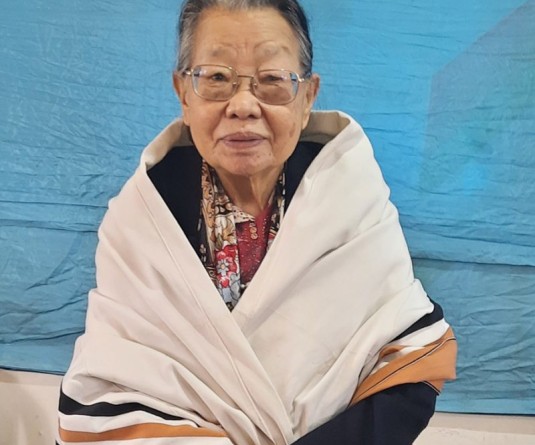
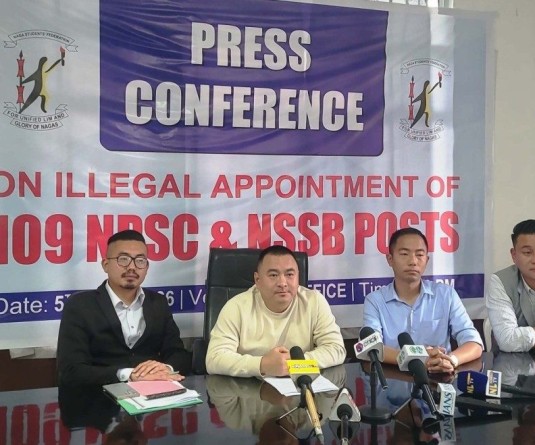
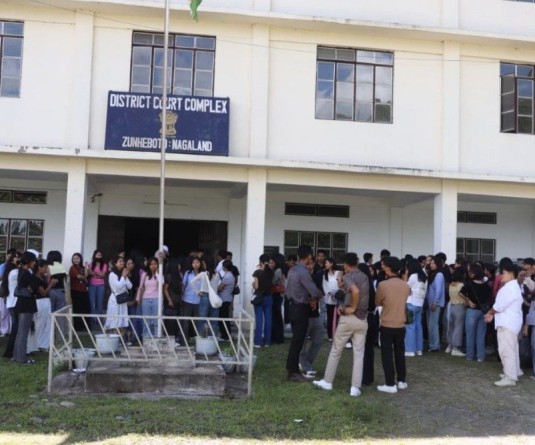
Officials and delegates during the71st anniversary of the 1st Indo-Naga Battle held at Hospheu on September 10. (Photo Courtesy: Holoka Sumi)

A call to remember sacrifices and preserve collective history
Morung Express News
Zunheboto | September 11
The All Sümi Students’ Union (SKK) observed the 71st anniversary of the 1st Indo-Naga Battle at the Hoshepu ADM EAC Headquarters on September 10, with Naga Students’ Federation (NSF) President Mteisuding Heraang attending as the Guest of Honour.
The commemorative programme was hosted by the Hoshepu Range Public Organisation (HRPO) and brought together representatives of various Naga communities and student organisations to remember the historical significance of the 1st Indo-Naga Battle and reaffirm a spirit of unity and solidarity.
Addressing the gathering, the NSF president described the historic confrontation at Hoshepu as more than a battle, stating that it formed part of the historical journey that gave birth to the Naga political movement. Heraang said the sacrifices of those who lost their lives during the conflict must continue to be remembered as part of Naga history.

Heraang paid tribute to the fallen Naga heroes, saying their sacrifices had become an important part of the history of the Naga people. He urged the people of Hoshepu and the Sümi community to continue preserving the site and passing its history to future generations.
He also stressed the importance of using the term “Naga-Indo Battle” rather than “Indo-Naga Battle,” saying the terminology should reflect the Naga perspective of the historical event. He informed the gathering that the NSF had adopted a resolution to use the term “Naga-Indo” in reference to the Naga-India political talks as well.
The NSF president further appealed to the people to allow the federation more time to examine historical records concerning the battle. He said the federation was studying the issue with sincerity and transparency before making any definitive historical recognition or declaration.
Emphasising the broader significance of the Hoshepu battle, Heraang said the history of the conflict should not be viewed merely as the history of one village or community, but as part of the wider history of the Naga people and their political journey.
He called upon the younger generation to learn from the sacrifices of their forefathers and preserve the historical identity of the Naga people. He also stressed the need for greater Naga unity, saying that historical places such as Hoshepu should serve as reminders of a shared past and collective identity.
Heraang said the history preserved at Hoshepu should continue to be passed on to future generations so that the sacrifices and events associated with the Naga-Indo Battle are not forgotten.
Hoshepu a key chapter in Naga history
Dr Vihuto A Sümi, President of Sümi Hoho, stated that Hoshepu is not merely a geographical location but an important chapter in Naga history.

He said that while commemorating this historic event, they must also recognise the significant contributions and sacrifices of the Sümi people. From the beginning, many Sümi voluntarily came forward for the Naga cause, while others were forcibly recruited into the Naga Army. Schools in Sümi areas were also burnt to compel young men to join the movement. He added that these are difficult chapters of history, and they must have the courage to acknowledge both the sacrifices and the excesses committed during those turbulent years.
He stated that for the Sümi people, the Naga cause has always been of great importance, and even today, they continue to be major participants in keeping the Naga political aspiration alive.
He concluded by paying tribute to all who suffered and sacrificed during the Naga political struggle, honouring Hoshepu as an important site in their collective history.
Historical site should be protected
Ghokiho H Zhimomi, President of Aghunato Area Kukami Hoho, traced the historical development of the Naga political movement in his address. Zhimomi appealed for the Battle of Hoshepu to be preserved and appropriately commemorated as an important landmark of Naga political and armed history, recognising the sacrifices and suffering of those involved. He stressed that the historical site should be protected for future generations and that the battle deserves wider recognition in the Naga political journey.
He proposed that SKK and ESSU jointly approach the GoN to upgrade Aghunato ADC Headquarters to a District Headquarters, citing the area's historical significance in connection with the First Indo-Naga Battle.
Calling for greater participation from the younger generation, Zhimomi said student bodies and community organisations could organise a dignified annual observance and support documentation of oral history, particularly the experiences and long-term hardships of the Hoshepu-range population.
He further called for an inclusive historical memorial at Hoshepu, stressing that the First Indo-Naga Battle should be remembered as an event transcending individual factions, organisations, and personalities. Any future commemorative initiative, he said, should honour all who participated in the wider Naga political struggle and sacrificed their lives for future generations.
Look beyond tribal lines
Akükaü Hetotho S Zhimomi, President of Sümi Kukami Hoho, paid tribute to those who fought, suffered, and sacrificed their lives in the historic conflict. He acknowledged the Hoshepu Range Public Organization for preserving the battle’s memory, including its 50th-anniversary commemoration in 2005.
Zhimomi stressed the wider sacrifices of the Naga people, noting that the Sümi community also endured burned villages, destroyed property, and loss of lives and livestock. He urged younger Nagas and future leaders to look beyond tribal boundaries and build a shared history recognising both individual tribal achievements and collective struggles and sacrifices.
“We must remember not only the battle itself, but also the sacrifices, suffering, and courage of all those who lived through those difficult times,” he said.
Holonto S Zhimomi, Editor of SKK, chaired the programme, with Shikupu Phuleshe, General Secretary of ESSU, as recorder. It began with an invocation by Rev Mughato Awomi, Pastor of Hoshepu Baptist Church, followed by a presidential address by Hipito Achumi, President of SKK. Khekiye Village presented a welcome song, and Hoshepu Village performed a traditional war dance. Solidarity speeches were delivered by representatives of various Naga organisations, Ao Kaketshir Mungdang, Angami Students’ Union, Chakhesang Students’ Union, Lotha Students’ Union, Pochury Students’ Union, Rengma Students’ Union, and Zeliangrong Students’ Union, Nagaland. Kiviti V Murru presented a special song. The programme concluded with a vote of thanks by Katolu K Zhimo, President of ESSU, and a benediction by Nikato Assumi, Pastor of Nihoshe Village Baptist Church.