(Representative Image)
During the dialogue, revelations emerged of an increasing number of students opening up about disrupted childhoods, abuse, and discrimination, frequently involving violence within families, particularly against women and children
Monalisa Changkija
During the dialogue, revelations emerged of an increasing number of students opening up about disrupted childhoods, abuse, and discrimination, frequently involving violence within families, particularly against women and children.
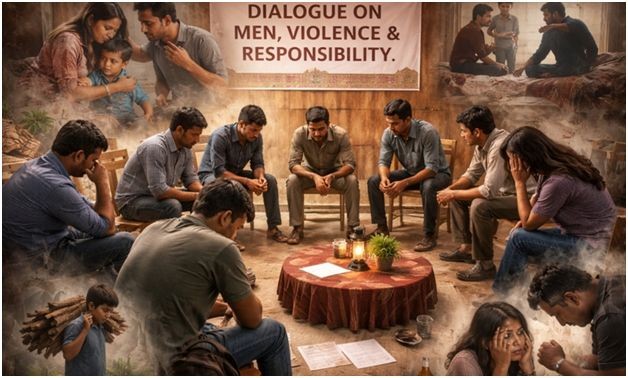
Surely, what happens within and outside the home must affect boys and men? It does. Perhaps, for the first time, a beginning seems to have been made when a small group gathered for a closed-door dialogue on men, violence, and responsibility on December 13 at Zubza, Kohima district, organized by Dimapur-based Prodigals’ Home and Peren Touch, supported by the North East Council.
Reportedly, the meeting was conceived as a space for men to reflect on social harm, responsibility and emotional disconnect. The organizers are right that such conversations are largely absent in Naga society, as they are in any patriarchal society, particularly in the Northeast.
The dialogue, we are informed, emerged from observation and field experience and was therefore intended as a starting point rather than an outcome-driven exercise. We are also informed that the discussions were framed around a growing concern for crimes involving men and boys and the difficulty of addressing such issues openly within homes, churches, and communities. The need for personal responsibility and inner honesty underscored that change begins with recognizing harm rather than rationalizing it.
During the dialogue, revelations emerged of an increasing number of students opening up about disrupted childhoods, abuse, and discrimination, frequently involving violence within families, particularly against women and children. It was further revealed that many students carried “invisible baggage” shaped by abusive homes, addiction, and long-standing family conflicts.
The dialogue also addressed women’s often-overlooked vulnerability, discrimination between boys and girls in household chores—with the heavier load placed on girls—men’s emotional lives shaped by conditioning that discourages them from expressing emotions and loyalty to brothers over sisters, wives and other female relatives. Men’s social interactions were largely limited to non-personal issues such as politics, church, public matters, and sports—never about themselves, their pain, anger, or trauma, except during crises or structured programs—underscoring that men were allowed only two emotions: happiness and anger. The dialogue further revealed that religion plays a large role in perpetuating violence against women, through language such as telling women to “pray more,” “bear suffering,” or “carry their cross,” as well as instances of faith leaders discouraging women from reporting abuse to protect family reputations or the status of financially influential men—accentuating “latent conflict” such as resentment, entitlement, and emotional neglect within families.
This dialogue hopes to be the start of creating “safe spaces” for both men and women to express feelings in an effort to prevent decisions based on “traumas and pain that have been stored over years.” Indeed, it is a positive development, because whether in Naga society or any other patriarchal society, violence at home and outside is a recurring theme, one that patriarchy prevents us from fully seeing or acknowledging. Our societies have been so deeply conditioned by patriarchal culture over thousands of years that we have come to believe patriarchy is unchangeable, and suggesting or attempting to adapt it to more humane ways is often considered sacrilege. Yet, the ways of patriarchy have not served men, women, children, or vulnerable and disadvantaged sections of society, communities, and nations. In fact, this disservice has spawned discrimination, resentment, anger, entitlement, racism, sexism, misogyny, egoism, inequalities, inequities and numerous forms of conflict—much of the human race’s woes—if we care to notice that our political, economic, social, cultural, and religious systems and structures are based on patriarchal ideology.
Patriarchy is fundamentally about power, control, and domination. All Naga traditional power structures and systems—such as village councils—as well as modern power centers such as tribal hohos, NGOs, civil societies and the church, regardless of denomination, are male-dominated or male-only bastions. Their primary focus, in fact the raison d’être for their existence, is political, economic, social, cultural, and religious power and control. In cases of rape, murder, molestation, sexual harassment, or any kind of violence and discrimination against women—especially at home—which are widely reported in local media, these bodies generally seem indifferent. There are no records of these bodies addressing the vulnerabilities of women, children, the disabled, or other marginalized groups. Their focus is primarily on politics, including the Naga national issue. The impact on women and other vulnerable sections of society seems largely absent from their considerations. Notably, most of these same bodies vehemently opposed the 33% reservation for women in Urban Local Bodies for many years. This is the power and entitlement patriarchy endows to one sex.
Men rarely talk about the realities of patriarchy, and as noted, even media reports on the dialogue failed to mention that the experiences of boys and men in our society are consequences of patriarchal ideology, systems, and structures that both empower and imprison them. The conflicts, contradictions, and unrealistic expectations of patriarchy punish and victimize both men and women—in different ways, because introspection is an alien concept to men and often perceived as conceding defeat.
Unfortunately, men often take their frustrations out on vulnerable sections of society, creating their own physical, mental, and psychological issues and tribulations, from which they see no escape except by entrenching themselves further, repeating conditioned and culturally ingrained habits. Therefore, dialogues such as this have the potential to heal not only Nagaland but much of the Northeast.
(The Columnist is a Dimapur-based veteran journalist, poet and former Editor of Nagaland Page)