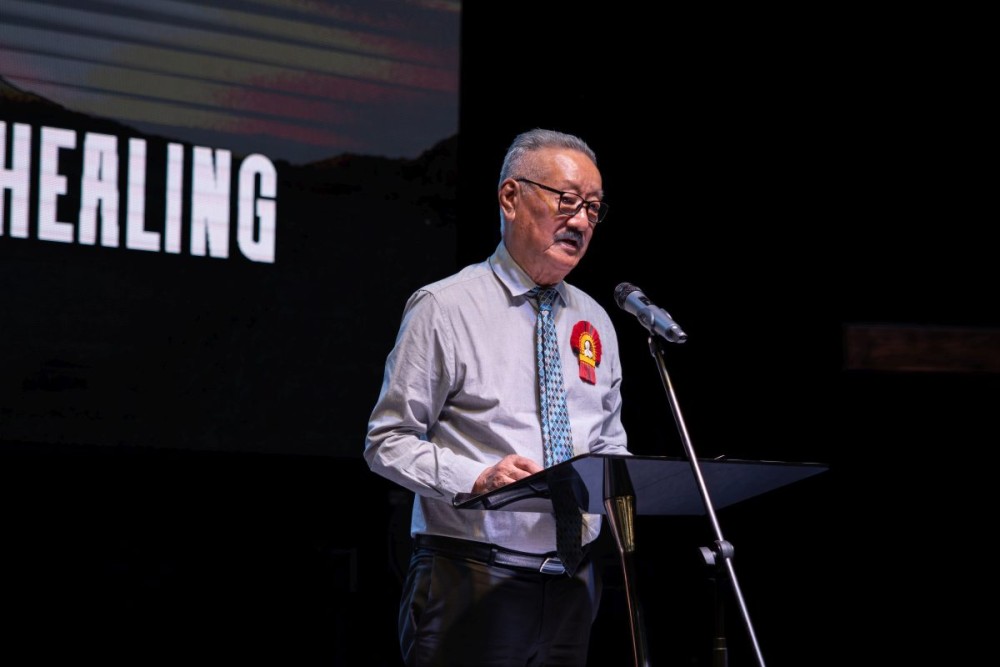
Rev Dr Wati Aier, Convener, FNR speaks during the September Dialogue 2026 held at The Lighthouse Church, Dimapur on September 5. (Morung Photo)
Repatriated Naga remains to receive communal burial
Morung Express News
Dimapur | September 5
The long road to bringing home ancestral remains taken during the British colonial era is neither an administrative chore nor a bureaucratic milestone—it is an intentional, sacred dismantling of imperial violence.
Delivering a powerful keynote address titled “Returning to Wholeness through Healing: The Naga Journey in the Light of Repatriation,” at The Lighthouse Church in Dimapur on September 5, Forum for Naga Reconciliation (FNR) Convener Rev Dr Wati Aier framed the return of mortal remains from Oxford University’s Pitt Rivers Museum as an overdue spiritual restoration. For Dr Aier, the initiative—underway since 2020—transcends the physical recovery of skeletal remains; it marks the reclamation of personhood, sacred memory, and communal dignity for a historically wounded people.
Confronting Imperial Trauma and Dehumanisation
Drawing parallels with global indigenous struggles, Dr Aier invoked the insights of scholars Dolly Kikon, Maria Yellow Horse Brave Heart, and psychoanalyst Carl Jung to articulate how colonial intrusion, militarisation, and systematic criminalisation carve deep scars of intergenerational trauma. For more than a century, colonial collectors carted away ancestral bones under the guise of racial and evolutionary science, turning living ancestors into exotic display specimens.
Repatriation, Dr Aier asserted, directly confronts that deep-seated dehumanisation. Citing Prof Arkotong Longkumer of the University of Edinburgh, he described this juncture as a kairos—an appointed, transformative hour that shifts the Naga people from passive subjects locked in imperial vitrines into living witnesses confronting historic injustice.
Weaving theological insight with moral philosophy, Dr Aier characterised the repatriation as a “sacrament of belonging”—a visible sign of invisible grace. He invoked Aristotle’s concept of eudaimonia, arguing that genuine collective flourishing is unattainable without communal virtue and mutual harmony.
Resisting the weaponisation of grief
Yet, even as he urged an unblinking confrontation with the past, Dr Aier offered a solemn caution. Citing Noam Chomsky’s critiques of dominance, he warned against the subtle ways power systems enforce historical amnesia. At the same time, he vehemently appealed to the Naga people not to allow their grief to curdle into vengeance, factional score-settling, or inter-tribal bitterness.
“Memory is not neutral; we must choose redemptive memory that heals the present rather than poisoning the future,” Dr Aier urged.
He challenged the community to abandon the mindset of victimhood and step forward as empowered storytellers. By welcoming the ancestors home through traditional hospitality, shared rituals, and unified embrace, he argued, the Naga people can break free from historical cycles of objectification and usher in profound cultural and spiritual renewal.
A common resting place: Restoring ‘Shalom’
Looking ahead to the homecoming, Dr Aier announced that the repatriated remains will be interred together at a common burial site in Kohima, designated jointly by the FNR and the tribal Hohos. Rather than dispersing the remains into contested tribal boundaries, this shared resting place is intended to provide a sacred, communal moment of closure—turning collective pain into shared resilience, traditional song, and restored kinship.
Calling the initiative an act of public theology,” Dr Aier affirmed that human dignity does not end with physical death. The process, he said, demands ethical accountability from Western institutions while placing a moral imperative on indigenous communities to end internal strife.
Citing the late anthropologist David Graeber’s notion of a “covenantal debt” owed to future generations, Dr Aier maintained that the return must lead to lasting spiritual release. “We will never forget what happened, but we will not allow injustice to make us permanently resentful or victimise us in the present,” he said.
Making his case for wholeness, Dr Aier echoed Archbishop Desmond Tutu’s conviction that “there is no future without forgiveness.” By offering proactive forgiveness from below, he stated, Nagas can cultivate the biblical ideal of Shalom—a transformative, durable peace rooted in justice, reconciliation, and enduring wholeness.
He envisioned a unified future where the Nagaland Baptist Church Council (NBCC), the Nagaland Christian Revival Church (NCRC), the Catholic Church, Political Groups and all Christian bodies lead prayer vigils emphasizing that wholeness is inseparable from forgiveness.
Concluding his address, Dr Aier invoked the words of late Naga Peace Advocate Niketu Iralu, appealing: “Nagas must learn to love one another and forgive one another.”