

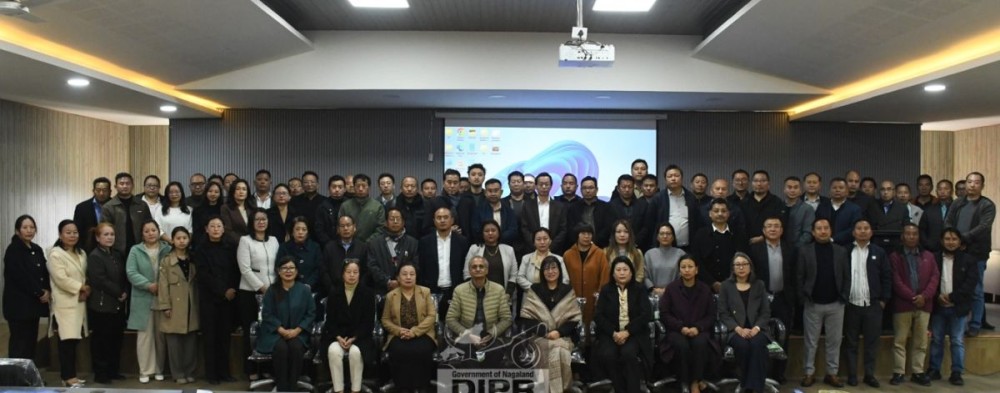
Joint Secretary (Rtd) GoI, Rajesh Saxena with Development Commissioner, Nagaland, Temsunaro Aier, other officials and participants during training on Gender Sensitive Budgeting & Outcome Budgeting held at Administrative Training Institute, Kohima on February 16. (DIPR Photo)
Kohima, February 16 (MExN): Stressing that financial planning must reflect the needs of all sections of society, Development Commissioner of Nagaland, Temsunaro Aier, IAS, has asserted that the government budget is the most powerful policy instrument to drive gender equality.
Speaking at training on Gender Sensitive Budgeting & Outcome Budgeting was held at Administrative Training Institute, Kohima on February 16, Aier emphasised that while policies and commitments are important, they only translate into real change when backed by proper planning and adequate financial resources. “Gender equality and women’s empowerment are central to sustainable and inclusive development,” she stated.
She mentioned that the officers present in the training reflects the importance that the Government of Nagaland attaches to building a more inclusive, effective and capable system of planning and budgeting, stated a DIPR report.
Aier highlighted that Gender Responsive Budgeting is not a separate budget for women, nor is it about spending equal amounts on women and men. She explained that it is about examining the plans and budgets through a gender lens and ensuring that public resources respond to the different needs and realities of women and men, girls and boys. “It helps to make the spending more efficient, more equitable, and more impactful,” she added.
The Development Commissioner revealed that Nagaland initiated the process of gender budgeting as far back as 2009-10. The Planning & Transformation Department serves as the Nodal Department, guiding other departments to integrate gender perspectives into their plans.
To institutionalise these efforts, Gender Budgeting Cells have been constituted to support departments in tracking and improving their interventions.
The objective of the training is to build awareness and practical skills among officers to integrate gender concerns into planning, budgeting and monitoring, she said. “It aims to help assess whether programmes are reaching the intended beneficiaries, whether resources are being used efficiently and whether outcomes are contributing to reducing existing gaps.”
Reinforcing the collective nature of the responsibility, Aier stated, “Gender Responsive Budgeting is not the responsibility of one department alone. Every department, whether in social or economic sectors, has a role to play, because every policy and programme has a gender impact in one way or another.” She cautioned that a budget not examined through a gender lens risks becoming “gender-blind.”
She urged the participating officers to actively engage with the programme and reflect on how the tools and ideas discussed could be applied within their respective departments.
Joint Secretary (Rtd) Government of India, Rajesh Saxena will be the main resources person in the two-day training, organised in collaboration with planning & Transformation department.

.jpg)
.jpg)
.jpg)
