Raipur: Union Home Minister Amit Shah holds a review meeting with the Chhattisgarh government and officials regarding anti-Naxal operations, in Raipur on Sunday, February 8, 2026. (Photo: IANS/X/@AmitShah)
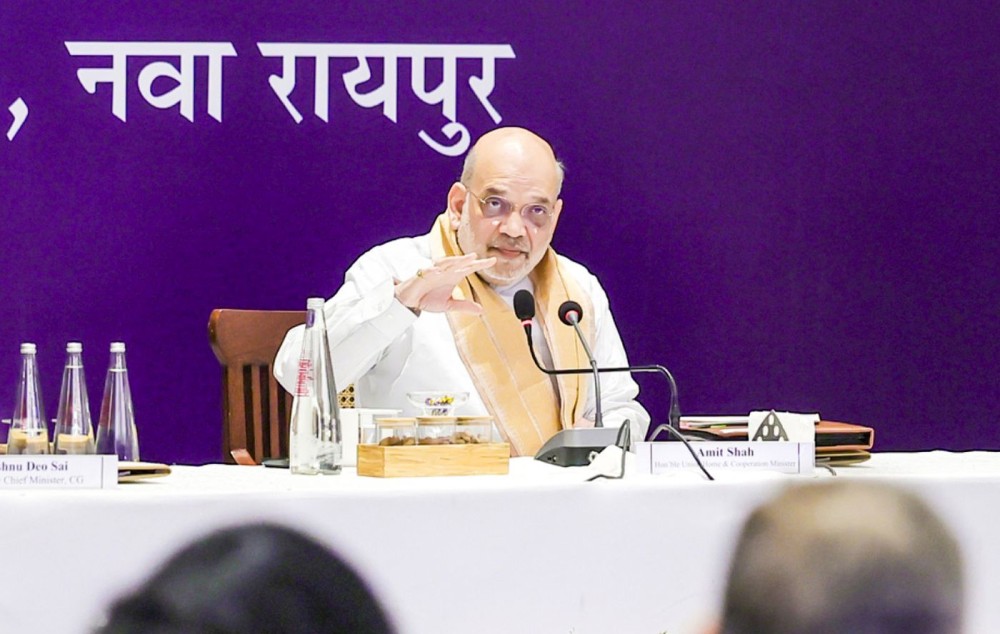
New Delhi, February 10 (IANS) Union Home Minister Amit Shah said on Tuesday that the government has cancelled 12 lakh SIM cards for the cyber security, blocked IMEI of 3 lakh mobiles, and arrested 20,853 accused till December 2025.
Delivering the keynote address at the National Conference on “Tackling Cyber-Enabled Frauds and Dismantling the Ecosystem”, organised by the CBI and Indian Cyber Crime Coordination Centre (I4C), HM Shah said that multiple government agencies are working together in a coordinated manner to prevent cybercrime.
Shah said that I4C, State Police forces, the CBI, the National Investigation Agency (NIA), the Enforcement Directorate (ED), the Department of Telecommunications, the banking sector, the Ministry of Electronics and Information Technology (MeitY), the Reserve Bank of India (RBI), and the judiciary are collectively making every possible effort to curb cybercrime.
He emphasised that each institution has a critical role and responsibility, and that close coordination among all stakeholders is essential to achieve the desired outcomes.
The Union Minister said that the initiative by the CBI and I4C is extremely significant, adding that it will help connect various government departments and agencies with one another and ensure effective implementation of their efforts, which will lead to the expected success.
Union Home Minister said that under the leadership of Prime Minister Narendra Modi, the journey of ‘Digital India’ over the past 11 years has been remarkable.
He pointed out that 11 years ago, the country had only 250 million internet users, whereas today India has crossed 1 billion internet users, reaching new heights in the digital domain. Broadband connections have increased nearly 16 times and have also surpassed the 1-billion mark.
He Shah said that the cost of one gigabyte of data has declined by 97 per cent, which has significantly expanded both internet access and usage. He said that the rise in the number of internet users and the connectivity of Parliament to Panchayats through BharatNet is a remarkable achievement of Digital India.
Under the BharatNet project, only 546 village panchayats were connected 11 years ago, while today more than 200,000 village panchayats have been brought under the project.
He also informed about the unprecedented growth in UPI transactions, stating that in 2024 alone, India recorded more than 181 billion digital transactions with a total value exceeding Rs 233 trillion.
Home Minister Shah said that cybercrime, which was earlier carried out at an individual level, is now being executed in an institutionalised manner.
“Cyber criminals are continuously evolving their methods by using various kinds of advanced technologies,” he said.
He said that it is the collective responsibility of representatives of all agencies and departments engaged in combating cybercrime to deeply understand their challenges and commit to minimising vulnerabilities at every possible level.
The Home Minister called for concrete and coordinated efforts to make the fight against cybercrime more effective.
He said that the Ministry of Home Affairs has adopted a comprehensive and multi-dimensional strategy to combat cybercrime.
The key pillars of this strategy include real-time reporting of cybercrime, a robust network of forensic laboratories, capacity building, research and development, promotion of cyber awareness in society, and ensuring cyber hygiene in cyberspace.
He said that our goal is to bring together all relevant stakeholders, including the CBI, NIA, RBI, state police forces, other investigating agencies, and government departments, to create a coordinated and highly secure ecosystem.
He said that such coordination is essential to effectively combat cybercrime and to make India’s digital ecosystem safe and trustworthy.
Home Minister Shah informed about the critical role of the CBI and NIA in preventing cybercrime, particularly crimes originating from outside the country.
He stressed the importance of strong communication and coordination among all institutions, highlighting that lapses in the “chain of custody” of digital evidence often prevent conviction, posing a major obstacle to justice.
The Home Minister said that if we had not taken adequate steps, cyber fraud would not have remained just an ordinary crime, but would have turned into a national crisis.
Therefore, all stakeholders must act simultaneously and urgently, whether it is identifying call centres operating domestically or abroad, conducting awareness campaigns, strengthening the 1930 helpline, reducing call response times, or improving coordination between banks and I4C.
The Home Minister also presided over an Investiture Ceremony of CBI Officers and inaugurated the New Cybercrime Branch of the Central Bureau of Investigation (CBI). Shri Amit Shah also launched the State Cyber Crime Coordination Centre (S4C) dashboard of the Indian Cyber Crime Coordination Centre (I4C), Ministry of Home Affairs.
On this occasion, Union Home Secretary, Secretary, Department of Personnel and Training (DOPT), Director, Intelligence Bureau (IB), Director, CBI and other senior officers were present.