CAU officials along with the pig farmers during the training programme in Pig Husbandry held at the College of Veterinary Science and Animal Husbandry, Jalukie on January 31.
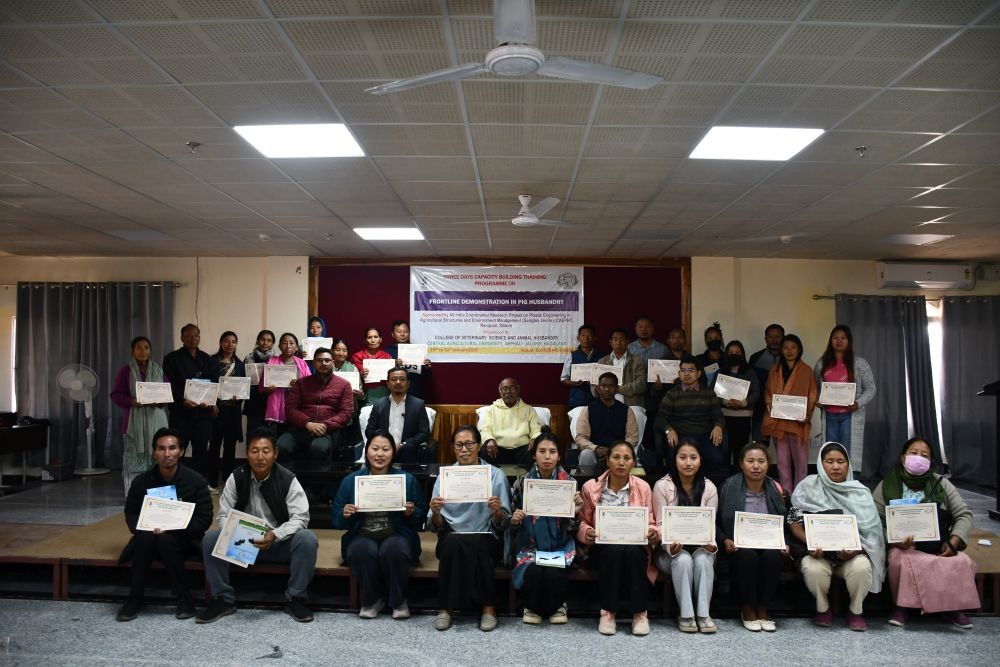
Jalukie, January 31 (MExN): The College of Veterinary Science and Animal Husbandry under Central Agricultural University (CAU) Imphal, Jalukie campus, conducted a three-day Skill Development training programme on Frontline Demonstration in Pig Husbandry from January 29 to 31, a press release received here stated.
The programme was sponsored by the All India Coordinated Research Project on Plastic Engineering in Agricultural Structures and Environment Management (AICRP-PEASEM), Gangtok Centre, CAEPHT, Ranipool, Sikkim.
A total of 30 pig farmers participated in the training programme, which combined classroom lectures with hands-on demonstrations aimed at improving productivity and income through scientific pig husbandry practices.
Course Director Dr Imtiwati, Assistant Professor, spoke on the economic prospects of pig farming, critical care and management of piglets, and scientific feeding practices, addressing common field-level challenges faced by pig rearers.
Course Coordinator Dr Bhabesh Mili, Assistant Professor, highlighted the advantages of environment-enriched pig housing systems suitable for tropical conditions. He laid special emphasis on plastic-slatted floor-based pig housing systems, stating that such systems help maintain better hygiene, improve waste management, ensure animal comfort and enhance farm returns. He also interacted with farmers on pig genetic resources of India and selection of breeding stock to improve productivity.
Hands-on training on detection of estrus in sows and artificial insemination in pigs was conducted by Dr Tukheswar Chutia, Assistant Professor and Co-Coordinator, enabling farmers to understand improved breeding techniques.
A session on herd health management and disease prevention was delivered by Dr Sashitola Ozukum, Assistant Professor, Department of Veterinary Clinical Complex, focusing on minimising disease-related losses through timely preventive care.
To encourage adoption of scientific practices, participating farmers were provided with mineral mixtures, vitamins, deworming tablets and other essential supplements. A training manual was also released and distributed among the farmers to serve as a reference guide for adopting improved pig farming practices.
The programme helped farmers gain a better understanding of modern piggery practices and underscored the importance of scientific housing, proper feeding and health management for sustainable and profitable pig farming in the district.
Speaking at the valedictory programme, Dr A Palanisammi, Dean (i/c), encouraged farmers to adopt new technologies while effectively utilising locally available materials, stating that such an approach could make pig farming more economical, resilient and profitable.