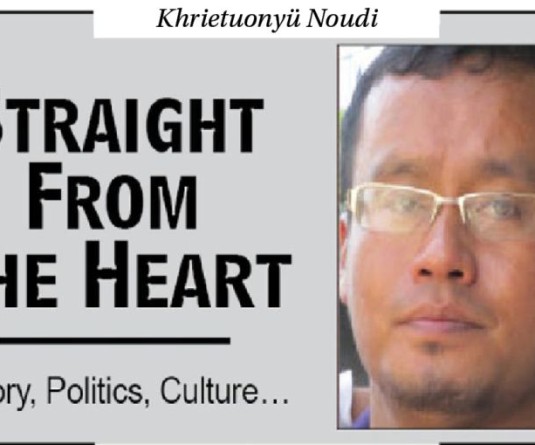
Frontier Center Scholar Sumit Saha from IIT Bombay works on a project at Ohio State’s ElectroScience Laboratory. (Photograph by Michael Huson / Courtesy The Ohio State University)
A partnership between Ohio State University and IIT Bombay expands educational exchange in advanced manufacturing, semiconductors, and materials to build a world-class workforce.
Krittika Sharma
SPAN Magazine, U.S. Embassy New Delhi
For Shambhavi Singh, director of the Ohio State University (OSU) India Gateway, the bridge to the world’s most advanced education systems is more than a metaphor—it’s her daily reality. Singh, who completed her Fulbright-Nehru Master’s Fellowship in 2023 at the Harvard Graduate School of Education in education policy and analysis, embodies what a successful educational exchange between the United States and India can achieve. She oversees the cross-pollination of academic rigor and research culture at the IIT-Bombay-Ohio State Frontier Center, a partnership between the two universities supported by the U.S. Consulate General Mumbai.
The Frontier Center’s flagship scholar program enables doctoral students to conduct research projects that are co-developed and co-advised by faculty members from both institutions, complete a semester at the partner institution, and work directly with faculty across both campuses. The goal is to create a community of researchers, students, and industry that will build on the strengths of the universities in materials, devices, components, and systems through joint workshops and webinars, faculty exchanges, and seed funding to researchers.
The primary areas of research are advanced manufacturing, electronics, photonics, emerging materials, and quantum information and technology.
Interoperable workforce
The center’s most powerful contribution is its ability to prepare a world-class workforce for the semiconductor and materials industries.
The OSU-IITB partnership’s newly launched dual doctoral degree program offers Ph.D. candidates an opportunity to earn degrees recognized by both OSU and IIT Bombay through the Frontier Center in microelectronics and artificial intelligence.
For Indian students, this is a career-defining opportunity. “Students will get global exposure that will definitely add to their research portfolio,” says Singh. American students get an opportunity to work in a very different academic context. “These researchers gain experiences and go back to their countries, adding value to their own ecosystems,” Singh adds, calling it a “force multiplier” for both countries.
The center does not stop at equipping students and facilitating research. Singh explains that it actively addresses the challenge of translating high-level research into real-world applications by bringing together major industry leaders from both countries and using their expertise to shape research projects and curriculum development. When institutions are informed by commercial requirements and employment perspectives, they channel a highly educated workforce directly into high-growth sectors.
Mature expertise
Through the Frontier Center, the United States and India work together to translate U.S. expertise into opportunities in priority fields like semiconductors, strengthening talent pipelines in both countries.
The Ohio State University’s role in shaping those opportunities is critical. “The state of Ohio is very much at the heart of the semiconductor and the chips revolution,” says Singh. “Intel, one of the largest chip manufacturers, has a plant in Columbus, and a very strong partnership with OSU,” she explains. The Institute for Materials and Manufacturing Research (IMR) , a multidisciplinary institute that supports materials-allied research at OSU, is the birthplace of the Frontier Center. The IMR, which works closely with Intel Corporation on advancing semiconductor fabrication, offers Frontier Center researchers unprecedented access to materials expertise guided by industrial giants.
“The opportunities for Indian researchers are huge as learning from a mature context and system [at OSU] will enable them to enter India’s developing workforce,” she says.
The origin story
The OSU Office of International Affairs India Gateway in Mumbai, established in 2012 with support from the U.S. Consulate General Mumbai, laid the groundwork for closer academic and industry collaboration. Intensive exchanges from 2014 to 2019—including joint grants and reciprocal faculty visits driven by Ardasher Contractor, an OSU professor with roots at IIT Bombay—culminated in the launch of the Frontier Center in 2019. Since then, the center has supported 23 research projects spanning semiconductors, photonics and imaging, power electronics and systems, and quantum science.
Singh believes this collaboration holds huge potential for academic and research progress for both the United States and India. As a passionate believer in the power of education to strengthen ties between the two countries, she believes the IITB-OSU Frontier Center represents a crucial step in realizing that potential, ensuring that the next generation of researchers, on both sides of the globe, can tackle shared challenges together.