

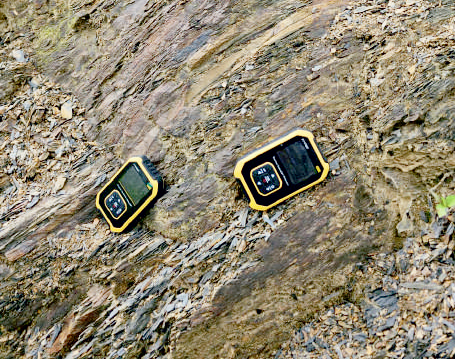
Handheld radiation detectors placed on shale formations during a radioactive mineral survey conducted by the Department of Geology and Mining. (Photo Courtesy: DGM AAR 2025-26)
Findings preliminary, detailed chemical analysis underway, Dept stresses
Morung Express News
Dimapur | March 16
A preliminary investigation by the Department of Geology and Mining (DGM) has identified seven locations with “anomalous” radiation readings across Nagaland, prompting detailed chemical analysis to determine the possible presence of radioactive minerals.
The findings are part of the Department’s Annual Administrative Report 2025–26, which stated that the preliminary investigation covered 10 districts: Dimapur, Chümoukedima, Kohima, Tseminyu, Wokha, Mokokchung, Zunheboto, Phek, Longleng and Mon.
During the survey, a total of 200 radiation readings were recorded using field instruments to measure natural radiation levels, it said.
The readings ranged between 0.16 and 0.32 microsieverts per hour (μSv/h), a unit used to measure the rate of exposure to ionising radiation.
According to the report, comparatively higher radiation levels were observed in shale formations, particularly in Longleng, Zunheboto and Kohima districts.
Out of the readings recorded, seven “anomalous locations” were identified with radiation readings exceeding the background levels, the DGM report stated.
Samples from these locations were collected and sent for detailed chemical analysis, which is currently in progress, it added.
In geological surveys, anomalous radiation readings may indicate areas where naturally occurring radioactive minerals, such as thorium, potassium or uranium, could be present.
However, as noted in the report, the findings are preliminary and remain subject to further analysis and interpretation.

.jpg)
.jpg)
.jpg)
