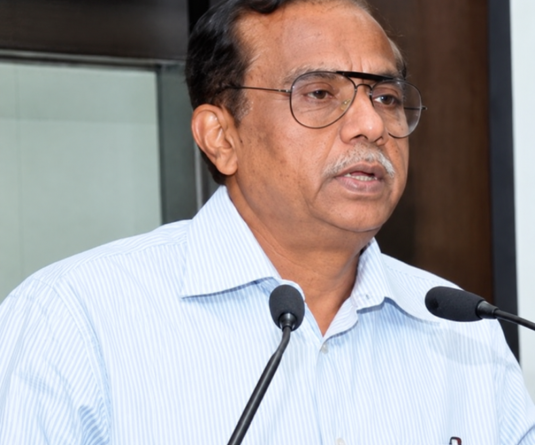
KOHIMA, JUNE 25 (DIPR): Superintendent of Police, Dimapur, Bidhu Shekhar, IPS urged the participants at a five day training to take the training on disaster management seriously and to convince superior officials to accord top priority to disaster management programmes in respective places of postings. “We cannot ignore the need of disaster management as we are sitting on zone five of the seismic map of the country. The Government of India has adopted new approach including institutional changes and restructuring of relief and rehabilitation in the country, following the policy of the Government of India that investment in mitigation is more cost effective”, the SP said during his address.
Bidhu Shekhar was speaking as the Chief Guest at five day training on Comprehensive Natural Disaster Risk Management at Kohima organised by the National Institute of Disaster Management (NIDM), Ministry of Home Affairs, Government of India in collaboration with the Administrative Training Institute, Kohima. The training is held at the ATI from June 25 onwards.
The SP stressed on the need to make the community empowered and capable of managing disaster. He also said, “At the village level, each and every one should be made aware of their responsibilities, adding that every household should have a disaster plan of its own. As per the National Plan, Disaster Risk Management programmes are being taken up in some states of the country with funding from UNDP, USAID and the EU”.
“Emergency Operation Centres (EOCs) are being set up at the state and district level to serve as control rooms and aid in the implementation of disaster management plans”, Shekhar stated. He said that these EOCs will serve as the centre of decision making during time of disaster, and effectively support, co-ordinate and manage the disaster when it strikes.
Shekhar stated that specialist response teams or National Specialist Teams are being set up to rush to the aid of a disaster hit state when the scale of the disaster is too overwhelming for the state. He maintained that disaster management plans should be backed by continuous preparedness plan, urging participants that being crisis managers, they should be better prepared to face any eventuality.
Amir Ali Khan from the NIDM, New Delhi gave an introduction to the workshop. He said that the workshop would focus on basic concepts of disaster risk management; natural disaster risk mitigation and preparedness; post disaster relief and response; post disaster rehabilitation and reconstruction and also address a wide range of cross sectoral issues.
The function was chaired by Faculty Head, Disaster Management Cell, ATI, Kewachu Semy, while vote of thanks was delivered by Associate Professor, Disaster Management Cell, ATI, Kohima Hovithal Norbert Sothu. Participants at the five day training programme include district administrative officers and officials from various departments. The training will conclude on June 29, 2007.
.jpg)