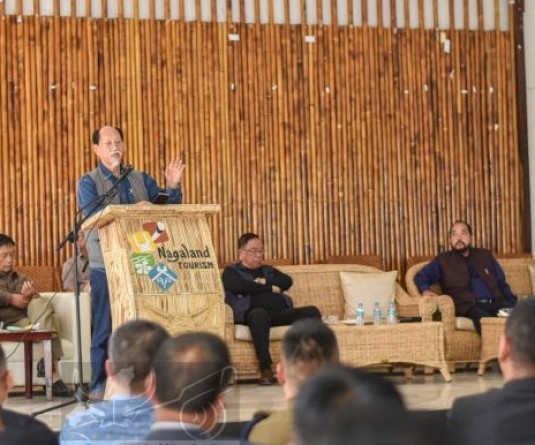
Kohima, December 9 (MExN): The Investment & Development Authority of Nagaland (IDAN) held the final draft review meeting for a comprehensive study aimed at boosting the state's economy through niche agriculture, creative industries, and investment diversification.
The research, titled “Strategic Interventions for Endogenous Development through Export Promotion of Niche Agriculture Products, Advancement of Creative Economy, and Investment Diversification in Nagaland,” was funded by NEDFi’s Techno Economic Development Fund (TEDF) and initiated in January 2025.
As per the DIPR report, the study focused on three key development domains: Niche Agricultural Products – assessing production capacity, market potential, and export readiness; Creative Economy – mapping opportunities in crafts, music, performing arts, and contemporary creative industries, including training institutions; and Investment Diversification – identifying emerging sectors such as tourism, hospitality, eco-enterprises, and renewable energy.
IDAN highlighted that this initiative serves as a sample baseline study to understand sectoral dynamics, identify gaps, and explore new pathways for economic development in Nagaland. The findings have revealed the need for more in-depth sector-specific studies for evidence-based planning and programme formulation.
Chairing the meeting, I Changsang, Under Secretary & Chairman of the IDAN Internal Study Committee, acknowledged NEDFi's support. He stated the study has laid the groundwork for investment diversification and developing frameworks for Public-Private Partnership (PPP) and Community-Private-Public Partnership (CPPP) models.
He further said IDAN looks forward to receiving structured recommendations from departments to collaboratively build strategies for scaling the agriculture and creative sectors in Nagaland.
The meeting saw participation from the TEDF team, the IDAN Internal Study Committee, domain experts, and stakeholders from departments including Agriculture, Horticulture, and Information & Public Relations. Institutional research partner Educentre School of Business was also present.
Participants provided feedback to refine the report and strengthen its policy alignment. Stakeholders recognised the study as a critical step towards evidence-based policy and programme design and strategic development interventions.
The final report, integrating expert suggestions and sector-specific recommendations, will aim to support sustainable livelihood creation and inclusive economic development in the state.