MLA & Advisor, Hekani Jakhalu with others during an interactive session on the UNNATI 2024 Scheme and PM Vishwakarma held in Kohima on May 26. (DIPR Photo)
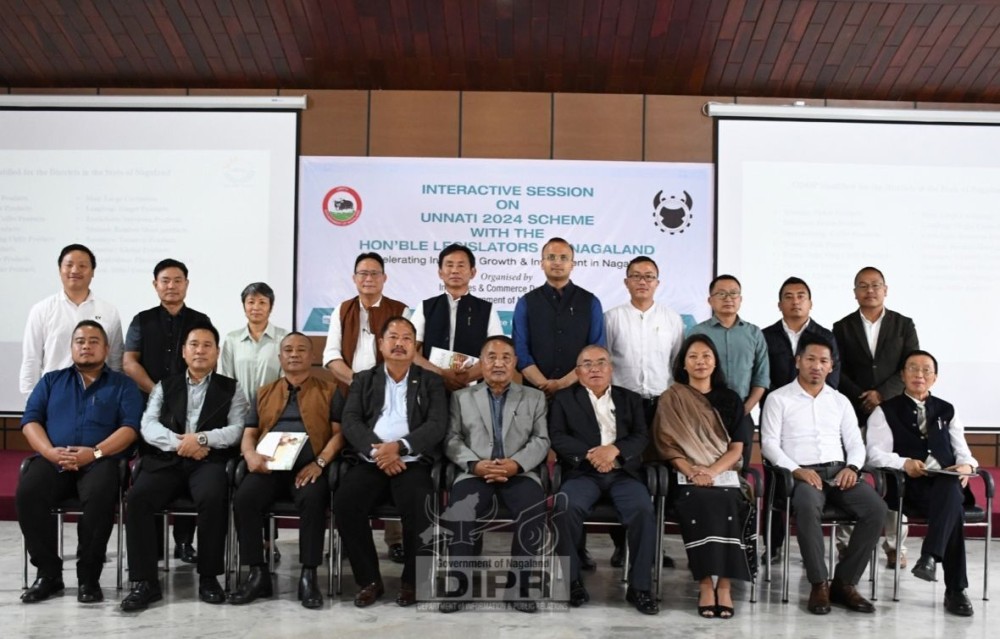
Kohima, May 26 (MExN): Legislators must act as catalysts to spread awareness about central schemes and ensure genuine beneficiaries are identified, said MLA & Advisor for Industries & Commerce, Hekani Jakhalu, during an interactive session on the UNNATI 2024 Scheme and PM Vishwakarma on Tuesday. The event, organised by the Department of Industries & Commerce at its conference hall, Kohima was attended by 12 legislators, senior officials and the PM Vishwakarma Team Nagaland, stated a DIPR report.
Highlighting the transformative potential of micro, small and medium enterprises (MSMEs), MLA & Advisor for Industries & Commerce, Hekani Jakhalu, asserted that if MSMEs are properly established, “70–80% of the struggles are already won.” She emphasised that the local economy and employment opportunities in Nagaland can be fortified only through MSMEs and the business community, calling upon legislators to actively make the public aware of alternative livelihood schemes.
Speaking on the World Bank-assisted RAMP (Raising and Accelerating MSME Performance) scheme, a central sector programme under the Ministry of MSME, she informed that officials have reached every corner of the state to spread awareness. She urged legislators to identify genuine beneficiaries, noting that 750 high-potential MSMEs would be mentored under the initiative. “Entrepreneurs who can become role models for their constituencies must be recommended,” she added.
Jakhalu also briefed the gathering on the PMFME (PM Formalisation of Micro Food Processing Enterprises) Scheme under the Aatmanirbhar Bharat Abhiyan, which empowers individual micro-entrepreneurs, Farmer Producer Organisations (FPOs), and Self Help Groups (SHGs). She noted that the food processing sector is rapidly growing in Nagaland and appreciated the efforts of the Nagaland State Rural Livelihoods Mission (NSRLM) in systematising activities at the constituency level.
Turning to traditional livelihoods, she called upon women engaged in handloom activities to submit names of genuine weavers for Individual Weaver’s Sheds. “Proper sheds are necessary for communication, upgrading skills, and supporting authentic weavers to avail government assistance,” she said. She highlighted textiles, particularly handloom and handicrafts, alongside food processing, as key sectors for economic growth.
The Advisor further underscored the PM Vishwakarma scheme, describing it as an initiative aimed at empowering traditional artisans and craftspeople through skill development, financial assistance and market support to strengthen self-reliance and sustainable livelihoods.
Secretary, Industries & Commerce, Kumar Ramnikant, IAS, in his welcome address, said the schemes reflect a shared vision of self-reliance through entrepreneurship and skill development. He informed that there are currently 55 units in Nagaland under the UNNATI scheme, which is emerging as a catalyst for entrepreneurship in the Northeast region.
Noting that six traditional trades have been identified for training in the state, he said that as of May 25, 2026, a total of 1,939 artisans had been trained under PM Vishwakarma. “These schemes act as a bridge between heritage and the modern economy,” he said, urging legislators to extend their leadership for effective implementation.
Director, Industries & Commerce, P Tokugha Sema, appealed to legislators to help identify genuine and capable entrepreneurs from their constituencies who could benefit from UNNATI, while Additional Director, Er Lipongse Thongtsar, said the department is focusing on ease of access to finance, technology support, and grievance resolution. Altogether, 12 legislators attended the programme.
Scheme presentations
During a detailed presentation on the UNNATI 2024 scheme, officials highlighted that the programme was launched to strengthen the industrial ecosystem in the Northeast and attract new investments. The scheme covers all eight Northeastern states and provides incentives for manufacturing, services, and micro industries, including capital investment support, capital interest subvention, and manufacturing and services-linked incentives. Focus sectors include tourism and hospitality, healthcare, biotech, EV charging stations, IT-enabled services, ropeways, and tech-oriented startups.
Presenting on PM Vishwakarma, the PMVK Team Nagaland outlined that active trades in the state include basket weaving, tailoring, carpentry, masonry, barbering, and doll and toy making. Beneficiaries receive PM Vishwakarma Certificates and ID cards, toolkits worth Rs 15,000, collateral-free loans of up to Rs 3 lakh at 5% interest, and digital market linkage support. As of March 31, 2026, a total of 1,884 artisans in Nagaland have been trained and assessed, while loans worth Rs 3.91 crore and 773 toolkits have been disbursed.
The team also highlighted the PMFME Scheme, under which beneficiaries are eligible for a credit-linked capital subsidy of 35% for setting up new units or upgrading existing enterprises. Implemented under the One District One Product (ODOP) approach, the scheme focuses on promoting local products, improving value chains, and supporting SHGs, FPOs, and cooperatives.