

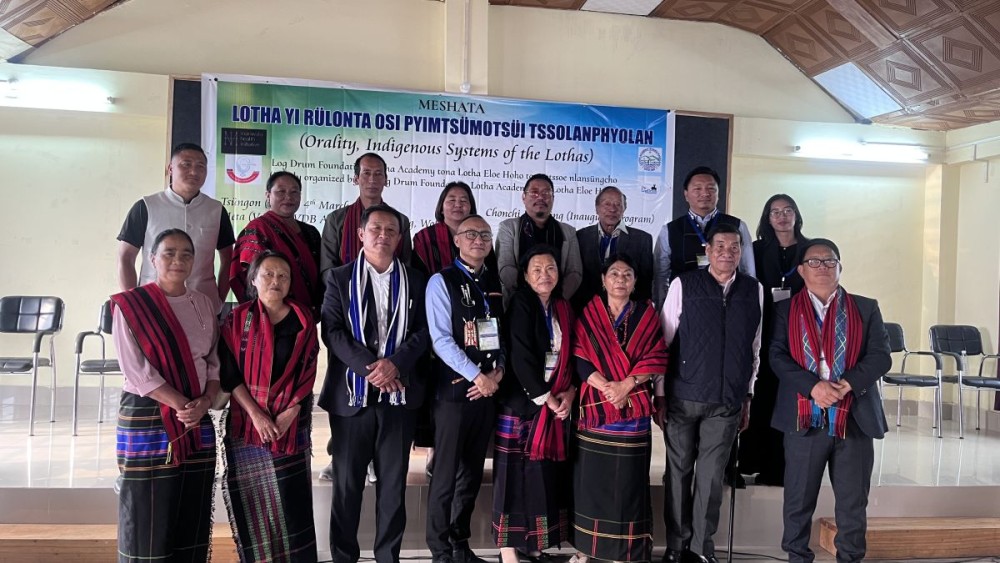
Members of Logdrum Foundation, Lotha Academy and Lotha Eloe Hoho during the seminar held at the VDB Association Building, Wokha Town on March 4. (Morung Photo)
• Pitt Rivers Museum holds around 80 Lotha attires
• Carbon dating shows Wokha village established in 1103
Morung Express News
Wokha | March 4
A one-day seminar on “Orality and Indigenous Systems of the Lothas” was jointly organised by the Logdrum Foundation, Lotha Academy and Lotha Eloe Hoho at the VDB Association Building, Wokha Town on March 4.
The inaugural programme was chaired by Dr N Janbemo Humtsoe, Vice President of Lotha Academy, while Thungbeni Ngullie, President of Lotha Eloe Hoho, delivered the welcome address.
Delivering the keynote address, Mmhonlumo Kikon of Logdrum Foundation emphasised that such discourses are crucial, as Lotha history and knowledge systems have long been transmitted through oral traditions. He described the seminar as a reflection of the community’s inherited practices but lamented the gradual neglect of ancestral systems in the face of modern change.
He cautioned that ignoring the earliest form of information transmission would weaken cultural foundations. Calling for a mass movement among the Nagas, he highlighted concerns over cultural amnesia, identity crisis and the erosion of traditional knowledge due to globalisation and technological distractions. He underscored the importance of cultural archiving, revival and safeguarding Lotha oral institutions as a collective responsibility.
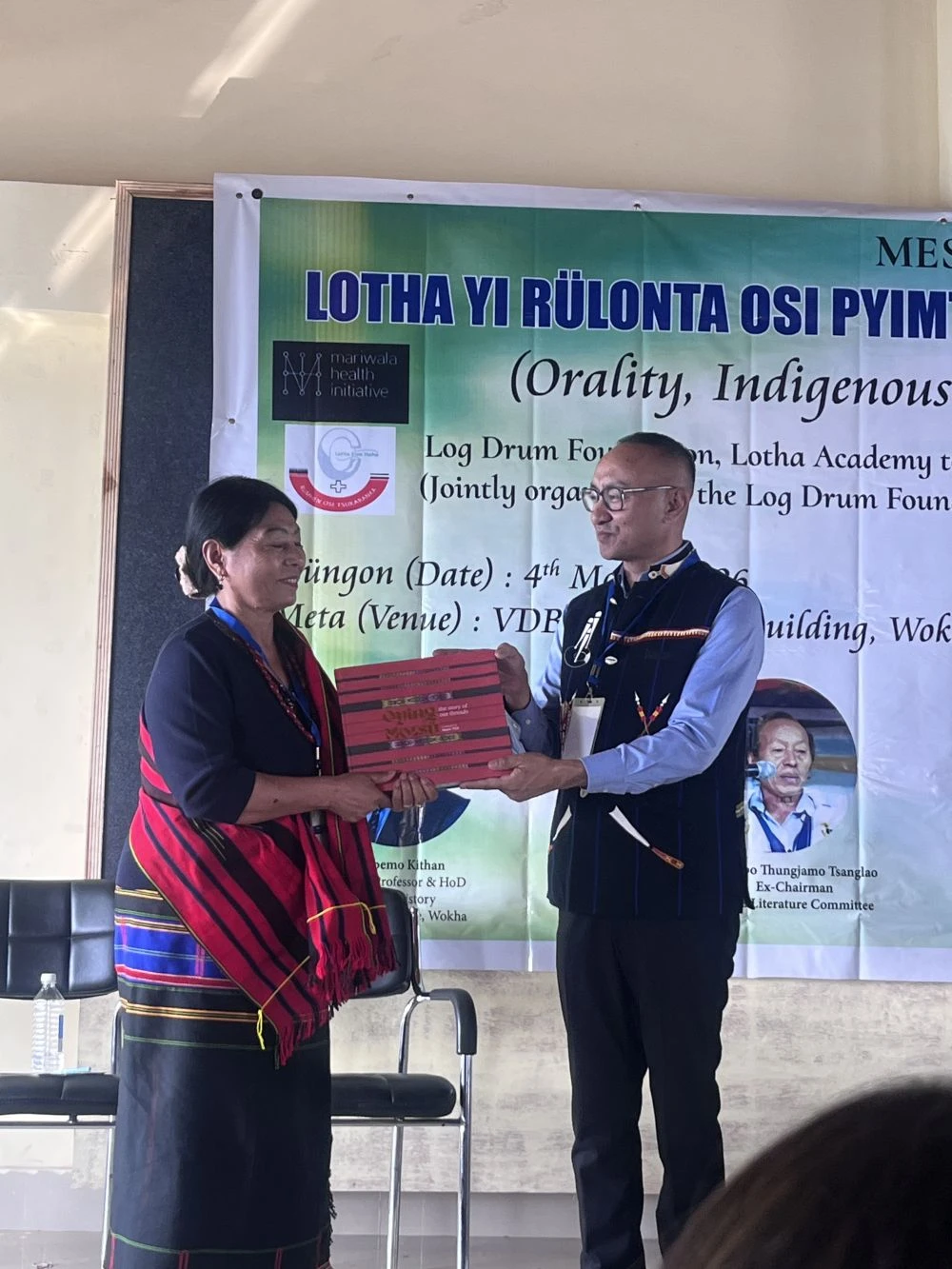
Author Abeni TCK shared insights from her book The Story of Our Threads (Oying Motsü), explaining how Lotha women historically preserved cultural thoughts and values through weaving. She noted that traditional attires, worn by both men and women, embody ideas, emotions and identity.
She informed that nearly 3000 Naga traditional attires are currently housed at the Pitt Rivers Museum in London, including around 80 belonging to the Lothas.
She suggested that the decline in weaving practices may be linked to displacement during the post-Independence Naga political movement, when village burnings forced people to flee into forests, leading to the loss of many traditional cloths. She encouraged Lotha women to continue research and revive lost weaving traditions through documentation and archival references.
In the afternoon session, chaired by Penthungo T Lotha, Secretary of Lotha Academy, Rev Dr Ezamo Murry, former Principal of ETC, Jorhat, spoke on the transition from oral to written traditions. He emphasised the need to document grammar and vocabulary extensively, advocating for maximum translation of the Lotha language except for names and places. He expressed concern that socio-political changes have weakened linguistic usage and cultural direction.
Former Chairman of the Lotha Literature Committee, Thungjamo Tsanglao, spoke on traditional tiger hunting practices among early Lothas. He elaborated on how entire villages collaboratively engaged in tiger hunts, which served both as community protection and as a symbol of bravery and prestige.
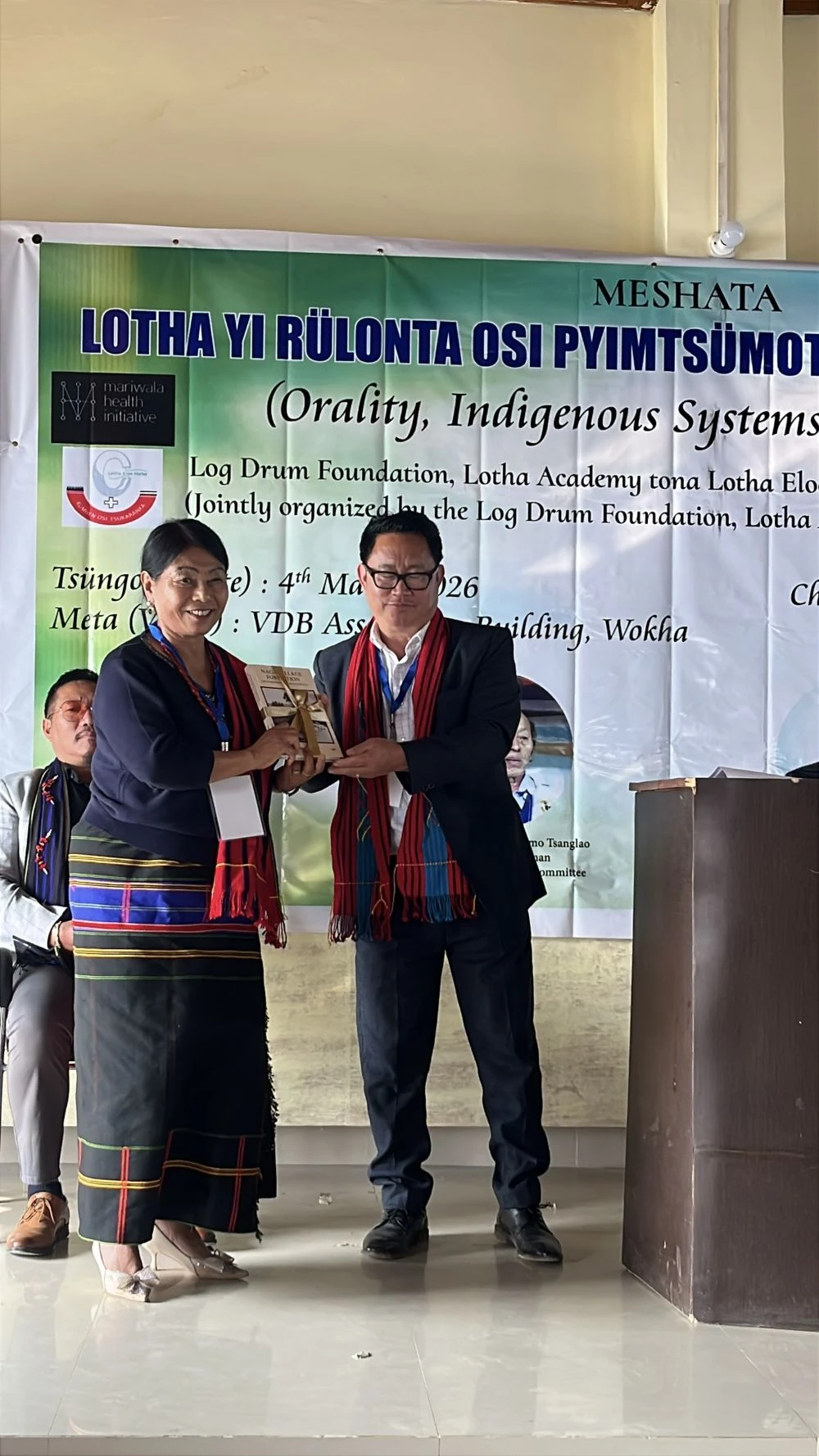
Dr Libemo Kithan, Associate Professor at Mount Tiyi College, spoke on Lotha village formation and lauded the organisers for initiating collaborative efforts to sustain oral traditions. Referring to his published research, Naga Village Formation, with particular focus on the Lotha Nagas, he stated that while the subject requires extensive elaboration, such platforms provide meaningful opportunities for deeper engagement with indigenous history and knowledge systems.
Presenting his findings, Dr Kithan explained that during the establishment of new settlements, symbolic items were traditionally carried from parent villages, signifying continuity of identity, authority and ancestral connection. Citing carbon dating records and oral historical references, he noted that Wokha Village is believed to have been established as early as 1103, underscoring the antiquity of Lotha settlement history.
.jpg)
.jpg)
.jpg)
