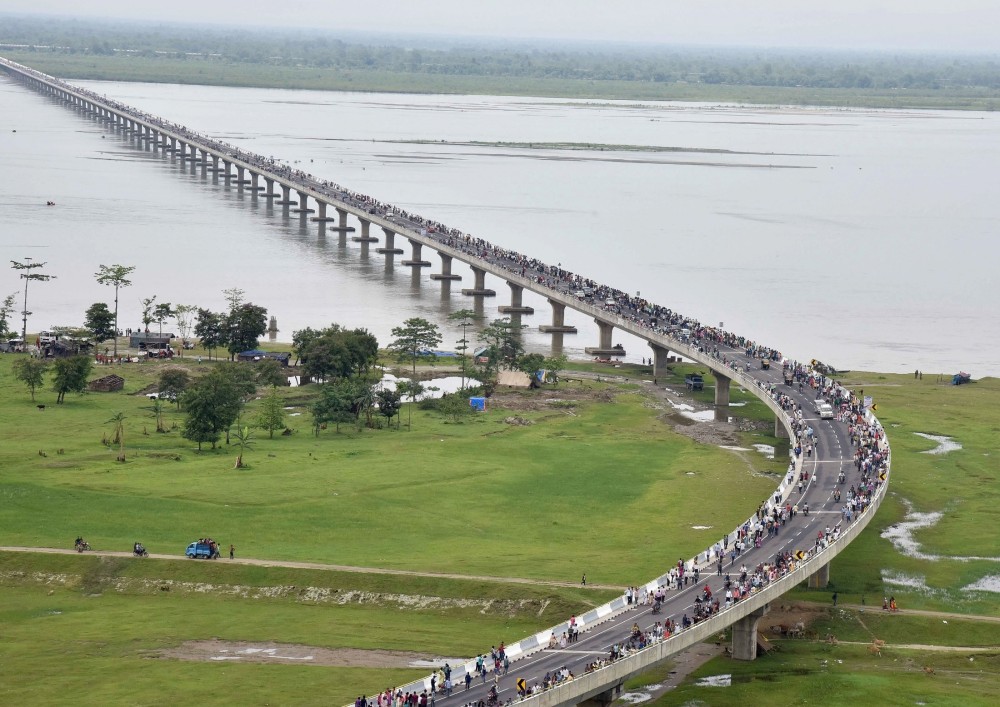
An aerial view of the Dhola-Sadiya bridge across River Brahmaputra. (IANS/PIB Photo)
New Delhi, January 5 (IANS): Mega infrastructure projects such as the Dhubri-Phulbari River bridge and the Bogibeel bridge over the Brahmaputra River are fast transforming Assam’s logistics landscape, significantly improving connectivity, reducing travel time and opening up new economic opportunities across the Northeast.
The 19.3-km Dhubri-Phulbari bridge, once completed, will become India’s longest river bridge, linking Dhubri in western Assam with Phulbari in Meghalaya. The project is being seen as a game-changer for regional trade and mobility, as it will drastically cut travel time between the two states and provide a direct, all-weather road link across the Brahmaputra.
Currently, people and goods rely heavily on ferries, which are time-consuming and often disrupted during monsoon months. Recently, Assam Chief Minister Himanta Biswa Sarma said the bridge will play a crucial role in boosting trade between Assam, Meghalaya and neighbouring states, while also strengthening connectivity with Bangladesh.
By shortening routes to ports and markets, the project is expected to reduce transportation costs for agricultural produce, coal, limestone and other commodities, giving a fillip to local economies.
Another landmark project reshaping Assam’s infrastructure is the Bogibeel bridge, which connects Dibrugarh and Dhemaji districts in Upper Assam. Inaugurated in 2018, the 4.94-km-long bridge is India’s longest road-cum-rail bridge and serves as a strategic and economic lifeline for the region. It has significantly improved access to Arunachal Pradesh and remote areas of Assam, facilitating faster movement of goods, security forces and essential supplies.
Before the Bogibeel bridge became operational, travel between the north and south banks of the Brahmaputra in Upper Assam involved long detours or dependence on ferries. The bridge has reduced travel time by several hours and has become a vital corridor for industries such as tea, oil and natural gas, which form the backbone of Assam’s economy.
Infrastructure experts say these mega bridges are not just engineering milestones but catalysts for regional development. Improved connectivity has led to better access to healthcare, education and markets for people living in riverine and border areas.
The bridges also enhance disaster response capabilities by enabling quicker movement of relief and rescue teams during floods, a recurring challenge in Assam.
The Assam government has repeatedly stressed that such projects align with the Centre’s Act East Policy, aimed at integrating the Northeast with Southeast Asia through improved road, rail and river connectivity.
By strengthening internal logistics and cross-border linkages, the region is better positioned to attract investment and industrial growth.
As work progresses on the Dhubri-Phulbari bridge and other connectivity projects across the state, Assam is witnessing a steady shift from geographical isolation to economic integration, with the Brahmaputra increasingly becoming a bridge to opportunity rather than a barrier.