Officials along with the participants during a state-level seminar held at Modern College in Kohima on August 21.
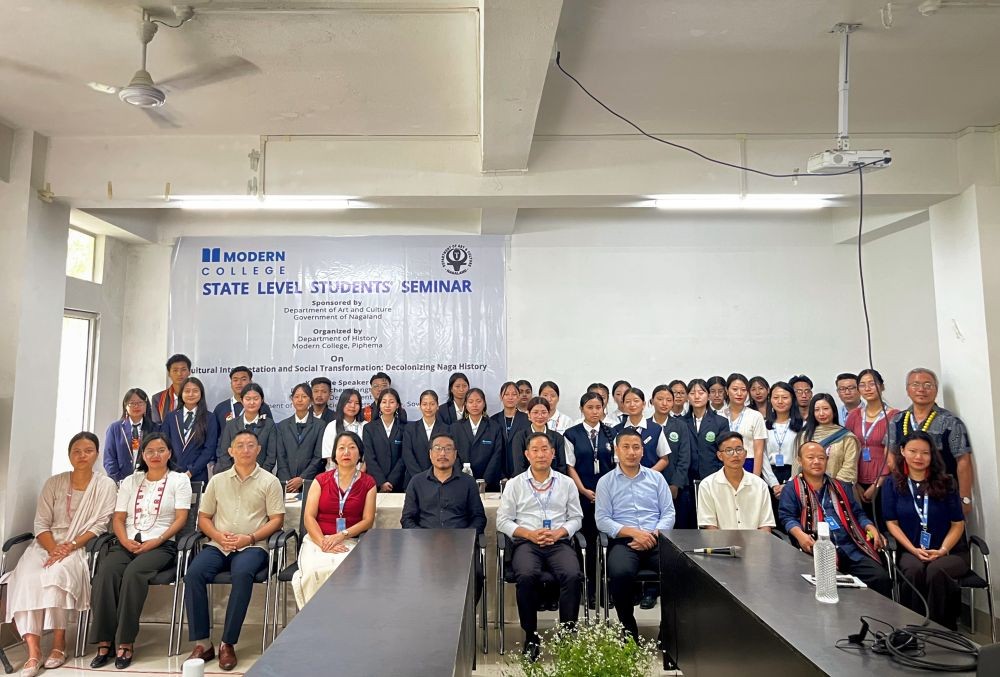
Kohima, August 21 (MExN): Modern College, Piphema, organised its annual State Level Students' Seminar on Friday on the theme “Cultural Interpretation and Social Transformation: Decolonizing Naga History”.
The seminar was organised by the Department of History and supported by the Department of Art and Culture, Government of Nagaland. Dr T Cholichem Sangtam, Head of the Department of Political Science, Tetso College, Sovima, was the keynote speaker.
The inaugural session was held at the college's Conference Hall, with Grace Gonmei, a BA fifth-semester student, as chairperson. Principal Dr Vitsou Yano delivered the welcome address, while Maithron Konyak S, convener of the seminar, introduced the theme and objectives of the programme.
In his keynote address, Dr Sangtam stressed the need to critically examine and decolonise the ways in which Naga history, culture and knowledge have been understood and represented.
He examined the influence of colonial and post-colonial structures on the understanding of Naga history and raised questions about who narrated the history, from whose standpoint it was written and whose interests those narratives served.
Despite the challenges involved in decolonising knowledge and history, Sangtam struck a note of hope, emphasising the importance of reclaiming the Naga voice by questioning inherited texts, listening to indigenous voices and writing back to reclaim Naga stories and narratives.
He clarified that decolonisation did not necessarily mean rejecting everything already written, but creating space to speak from one's own ground, experiences and perspectives. Questioning inherited narratives, he said, was itself an important beginning in the ongoing process of decolonising Naga history, culture and knowledge.
The seminar featured four technical sessions during which student researchers presented papers on a range of themes, including oral traditions and history, decolonisation, cultural identity and values, rewriting narratives, Naga polity in pre-colonial and present-day society, revitalising traditional institutions, customary laws and practices, indigenous knowledge systems, Naga women's history, cultural artefacts and human remains, the contribution of anthropologists to Naga history, Naga literature and writers, and transformations following the coming of Christianity.
Students and participants from colleges across Nagaland and beyond attended the seminar. Paper presenters included students from St Joseph University, Modern College, Tetso College, St Xavier College, Senapati, Manipur, Baptist College, Sazolie College, Capital College of Higher Education, Mt Olive College and Don Bosco College.
A total of 21 participants presented papers during the technical sessions.
Lamgousang and Neizokholie of Modern College secured the first position. The second position was awarded to Nungshibenla of Tetso College and Asieno Kielienyü and Pezangunuo Pfukri of Modern College, while Tsuvie-o Koza of Baptist College secured the third position.
The seminar brought together students and scholars from various colleges to discuss historical, social, cultural and political aspects of Naga society and its history. It also provided a platform for young scholars to engage in discussions on Naga history and contemporary issues.