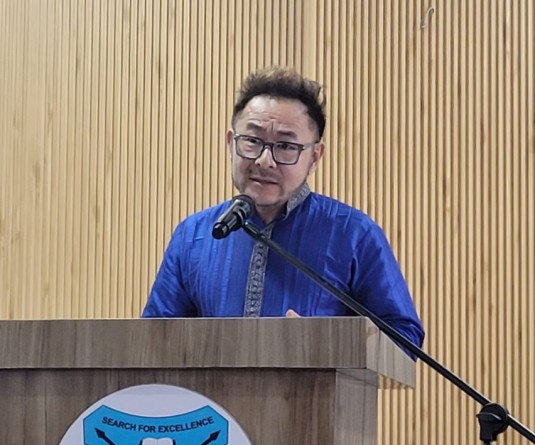
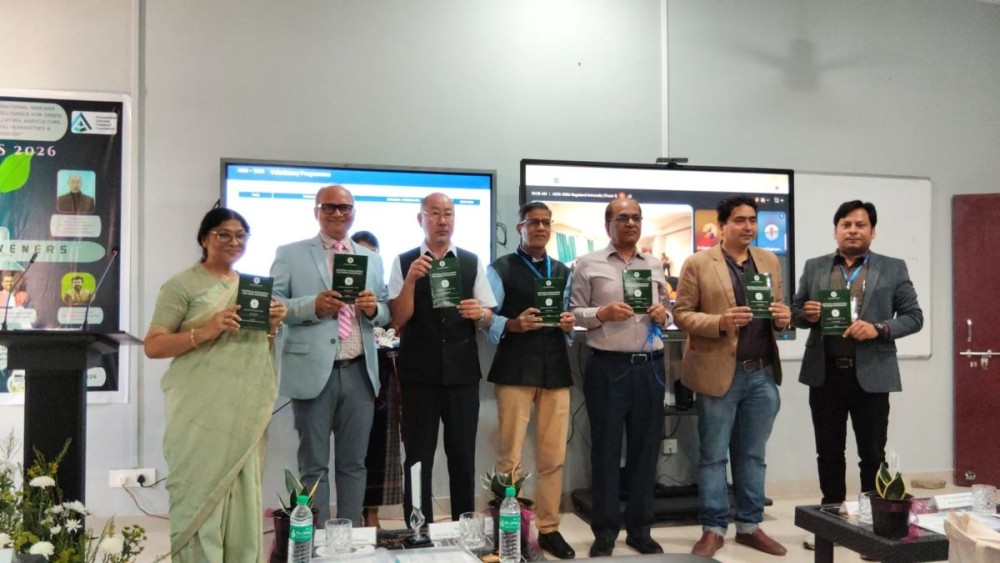
Prof N Venuh with others during release of seminar souvenir cum abstract book on August 10. (Morung Photo)
Scientists, humanists and educators converge at AIGS-2026 to explore AI for ecological good
Our Correspondent
Kohima | August 10
A two daylong AIGS- 2026 international seminar-cum-workshop on “Artificial Intelligence for Green Sustenance: Collating Agriculture, Environmental Humanities and Pedagogy” got underway at School of Engineering & Technology, Nagaland University, Kohima Campus, Meriema.
This seminar is being organised by the Department of Agricultural Engineering, in collaboration with the Departments of Teacher Education and English and sponsored by sponsored by ANRF, Government of India and Nagaland University (NU).
AIGS- 2026 brings together scientists, humanists and educators to discuss how Artificial Intelligence (AI) can serve ecological and social substance in the hills of Northeast India and beyond.
The two day seminar will focus on discussion on smart agriculture, climate resilience, environmental humanities, indigenous knowledge and AI-enabled pedagogy.
Prof N Venuh, Pro-vice chancellor, NU Kohima Campus, Meriema released the seminar souvenir cum abstract book during the inaugural programme.
In his address, Prof Venuh stressed on the need to work out mechanism to protect the environment, the culture and the humanity.
“We need to take into consideration all this. When there is water scarcity, how do we generate? Artificially you cannot create water,” he said. “We can't just feed something which is not harmful to the body and to the human society,” he said.
There is a certain system and that is how we have to innovate the ideas, Prof Venuh said and stressed on the need to know about the indigenous system.
Stressing on the need to control pollution, he said “In one way to minimize, you can't control everything, but we need to identify how to minimize it.”
He said that it is time for the scholars and researchers to find out how to go about and find out something and innovate new ideas.
Describing theme of the seminar as both timely and though provoking, he stated “It reflects the interdisciplinary thinking of our Kohima Campus which has strong tradition in the humanities and social sciences and connects emerging technology with questions of ecology, culture and education.”
Call for more sustainable agriculture, safer environment
Prof Sujata Dash, Dean, School of Engineering & Technology, NU Kohima campus stressed on the need to work together towards a future “where Artificial Intelligence does not merely make systems smarter but helps make our agriculture more sustainable, our environment safer, our education more meaningful and our society more resilient.”
Stating that Artificial Intelligence is transforming the way we live, learn, work, and make decisions, she said “But the real challenge before us is not merely to make machines more intelligent. The larger challenge is to ensure that this intelligence contributes to a greener, more inclusive, and sustainable society. “
Stating that engineering has always been about converting knowledge into solutions, she said “Today, AI gives as powerful tools to understand complex problems, analyse large amounts of data, predict outcomes, and optimize the use of resources.”
Prof Dash said that Nagaland and the Northeast have unique agricultural practices, rich biodiversity, traditional knowledge and distinctive geographical conditions, adding that there is enormous potential to combine “our indigenous knowledge with modern AI and engineering technologies to develop solutions that are locally relevant and sustainable.
She said that the School of Engineering & Technology has also been actively promoting research and academic engagement in emerging areas of Al and intelligent systems.
She congratulated the seminar conveners- Prof Prabhakar Sharma, HoD, Agricultural Engineering; Dr Subhashis Banerjee, Dept of English and Dr Prasenjit Pal, Dept of Education and the entire organising team for bringing together diverse disciplines around a subject that is increasingly important for future.
Research Innovation, Community Engagement
Prof Jagadish K Patnaik, Vice Chancellor NU and Prof Saroj Sharma, Vice Chancellor, Ranchi University also made a virtual address. “Nagaland University remains committed to promoting excellence in teaching, research innovation, and community engagement, Prof Patnaik penned in seminar souvenir.
By encouraging interdisciplinary collaborations and embracing cutting –edge technologies, the University continues to strengthen its role as a centre of academic excellence and social transformation, he stated.
He hoped that the seminar will pave way for impactful collaborations, innovative research and sustainable solutions for the benefit of all society and the environment.
Prof Saroj Sharma stated in souvenir, “The convergence of artificial intelligence with agriculture, environmental humanities, and pedagogy reflects a truly interdisciplinary and forward-looking vision. They are essential for building a sustainable and self-reliant future.”
“As we work towards the goals of Access, Equity, Quality, and Skill Development envisioned under the National Education Policy and Viksit Bharat @2047, initiatives such as this seminar play a vital role in nurturing ecological consciousness, ethical values, and technological competence among our learners and researchers alike,” she penned.
Prof Sharma was confident that the technical sessions and paper presentations planned during this International Seminar over these two days will stimulate meaningful academic dialogue, inspire innovative research, and foster enduring collaborations among scholars, researchers, practitioners, and policymakers from diverse disciplines and institutions.
Earlier, Prof Prabhakar Sharma delivered welcome address while vote of thanks was proposed by Dr Prasenjit Pal.
The seminar will continue till August 11.