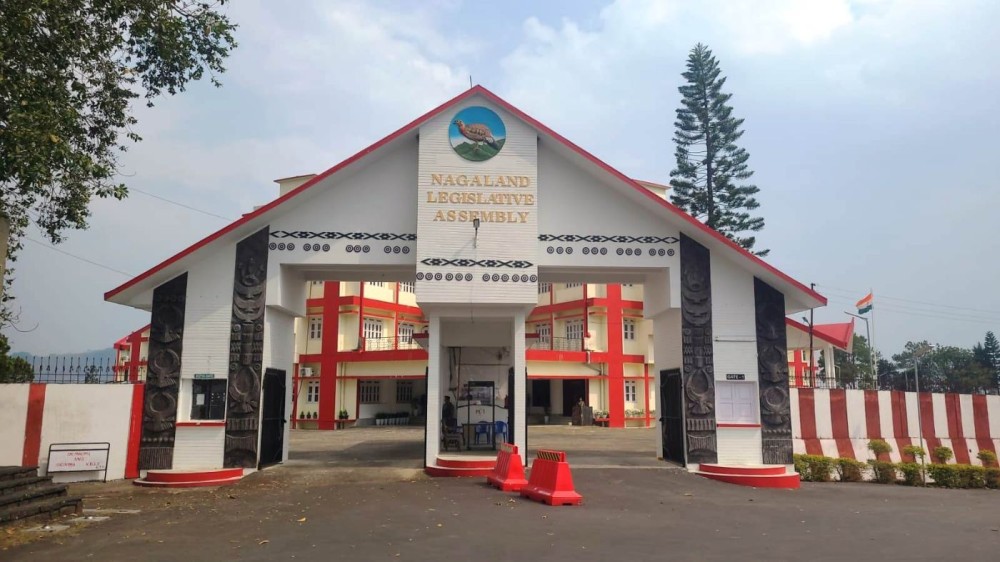
The 14th Nagaland Legislative Assembly deferred the consideration and passage of the Frontier Nagaland Territorial Authority Bill, 2026 on March 27. (Morung Photo)
Refers back to Centre for further examination
Our Correspondent
Kohima | March 27
The 14th Nagaland Legislative Assembly on Friday deferred the consideration and passage of the Frontier Nagaland Territorial Authority (FNTA) Bill, 2026, following a request from the Centre and an appeal from the Eastern Nagaland Peoples’ Organisation (ENPO).
The Bill, introduced by Deputy Chief Minister Y Paton on March 26, was originally scheduled to be taken up for passing on the floor of the House on March 27.
The decision followed the Leader of the House and Chief Minister Dr Neiphiu Rio, and Parliamentary Affairs Minister KG Kenye, who sought the House to refer the Bill back to the Government for further examination.
“In view of the request made by the Government of India, which is a signatory to the Memorandum of Agreement (MoA), and the appeal of Eastern Nagaland Peoples’ Organisation (ENPO) at the request made by Eastern Nagaland Legislators Union (ENLU), and keeping in mind the necessity of ensuring that provisions of MoA are addressed in a legally sound and constitutionally tenable manner, I propose that consideration and passing of the FNTA Bill 2026 be deferred as stated by the Minister of Parliamentary Affairs, to be referred back to the Government for further examinations,” Dr Rio said on the floor of the House.
NLA Speaker Sharingain Longkumer, exercising powers under Rule 93 (B) read with Rule 313 of the House rules, referred the Bill back to the state government. The decision followed a communication from Parliamentary Affairs Minister KG Kenye, who cited a letter from the ENLU.
The ENLU highlighted certain provisions missing in the Bill when compared to the MoA signed on February 5, in New Delhi, between the Centre, state government and ENPO.
He said the discrepancies and “contentious issues” necessitated reconsideration, suggesting that the Bill should not be enacted in the current session but be referred back to the government for further consideration. The Speaker said the Bill would be taken up in the “next earliest emergent session.”
The CM said the state government has been in constant touch with the Ministry of Home Affairs regarding the FNTA Bill, 2026, striving to ensure equity and inclusiveness across all sections of people.
He noted that Eastern Nagaland districts have suffered significant developmental deficits due to historical reasons and geographical challenges, remaining behind other parts of the state.
To fulfil the aspirations of the people, he said they have expressed their desire for an institutional arrangement in the form of the FNTA.
The CM said the state government extended its support and jointly worked with the Government of India in consultations and building consensus, which culminated in the signing of a Memorandum of Agreement on February 5.
The Frontier Nagaland Territory (FNT) will comprise six eastern districts - Tuensang, Mon, Longleng, Kiphire, Noklak and Shamator, the CM said.
Envisaged as a “unique self-governing authority,” the FNT aims to fulfil the social, economic, educational, cultural and linguistic aspirations of the region’s people, he said. It will also provide for democratic, decentralised self-governance at the regional level within the State.
Dr Rio said the State Government will allocate funds to the FNTA based on population and size, while the Centre will sanction requisite funds under various schemes, programmes of the Ministry, as a special development grant for development of the infrastructure within the FNTA, for which FNTA will themselves identify such development projects in consultation with the State.
The FNTA will prepare its own annual plan, making the allocation funds of the Department and subjects under its control, and will have its own planning and financing set up to formulate development plan based on grassroot needs, Dr Rio said.
The State Government, on its part, will ensure timely release of funds in accordance with the laid-down norms of the State Government as well as the Central Government.
The CM outlined the sequence of events leading to the drafting of the Bill for the constitution of the FNTA, amid legal hurdles over legislative powers.
Briefing the process, Dr Rio said the State Government began preparing the Bill after the signing of a MoA on February 5, 2026. The Cabinet deliberated on the draft on February 26, when Advocate General opined that legislative power cannot be conferred on the FNTA through a State Legislation under the constitutional scheme.
The Cabinet observed that the State Government does not possess the legislative competence to delegate powers equivalent to its own or to transfer a legislative authority to another body or authority.
Following further consultations and vetting by the Advocate General, a revised draft was sent to the Ministry on March 17. Rio also held discussions with the Union Home Secretary on March 16, stressing the need for early constitution of the FNTA.
ENPO representatives met the CM on March 24, urging that the Bill be passed before the Central Executive Committee meeting scheduled for March 30.
“So this letter mentioned that 49 days has left, and therefore no further delay should be done, and since President and his team was with me, and my Cabinet colleagues were with me, we assured that in this session we will pass the Bill,” Dr Rio said. “That is how we introduced the Bill yesterday, and we intend to pass the Bill today, but those letters were received, and we are seized of that situation,” he added.
“However, yesterday evening, I was also contacted by the Ministry of Home Affairs, conveying that the matter regarding the conferral of legislative power to the FNTA, which had earlier been raised by the State Government in its communication, is still under examination,” Dr Rio said.