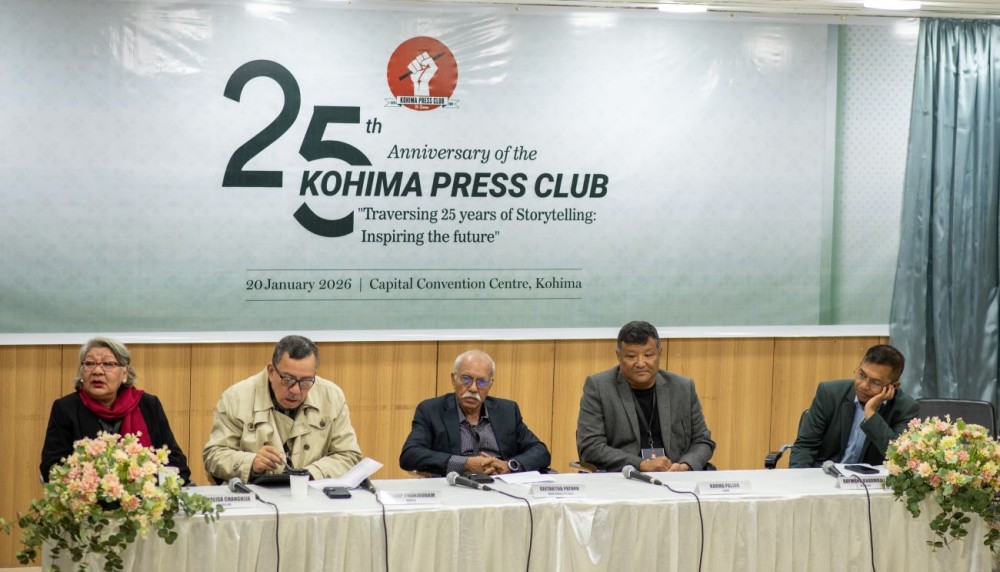
The panellist of the Northeast Media Conclave organised by Kohima Press Club at the Capital Convention Centre Kohima on January 20.
Morung Express News
Kohima | January 21
“With the changing nature of journalism, we have to adapt to the way of storytelling in Northeast,” noted Geetartha Pathak, President of Indian Journalists Union. Speaking as one of the panelists at the first-of-its-kind Northeast Media Conclave, he also dwelt on how the changing nature of journalism is affecting truth especially in the Northeast region where there is conflict and other social issues.
The conclave was organised by Kohima Press Club at the Capital Convention Centre Kohima on January 20 as part of its 25th Anniversary Celebration on the topic, “Evolving nature of Media: Ethics under pressure & strengthening credibility in the age of misinformation” which was moderated by Medolenuo Ambrocia Loucü, member of Kohima Press Club.
Stating that everyday, journalists are facing pressure from the government, corporate sectors and all other sources, he spoke about the challenges further distorted by propaganda and also diluted by misinformation and disinformation.
Maintaining that the single truth and facts has always been obscured, Pradip Phanjoubam, Editor of Imphal Review of Arts and Politics (IRAP) from Manipur explained that, “what was considered truth five decades ago may not be the truth anymore.” What was considered justice at the time? He posed and added that, “we also have to think of the context.”
In this regard, he further underlined that, “we can't impose our minds on the past, that this is right, this is wrong” while citing the question of gender discrimination as an example.
.webp)
Voicing that the changing nature of truth and the changing nature of reality has also been one of his major concerns, he underscored that, “we have no other choice but to adjust to it.”
“We can't say this is wrong. We have to either come to terms with it, or we will always be left behind,” he emphasized. In the meantime, observing that the revenue model of the media is shrinking, he underscored that we have to actually reform in this regard.
He also emphasized on the importance of striking the “balance” of the lived experience of people, which he added should also be one of the chief concerns of the government. What is a democracy? Is public interest always justice? He further posed while observing that the majority will hold the opinion but that, “that majority opinion can be actually very oppressive.”
Can newsrooms handle conflict of interest in the digital space?
Speaking on the context of whether newsrooms can handle conflict of interest especially in the era of sponsorships, influencers & branded content, Award-winning journalist and entrepreneur from Sikkim, Karma Paljor remarked that, “if we, journalists are to depend on Google Ads or YouTube Ads, then we can only be able to buy tea and coffee for offices. We will not be able to run our offices.”
As far as journalism is concerned, he underlined that, “it is not the technology. The challenge is we, ourselves, as journalists, have dug a hole so deep. And because of various reasons.”
While some call it financial pressure, editorial pressure or corporates buying in, he observed that corporates were always buying in. “We were always controlled by advertisers, in a way. But we were still free to speak and write what we wanted,” he added. This, however is changing, he further noted while highlighting that, “today, the biggest competitors are the “hey guys!” on YouTube or Facebook who take away much of our time.”
Dwelling on the reason why he started EastMojo, be said, “I found a problem here, back home.” In this context, he also highlighted, “the first time I came to Nagaland, the first question was, why are national channels not covering? And that question still is there.”
.webp)
Stating that the whole idea was to come back and tell our own stories, he however also underscored that, “if I am to tell my stories about my land, my people, my tribes, my communities, the communities have to support us.”
“Till our communities, our people understand the importance of journalism, then, I think, we will die out. Newsrooms will close, and the only way for you to get some information will be the influencers on social media,” he further commented.
‘Our biggest challenge is to fight against the untruth’
Noting that “what real journalists are facing is that we are competing, not among ourselves, but we are competing with the citizens first,” Raymond Kharmujai, independent journalist with decades of experience from Meghalaya said that initially it was 'citizen journalists' and 'now, comes the other journalists, the social media influencers.
In this regard, he underscored that, “our biggest challenge is to fight against the untruth- the fake news.” To fight this, he called for the need for more trained journalists while stating that, “the most important is that we should be truthful to ourselves when we report something.” He also reaffirmed that, “reporting is about accuracy and presenting facts to the people.”
On safeguarding editorial ethics, Monalisa Changkija, who was the only woman Editor, Proprietor & Publisher of an English Daily in the Northeast for over 25 years (May 1999 - December 2024) expressed that, “despite all our shortcomings and inadequacies, for Nagaland Page, we were very clear that we will not abandon our ethics. So we stuck to that, come hell or high water.”
“That did not make us the most popular paper and the highest selling paper or the most colourful, we were black and white. We didn't abandon our ethics,” she asserted.
Although that has been tough, she strongly maintained that, “it has been worth it standing up to our ethical beliefs” while highlighting that, “It is a question of what is right and what is wrong.”
She further maintained that “the decision is on you as the owner, the proprietor of a newspaper or publisher, editor, or even as a journalist.”
“When you talk about ethics under pressure, nobody can put us under pressure if we stick to our ethics,” she added.