More than 60% of the week’s case count was traced contacts
Morung Express News
Dimapur | December 12
Nagaland reported 329 confirmed COVID-19 cases during the week, 217 of which were in Kohima and 71 in Dimapur. It included 220 traced contacts, 55 security personnel, 31 frontline workers and 23 returnees/travelers.
The sample positivity rate for the week was 15 percent, higher than the previous week’s 10 percent. Overall, the positivity rate was 10 percent, almost twice that of the national average of 6.4 percent. As of December 12, Nagaland has tested a total of 1,166,85 samples.
The high detection rate signifies “undetected cases in the community,” reiterated the state Integrated Disease Surveillance Programme (IDSP), Health & Family Welfare, in its latest weekly COVID roundup published on December 12.
At the district level, Dimapur and Kohima’s positivity rate was higher than that of the state at 13.4 and 10.6 percent, respectively.
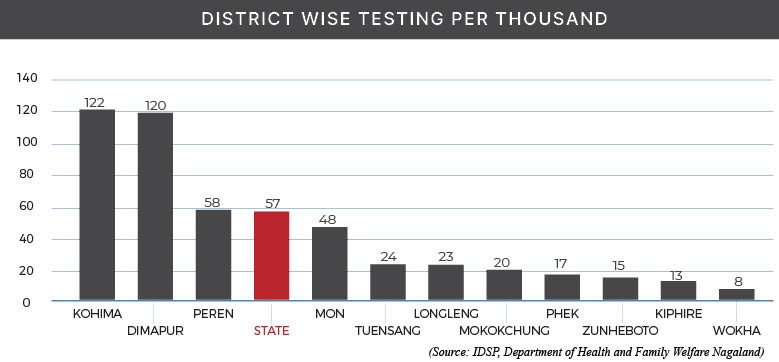
On the other hand, testing continued at a sluggish pace with Nagaland testing on average 57 per thousand population against the country’s 113.2 per thousand population.
The recovery rate reduced to 92.9 percent from the previous week’s 94.2 percent. Meanwhile, the recovery rate improved to 94.8 percent, nationally.
The state also reported 3 new deaths during the week, taking the toll to 68, while the mortality rate worked out to .52 percent, lower than the country’s 1.45 percent. The report added, “64 percent of deaths are below 60 years of age and 18 percent of deaths do not have any known co-morbidity/disease.”
Among the deaths, the most common associated co-morbidities have been diabetes, hypertension and chronic kidney diseases.
As per the report, late admission of suspected cases has resulted in several instances of patients (or 30 percent of the deaths) succumbing within 48 hours of coming to the hospital. Delayed reporting of cases leaves little hope for survival, it said, adding that “the treatment available for COVID-19 is very limited but the timing of interventions like oxygen, steroids, antivirals etc is extremely crucial.”
Rising traced contacts
Almost 2/3rd of the cases detected during the week were “traced contacts within the community,” further reaffirming the apprehension of community spread.
“The most affected age group among the traced contacts is 21-40-year age group, who could be inadvertently spreading the virus to the higher risk groups. This is evident by the constant increase in positivity among the 60 plus age group (6percent of traced contacts),” it stated.
Household (29 percent) and workplaces (24 percent) continue to be the most common places of spread among positive traced contacts. “In most cases, office goers have brought the infection home,” it said. Besides increasing detection of cases among people visiting flu clinics, an increase in positivity among church contacts and bank staff is also occurring.
“Flu clinic positivity among traced contacts has increased to 12 percent,” it said, while adding that this trend is cause for concern because this group of cases does not fall under contact tracing.
“The data of high household contacts, office goers, prison contacts and the recent spread among bank employees clearly points toward “living room/closed space spread” and is a reason why COVID-19 is increasing,” it reminded.