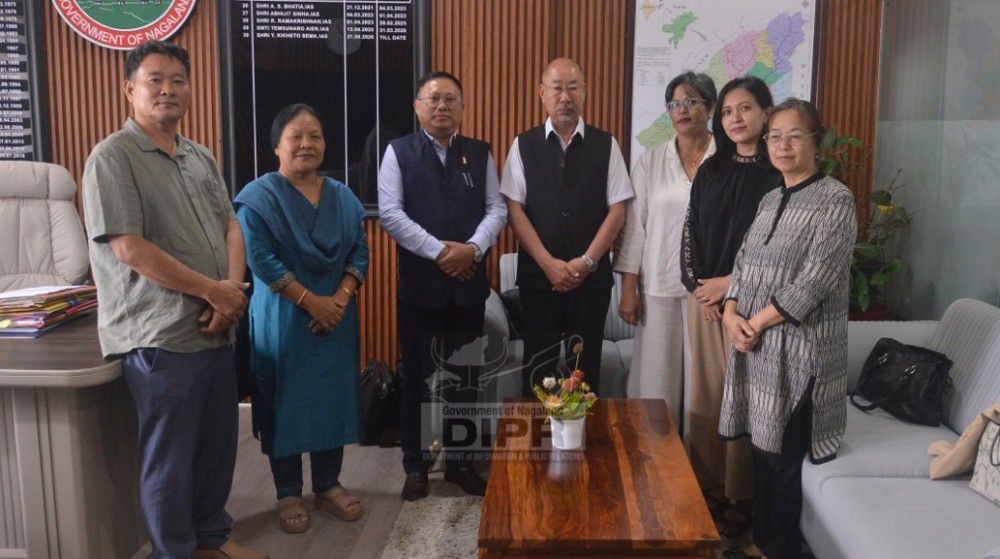
Development Commissioner, Nagaland, Y. Kikheto Sema along with Prof. N. Venuh, Pro Vice-Chancellor, Nagaland University, and officials of various departments during a consultation meeting held at his office chamber, Nagaland Civil Secretariat, Kohima on September 10. ( DIPR Photo)
Kohima, September 10 (MExN): The Nagaland Government is targeting greater self-sufficiency in higher education, agriculture, horticulture and livestock production as part of its vision for a “Viksit Nagaland 2047.”
This was discussed during a consultation meeting on key developmental priorities of the State in the context of the Sustainable Development Goals (SDGs) 2030 and Viksit Bharat 2047, held at the Conference Room of the Development Commissioner, Nagaland Civil Secretariat, Kohima on September 10.
The meeting was convened by Development Commissioner Y Kikheto Sema, IAS, and attended by representatives of Nagaland University (NU), School of Agricultural Sciences (SAS), Medziphema, College of Veterinary Sciences & Animal Husbandry, Jalukie, and concerned line departments.
Sema stressed the need to strengthen higher education institutions in Nagaland to reduce the expenditure incurred by families sending students outside the State. He said Nagaland’s peaceful environment and favourable eco-climatic conditions could also help attract students from neighbouring States.
On agriculture and horticulture, Sema called for a comprehensive assessment of demand and supply, including the quantity and value of products imported from outside the State. He stressed that field-level data and research should guide efforts to identify areas where Nagaland could achieve self-sufficiency and eventually explore export opportunities.
He also called for greater research on jhum and shifting cultivation, saying Nagaland’s unique agricultural practices and local conditions required greater attention in agricultural research and education. He urged SAS, Medziphema, to explore incorporating relevant aspects of jhum cultivation into its curriculum.
The livestock sector, particularly meat, milk and egg production, was also discussed. Sema called for an assessment of existing demand-supply gaps and measures to increase local production, including through goat and cattle rearing, to reduce dependence on imports.
Prof N Venuh, Pro Vice-Chancellor of Nagaland University, appreciated the initiative to involve the university in the State’s development and research priorities. He said substantial research and data were already available on education, agriculture and village-level development, but needed to be better utilised for policymaking and planning.
Dr Rokolhuu Keditsu, Associate Professor, SAS, said in-depth studies on the proposed areas had not yet been undertaken. Dr Debika Nongmaithem, Assistant Professor, highlighted inadequate irrigation facilities as a major constraint to agricultural production and farmers’ income.
Dr I Shakuntala Devi, Dean, College of Veterinary Sciences & Animal Husbandry, said research activities at the newly established college were still at an initial stage. She highlighted the demand for smoked meat and the potential for improved smoking technologies to enhance quality and create wider market and export opportunities.
Representatives of the Higher Education, School Education, Agriculture, Horticulture and Veterinary Departments also shared updates on available data and ongoing activities. The Agriculture and Horticulture Departments said demand-supply data would be updated and shared with SAS for further analysis.
The Veterinary Department, meanwhile, highlighted difficulties in obtaining accurate data on meat imports following the closure of check gates.
In his concluding remarks, Sema stated that the Vision 2047 document for Nagaland is targeted for release on or before December 2026.
Referring to assessments associated with the 14th and 15th Finance Commissions, he said families from Nagaland are estimated to spend not less than ₹1,500 crore on higher education outside the Statewhile expenditure on imported meat and meat products is estimated at around ₹1,000 crore
He also pointed to the State’s substantial deficiency in agricultural and horticultural products, particularly paddy, resulting in high import dependence.
Sema said the immediate priority under Vision 2047 should be to achieve self-sufficiency in essential sectors, with export promotion to follow once sufficient production capacity and market opportunities are developed.
He urged line departments and institutions to coordinate closely and submit a consolidated report at the earliest for further discussion and action.