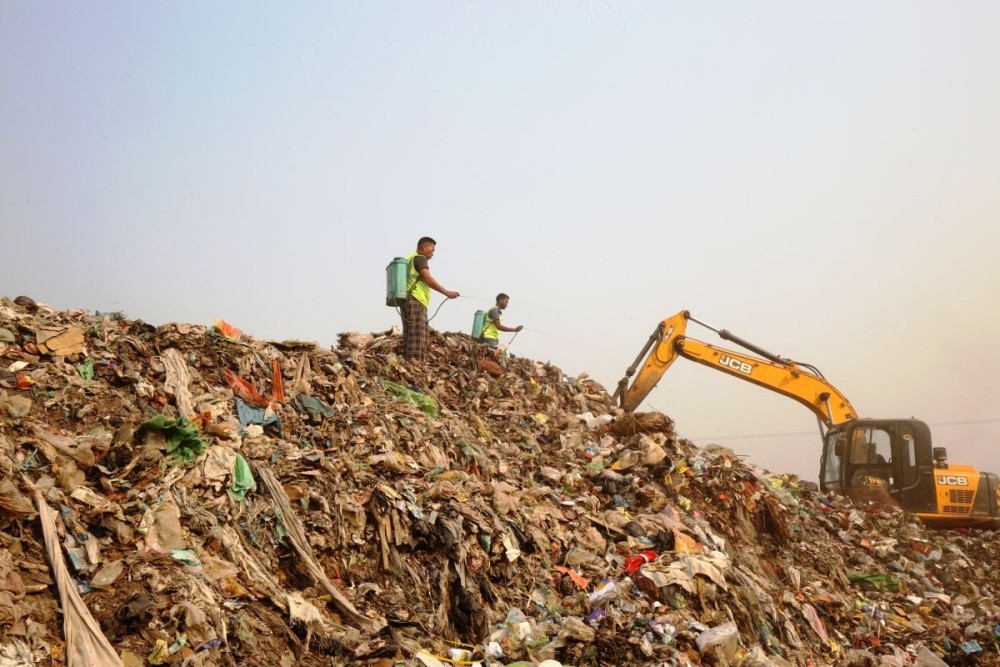
Workers at the Dimapur Municipal Council dumping site. As per the Nagaland’s Government submission to NGT, out of 1,61,110 MT legacy waste to be remediated in Dimapur, 80555 had been remediated in Dimapur as of September 5, 2026. (Morung File Photo)
Moa Jamir
Dimapur | September 27
Nagaland’s latest submission to the National Green Tribunal (NGT) presents a mixed picture of the State’s progress in waste management, with movement reported in legacy-waste remediation, waste transportation and institutional measures, but significant gaps remaining in collection, processing and scientific disposal.
The State Government’s Six-Monthly Progress Report for January-June 2026, filed in compliance with the NGT’s directions, reports incremental improvement in solid waste management across the State’s 39 Urban Local Bodies (ULBs). At the same time, the Tribunal’s observations and the State’s responses highlight continuing gaps between waste generated, collected, transported and processed.
Collection remains a major gap
According to the latest six-monthly report, the 39 ULBs generated 255.903 tonnes per day (TPD) of solid waste during January-June 2026. Of this, 182.100 TPD (71.2%) was collected, while 164.311 TPD, or 90.2% of the collected waste, was transported.
The State reported a 3.8% reduction in waste generation compared with July-December 2025, while transportation improved by 7.5%. It said efforts were continuing to cover the remaining 28.8% of uncollected waste.
The figures follow questions raised by the NGT over discrepancies in earlier data. The Tribunal had found an 83.914 TPD gap between generation and collection across the 39 ULBs, besides a 30.859 TPD gap between collection and transportation.
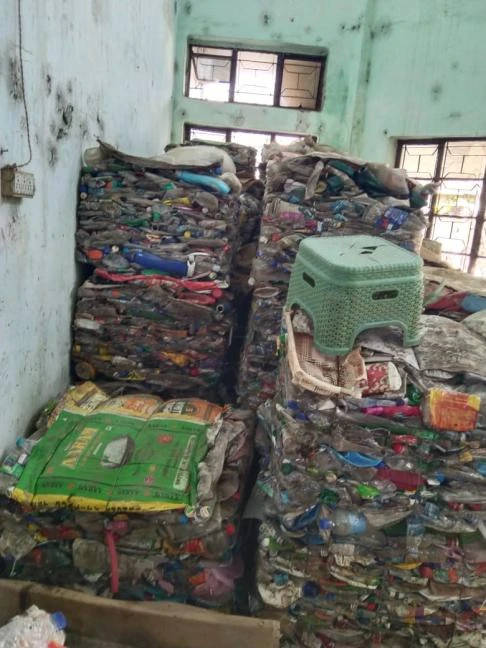
The State attributed some of the apparent gaps to waste being managed at source through animal feed, home composting and scrap dealers, while recyclable dry waste is stored and baled by ULBs before being transported outside the State.
Legacy waste: 16% remediation claimed
The State reported that 66,253 MT, or about 16%, of 4,08,946 MT of identified legacy waste across 12 sites has been remediated at Kohima, Kiphire, Pfutsero and Peren. The completed work is yet to be verified by the Urban Development Department, while remediation at the remaining sites has been initiated.
The NGT had questioned the use of 2022 as the cut-off year for the quantity of legacy waste at Kohima and Dimapur, saying a 2026 picture should have been provided. The State subsequently said fresh assessments for the two ULBs had been conducted with a 2026 cut-off.
The Tribunal had also pointed out that continuing gaps in daily waste processing could add fresh waste to existing legacy dumps. The State acknowledged the gap and said measures were being undertaken simultaneously to prevent further accumulation.
No RDF facility
Another unresolved issue is the disposal of recovered plastic, rubber and refuse-derived fuel (RDF) materials. The State acknowledged that Nagaland currently has no RDF processing or co-processing facility.
Recovered RDF is therefore stored until a commercially viable quantity is available for transportation. The State said RDF recovered from the Kohima legacy waste site has been transported to the Dalmia Cement plant in East Jaintia Hills, Meghalaya.
Waste fund opened, utilisation yet to begin
On the institutional side, the State has opened the Nagaland Waste Management Fund as a ring-fenced account on September 7, 2026, as directed by the NGT.
The State has proposed Rs 200 crore to be ring-fenced, while the Finance Department has sanctioned Rs 1 crore for initial deposit. No amount had been utilised at the time of the submission, with operational guidelines still awaiting approval.
Contrasting water tests
The State told the NGT that drain-water (used water) testing across 18 ULBs in 2024 showed quality within permissible limits. However, individual test reports enclosed with the submission record exceedances in several samples.
At Tamlu, a November 27 sample recorded pH 9.2 against the stated 6.5–8.5 range, iron 1.8 mg/l against 0.3 mg/l, lead 0.04 mg/l against 0.01 mg/l and BOD 38 mg/l against 30 mg/l. Chozuba and Peren samples also recorded exceedances in parameters including TDS, hardness, iron and pH.
The samples are individual results from November 2024 and do not by themselves establish overall water quality. However, they raise questions about the State’s broad “within permissible limits” assessment and the methodology used.
The issue assumes added significance as 28.8% of waste generated remained uncollected during January-June 2026, while the NGT had raised concerns over uncollected or untransported waste reaching water bodies.
Overall, the submission records measurable progress, continued challenges between infrastructure and implementation.