

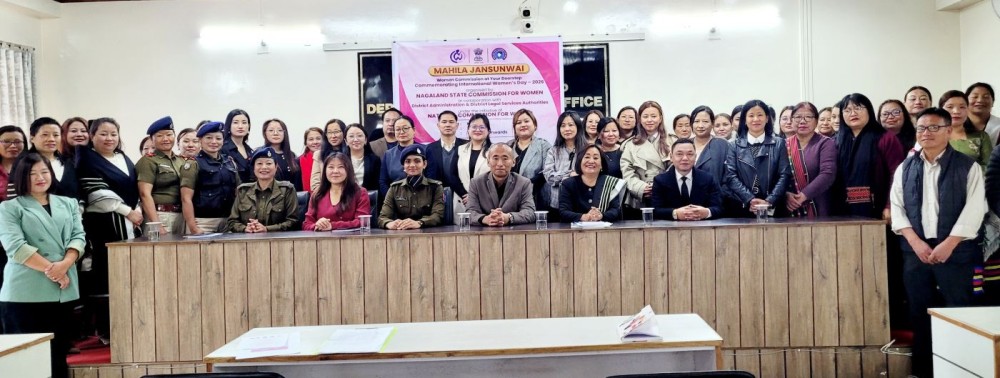
District Administration officials, panellists from various departments and participants during the Mahila Jan Sunwai at Kohima on March 13.
Morung Express News
Kohima | March 13
Mahila Jan Sunwai, a women’s public hearing, was held in Kohima as part of the International Women’s Day 2026 campaign to address grievances faced by women and strengthening mechanisms for justice and support.
Organised by Nagaland State Commission for Women in collaboration with District Administration, District Legal Services Authority, and Department of Social Welfare, the event took place at the conference hall of the Deputy Commissioner, Kohima. It was held under the initiative of the National Commission for Women, New Delhi.
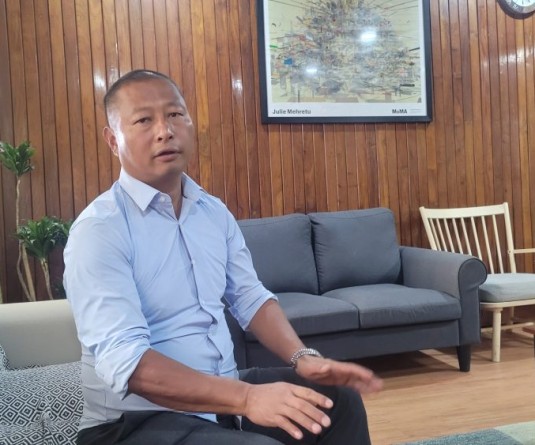
In his keynote address, Additional Deputy Commissioner, Ruopfükuotuo Noudi highlighted that the initiative primarily seeks to create a platform where women can directly raise their complaints before concerned authorities and to connect citizens directly with decision-makers so that long-pending grievances can be resolved more efficiently bypassing administrative delays.
“We are all aware, one complaint that we frequently encounter when it comes to our judiciary system is the long delays which is invariably involved in settlement of any complaint or grievances,” stated Noudi.
Although regarded as one of the safer places for women, he observed that there are concerning rises in cases of domestic violence, workplace harassment and other crimes against women in recent years in Nagaland. To this, he said, departments have been urged to establish Internal Complaints Committees (ICC) in all government offices and institutions, a requirement now made mandatory under workplace safety regulations.
A legal practitioner from KDLSA explained in brief the legal provisions and processes that are available for various forms of violence. Citing data, he informed that there were 33 cases of divorce from2023-2026, six maintenance cases, 47 guardianship issue and seven custody cases.
UBSI Vikuobinuo also highlighted the types of crimes registered in Women police station, manner of dealing with complaints from women in distress, crime scene management by the public, expectations from the first responder at a crime scene and other important matters from women safety.
Meanwhile, member of NSCW, Kekhrieno Meyase emphasised that the Mahila Jan Sunwai is more than just a grievance hearing, but an effort to amplify women’s voices, especially those from grassroots communities who often lack awareness about their legal rights or the support systems available to them.
She explained that the programme brings together multiple stakeholders including the police, legal services authorities, women’s organisations, and civil society groups to collectively address complaints related to domestic violence, workplace harassment, abandonment, trafficking and other forms of gender-based violence.
“Many women at the grassroots level do not know where to seek help or that legal assistance is available to them free of cost,” Meyase stated adding, “through this public hearing, we are bringing these services directly to women in distress.”
Highlighting the importance of community participation and awareness, she encouraged civil society organisations and women’s groups to document cases, educate communities about reporting crimes and support victims in seeking justice.
She also raised concerns about the emerging challenges such as cyber harassment, cyber stalking, and online bullying, which are increasingly affecting young women, content creators and even and media professionals. She called for a robust cyber safety mechanisms and greater awareness about existing legal protections.
Another issue, Meyase highlighted was the lack of advanced forensic facilities in the state, which often delays investigations and the delivery of justice in serious crimes against women wherein she urged the government to strengthen forensic infrastructure to ensure that cases can be handled more effectively.
Meanwhile, she stressed on the need for greater involvement of men and youth in addressing gender-based violence, noting that community mobilisation and collective responsibility are crucial in ensuring the safety and dignity of women.
The Mahila Jan Sunwai concluded with an interactive session where participants discussed legal rights, government welfare schemes for women, and institutional support systems such as One Stop Centres that provide shelter, counselling, and legal assistance to victims.
.jpg)
.jpg)
.jpg)
