Officials with participants of Varta on Cyber Suraksha Abhiyan in Kohima on August 21.
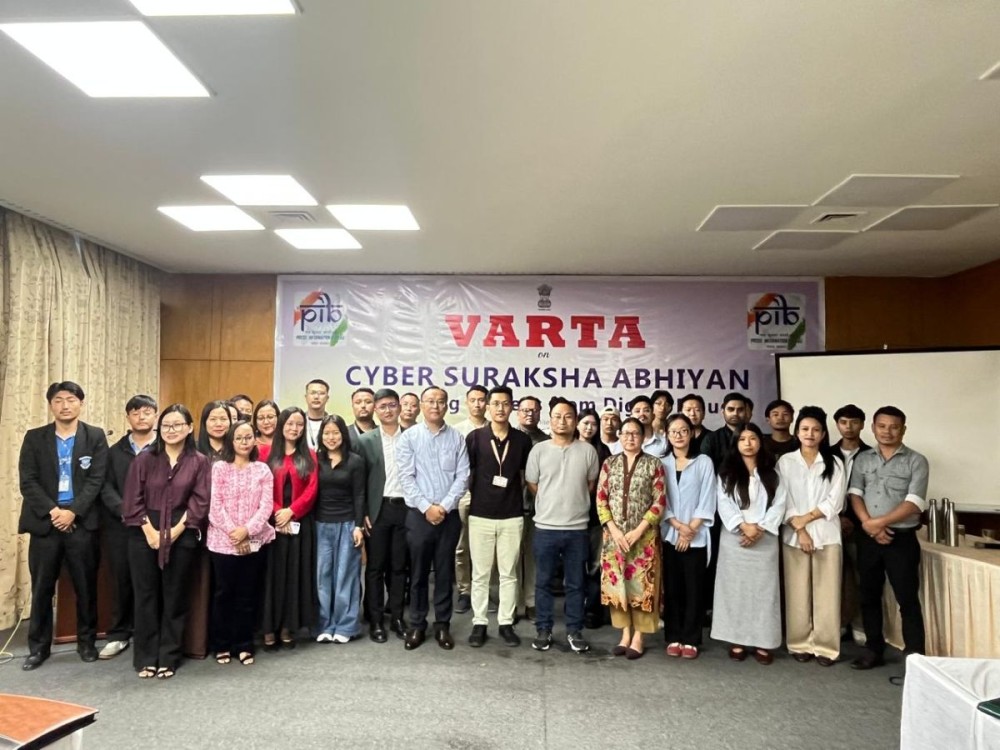
Varta on ‘Cyber Suraksha Abhiyan: Protecting Citizens from Digital Fraud’ held in Kohima
Our Correspondent
Kohima | August 21
A Varta on “Cyber Suraksha Abhiyan: Protecting Citizens from Digital Fraud,” organised by Press Information Bureau (PIB), Kohima on August 21, focussed on government initiatives to prevent cyber scams, digital financial fraud and related cyber threats as well as cyber safety and digital security.
Atoshe Lohe, Principal, Forensic Analyst, National Institute of Electronics & Information Technology (NIELIT) Kohima said that Nagaland is no more exemption from cyber crime.
“There is no boundary in cyberspace, regardless of whoever we are, we are the target,” Lohe said and stressed on the need to take extra precautions in order to keep safe from cyber crime.
He asserted that having a proper awareness about the technology usage would be the best way to protect from cyber crime.
Lohe outlined the Money Restoration and Grievance Redressal modules on the National Cyber Crime Reporting Portal, launched in April 2026 by the Ministry of Home Affairs.
He said the modules are aimed at streamlining fund recovery for victims of financial fraud and addressing grievances, including issues related to frozen bank accounts.
Lohe cautioned citizens about the increasing misuse of social media platforms and digital applications by cyber fraudsters.
He said fraudsters are increasingly using fake investment schemes and impersonating banks and financial institutions to deceive users.
He particularly cautioned against downloading applications or software from unverified sources, noting that remote-access applications such as AnyDesk, when misused, can allow fraudsters to gain control of devices and access sensitive information.
He urged citizens to download applications only from trusted and official sources and to exercise caution before granting remote access to their devices.
Highlighting the importance of prompt reporting, Lohe stressed the significance of the “golden hours” following a financial cyber fraud, stating that early reporting increases the possibility of tracing and recovering lost funds.
He urged victims to immediately report financial cyber fraud through the National Cyber Crime Helpline 1930 and the National Cyber Crime Reporting Portal.
He also noted that cybercrime investigations can be challenging due to the use of multiple digital platforms and encrypted communication channels, stressing the need for continued capacity building and training of law-enforcement agencies to effectively tackle emerging cyber threats.
India records Rs 22,495 crore in losses to cyber fraud
Visezo Dahou, Faculty, Cyber Security, NIELIT highlighted the scale of financial losses caused by cyber fraud in the country.
Citing figures from his presentation, he said India recorded Rs 22,495 crore in losses to cyber fraud in 2025, with 28.15 lakh complaints reported during the year.
He said 76% of the reported financial losses were attributed to fake investment and trading scams.
Dahou urged citizens to follow the simple approach of “Pause, Verify, Report” before responding to suspicious calls, messages, links or investment offers.
He cautioned against guaranteed-return schemes, fake trading platforms, “digital arrest” scams, AI voice-cloning frauds, fake loan applications and APK files received through unofficial channels.
He stressed that citizens should never share OTPs, PINs, CVVs or passwords and reminded them that a UPI PIN is required to send money, not to receive it.
In cases of sextortion or online blackmail, he advised victims not to pay or engage with perpetrators, but to preserve evidence and report the incident.
Emphasising the importance of immediate action, Dahou advised victims of financial cyber fraud to call 1930 without delay, contact their bank through its official helpline and report the incident through the National Cyber Crime Reporting Portal.
He also cited that Rs 11,158 crore had been saved across more than 32.80 lakh complaints through the Citizen Financial Cyber Fraud Reporting and Management System, with figures up to June 30, 2026.
Digitally safe society
Andrew Lalchhandama Media & Communication officer PIB, Kohima said that the objective of today’s workshop aim at highlighting initiatives of the central government in creating a digitally safe society as well preventing cyber crime and promote cyber hygiene at the same time.
He said that today's discussion aim to gain a better understanding of safe and responsible cyber usage.
He said that National initiatives such as Cyber Suraksha Abhiyan along with platforms like National Cyber Crime Reporting Portal, place considerable emphasis on educating and training citizens, government officials, students and other stakeholders on safe digital society.
Journalists from different media houses including students from St Joseph’s College Jakhama and Nagaland University attended the programme. The programme concluded with vote of thanks by P Sophie, Head Office, PIB, Kohima.