Kohima, June 11 (MExN): Nagaland Police has issued fresh statewide instructions prohibiting the registration of FIRs in “purely civil and commercial disputes” relating to recovery of business dues, trade credits, pending loans, contractual breaches and similar transactions.
The Director General of Police (DGP), Nagaland, and Police Headquarters (PHQ) have issued strict guidelines to all police stations and District Executive Forces (DEFs), stating that FIRs should not be registered in such cases unless there is “clear evidence of dishonest or fraudulent intention right at the inception of the transaction.”
A circular issued on June 10 stated that the instructions were based on a series of judgments and directives of the Supreme Court of India aimed at preventing the misuse of criminal law for settling civil and commercial disputes.
The directive aligns with legal principles repeatedly upheld by the apex court, which has held that mere non-payment of dues, breach of contract or failure to repay loans in ordinary business dealings does not amount to cheating or criminal breach of trust under the Bharatiya Nyaya Sanhita (BNS), it said.
“In such cases, criminal law and police machinery cannot be used as a tool to pressure parties into settling civil claims,” the circular stated.
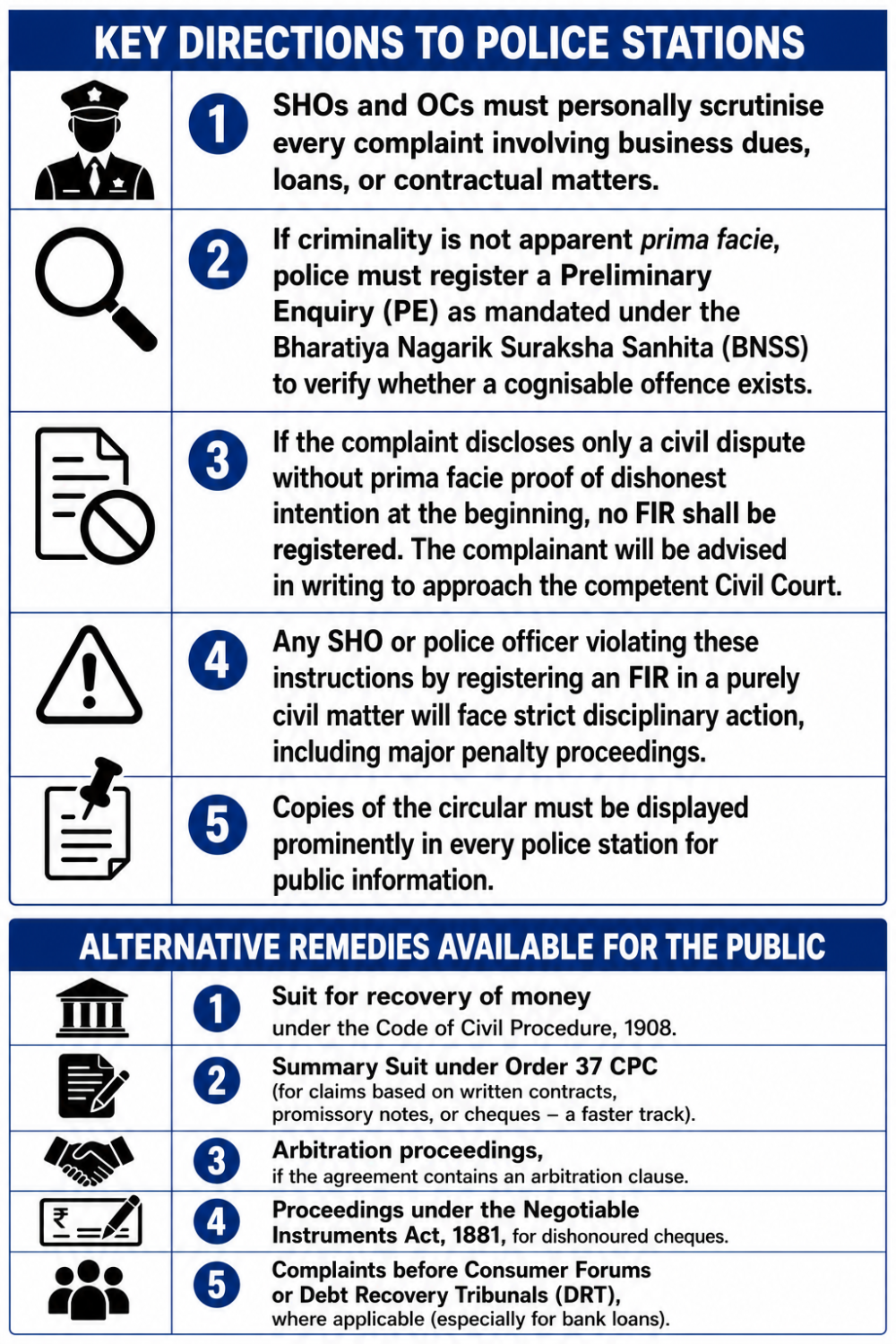
Key directions
As per the circular, Station House Officers (SHOs) and Officers-in-Charge (OCs) must personally scrutinise every complaint involving business dues, loans or contractual matters.
Where criminality is not apparent on the face of the complaint, police must conduct a Preliminary Enquiry (PE) under the Bharatiya Nagarik Suraksha Sanhita (BNSS) to determine whether a cognisable offence exists.
However, if the complaint reveals only a civil dispute without prima facie evidence of dishonest intention at the inception of the transaction, no FIR shall be registered. Instead, complainants are to be advised in writing to approach the competent civil court.
The circular further warns that any police officer registering an FIR in a purely civil matter in violation of the guidelines will face strict disciplinary action, including major penalty proceedings. Copies of the circular are also to be displayed prominently in every police station.
Alternative remedies
Nagaland Police outlined alternative legal remedies for recovery of money or enforcement of contracts, including recovery suits under the Code of Civil Procedure, 1908, summary suits under Order 37 CPC, arbitration proceedings, complaints before Consumer Forums or Debt Recovery Tribunals (DRTs), and proceedings under the Negotiable Instruments Act, 1881, in cases involving dishonoured cheques.
Private lending disputes
Addressing private lending disputes, the police stated that non-payment of loans or instalments between private parties is fundamentally a civil matter governed by contract law.
Referring to the Nagaland Money Lenders Act, 2005, it noted that a borrower's failure to repay a loan does not constitute a criminal offence. While violations by lenders, such as unlicensed lending or charging excessive interest, are punishable, enforcement primarily rests with designated Inspectors and civil courts.
In Nagaland, Extra Assistant Commissioners (EACs) have been designated as Inspectors under the Act. Police have only a limited supportive role and cannot initiate criminal proceedings suo motu for routine debt recovery.
According to Nagaland Police, the guidelines are intended to protect bona fide businessmen, borrowers and citizens from harassment through frivolous criminal cases, preserve criminal law for genuine offences involving fraud, and ensure that police are not used as recovery agents in private financial disputes.
Genuine cases involving cheating or criminal breach of trust with clear dishonest intent at the outset, however, will continue to be investigated following due preliminary enquiry, it added.