

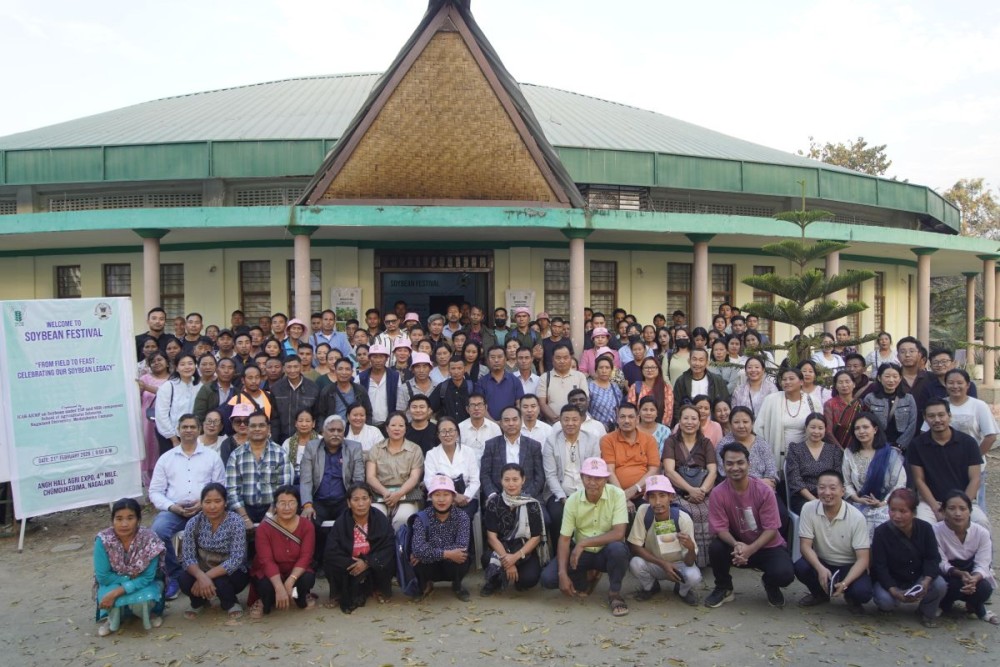
Participants along with the officials and organisers at the Soybean festival.
State accounts for just 0.1% of India's soybean output
Chümoukedima, February 21 (MExN): A two-day Soybean Festival under the theme “From Field to Feast: Celebrating Our Soybean Legacy” commenced at Angh Hall, Agri Expo, Chümoukedima, on February 20, drawing farmers, entrepreneurs, scientists and stakeholders from across the state.
The festival is being organised by ICAR–AICRP on Soybean under the TSP and NEH components, School of Agricultural Sciences (SAS), Nagaland University, Medziphema Campus, stated a DIPR report.
Gracing the occasion, Dr GP Singh, Director, ICAR-NBPGR, and Sanuzo Nienu, Director of Agriculture, Government of Nagaland, highlighted the growing importance of soybean as a “miracle crop” for economic empowerment and nutritional security.
Addressing the gathering, Sanuzo Nienu, Director of Agriculture, Government of Nagaland, described soybean (Glycine max) as one of the most valuable leguminous crops globally, rich in protein and oil, and a vital contributor to food security. He emphasized that soybean not only serves as a high-protein food for human consumption but is also a key component in livestock and poultry feed industries.
“Soybean is a crop of the future. It supports heart health, bone health, metabolic functions and helps regulate blood sugar levels. At the same time, it strengthens our agricultural economy,” he said.
Highlighting its environmental benefits, he noted that soybean naturally enriches soil by fixing atmospheric nitrogen through symbiotic bacteria, reducing dependence on synthetic fertilizers and improving fertility for subsequent crops.
He further underlined the crop’s vast economic and industrial potential, stating that beyond food products like tofu, soy milk, soy nuts and fermented items, soybean is also used in producing bio-diesel, cosmetics, plastics, inks and other industrial goods. Farmers were encouraged to adopt soybean cultivation as a sustainable and profitable option.
Delivering the keynote address, Prof L Tongpang Longkumer from Department of Agronomy, SAS, Nagaland University, emphasised the importance of scientific advancements and the adoption of improved soybean varieties suited to Nagaland’s unique agro-climatic conditions. He underlined that soybean cultivation can significantly enhance soil health, boost farmers’ income and promote nutritional security across the state.
Highlighting the global importance of the crop, Longkumer described soybean as a “wonder crop,” noting that it plays a crucial role worldwide, contributing nearly 50% to the global oilseed sector. In India, soybean was first introduced in the 1970s and has since emerged as the second most important oilseed crop in the country.
Soybean seeds contain approximately 20% oil and around 80% protein, making them a highly nutritious food source. Being a cholesterol-free oil, soybean oil was described as particularly beneficial for the health of people in Nagaland. The crop also produces a wide range of products, including edible oil, soy flour, soymilk, tofu and animal feed.
Among Indian states, Telangana was highlighted as one of the highest producers of soybean, showcasing the crop’s potential when supported by proper technology and policy measures.
Despite its vast scope, Nagaland currently contributes only about 0.1% to the country’s soybean production. Around 38 metric tonnes of soybean are presently utilised in the state, indicating significant room for expansion.
Speakers at the festival stressed the need to promote soybean farming on a larger scale, introduce improved seed varieties, and establish processing units to manufacture different soybean-based products within the state. They noted that with proper awareness, training and market linkages, soybean cultivation could become a viable and profitable venture for farmers in Nagaland.
Prof AK Singh, Department of Soil Science, SAS, delivered the welcome address, while Prof Akali Sema, Professor Incharge, Research Cell, SAS, chaired the session. The technical session was delivered by Dr Bendangsenla Imsong, SMS/CTO (Plant Breeding & Genetics), KVK, Jharnapani and Dr Pezangulie Chakruno, Jr Scientist (Plant Pathology), AICRP on Soybean, SAS, NU. The programme concluded with a vote of thanks by Dr G Zion, Young Professional-I, AICRP on Soybean, SAS.
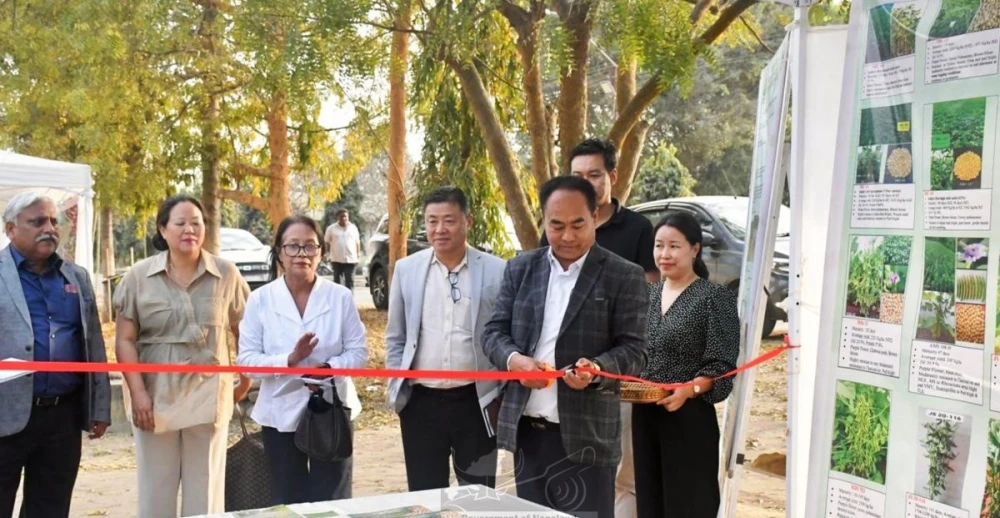
An exhibition stall showcasing soybean varieties, technologies and value-added products was inaugurated as part of the festival.
Technical sessions featured expert talks on variety selection for rainfed conditions and the soybean scenario in Nagaland, equipping farmers and stakeholders with updated knowledge and best practices.
Awards were presented for Best Stall (Chizami Community Seed Bank), Best Exhibit (AICRP on Fruits and Species), Best Farmer (Toluvi Zhimo, Chümoukedima, khekiho village 72 years), and Best Volunteers (Atsungpong Longchar and Nzanthung Ezung). Certificates and agricultural inputs iinclding Knapsack sprayer, tarpaulin, vermin kits (vermi bed, 500nos worms and vermin compost) along with a roll of pipe were distributed by officials from ICAR–NPBGR and officials.
.jpg)
.jpg)
.jpg)
