Host state Higher Education Minister Temjen Imna Along with his counterparts from the other NE states and other delegates at the inaugural of the two-day Education Conclave on NEP 2020 for the North Eastern States, which began in Chümoukedima on September 17. (Morung Photo)
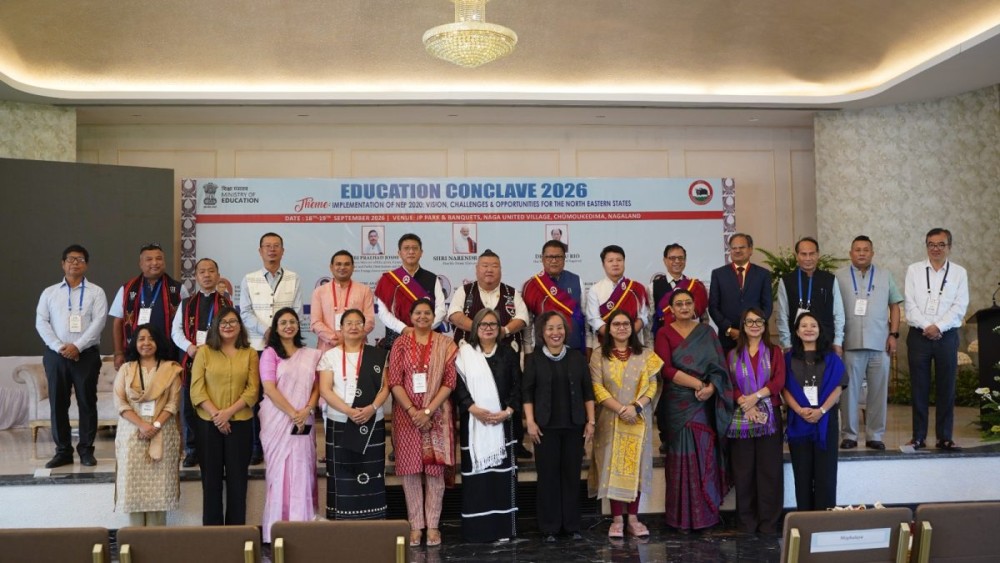
Education Conclave on NEP 2020 for the Northeastern States
Morung Express News
Dimapur | September 18
If the National Education Policy (NEP) is to work in the Northeast, New Delhi’s formulas will have to bend to the reality of the region. That was a common refrain that resonated at the inaugural session of the two-day Education Conclave on NEP 2020 for the North Eastern States, which began in Chümoukedima on September 17. Elected leaders from Assam, Mizoram, Tripura, Arunachal Pradesh, and Nagaland, who spoke at the inaugural session, said that the conventional policies formulated with the mainland in mind has not been doing justice to the region’s unique needs.
The conclave is being organised by the Nagaland state government in collaboration with the Union Ministry of Education under the theme: Implementation of NEP 2020: Vision, Challenges & Opportunities. According to the organisers, it aims to discuss and deliberate on various aspects of NEP 2020 while developing a team that could collectively share implementable ideas.
Mizoram School Education Minister Dr Vanlalthlana called for replacing uniform distance-radius rules with a dedicated “terrain index” and framing realistic hill construction norms. Citing official UDISE+ data, he stated that despite a generous pupil-teacher ratio of one teacher for every 11 children, Mizoram faces a primary dropout rate of 6.35 percent — four times the national average — while over 1600 state schools run with fewer than 50 students.
“Our region has been asked for too long to deliver the national norms on terrain that national norms were never written for. We are not asking for concession, we are asking for norms that describe the country we actually live in,” Vanlalthlana said. He suggested establishing a joint Northeastern multi-disciplinary university across the eight states, alongside a forum consisting of Education Ministers from the region under the North Eastern Council (NEC) to present combined funding proposals directly to the Centre.
Arunachal Pradesh MLA and Education Advisor Mutchu Mithi turned the focus to shrinking state budgets. He said that ‘horizontal tax devolution’ cuts under the 16th Finance Commission had created an estimated Rs 4000 crore annual shortfall for Arunachal Pradesh. Mithi held that hill states are forced to run an “uphill race” with higher building and logistics costs, even as the state government routed Rs 500 crore into its Mission Shiksha programme to upgrade school facilities.
Assam Education Minister Dr Ranoj Pegu stated that schooling across the country remains skewed toward coaching institutes and competitive examinations, despite state numbers showing that only 2.6 percent of students enter medical or engineering colleges and barely 1 percent clear civil service exams.
Pegu questioned the rationale of leaving the remaining 97 percent of students in general degree colleges without trade qualifications. He explained that Assam merged its elementary and secondary directorates and boards, introduced mother-tongue instruction in 14 languages at the lower primary level, and added accredited vocational credits into secondary schooling. He cited over 32,000 students currently enrolled in Bihu dance as an academic subject, and held that undergraduate colleges offering exit diplomas must link those credentials directly to specific trades such as copy editing, translation, or technology literacy.
Tripura Higher Education Minister Kishor Barman said that having a policy on paper is not enough. What really matters is how well it is taught and implemented in the classroom. Pointing to Tripura’s literacy record and its NITI Aayog ranking, he said the state is working to build an education hub by expanding technical and multi-disciplinary programmes. He urged schools to assess what students can create and solve rather than relying solely on test scores, calling for a framework built on what he said should be “local roots, global aspirations.”
Nagaland Higher Education Minister Temjen Imna Along noted that paper degrees no longer lead to employment. Delivering a welcome message from Chief Minister Neiphiu Rio, who was called to Delhi on policy discussions, Along asked university administrators and policymakers to use the conclave to produce a practical, common regional roadmap before the technical sessions concluded.