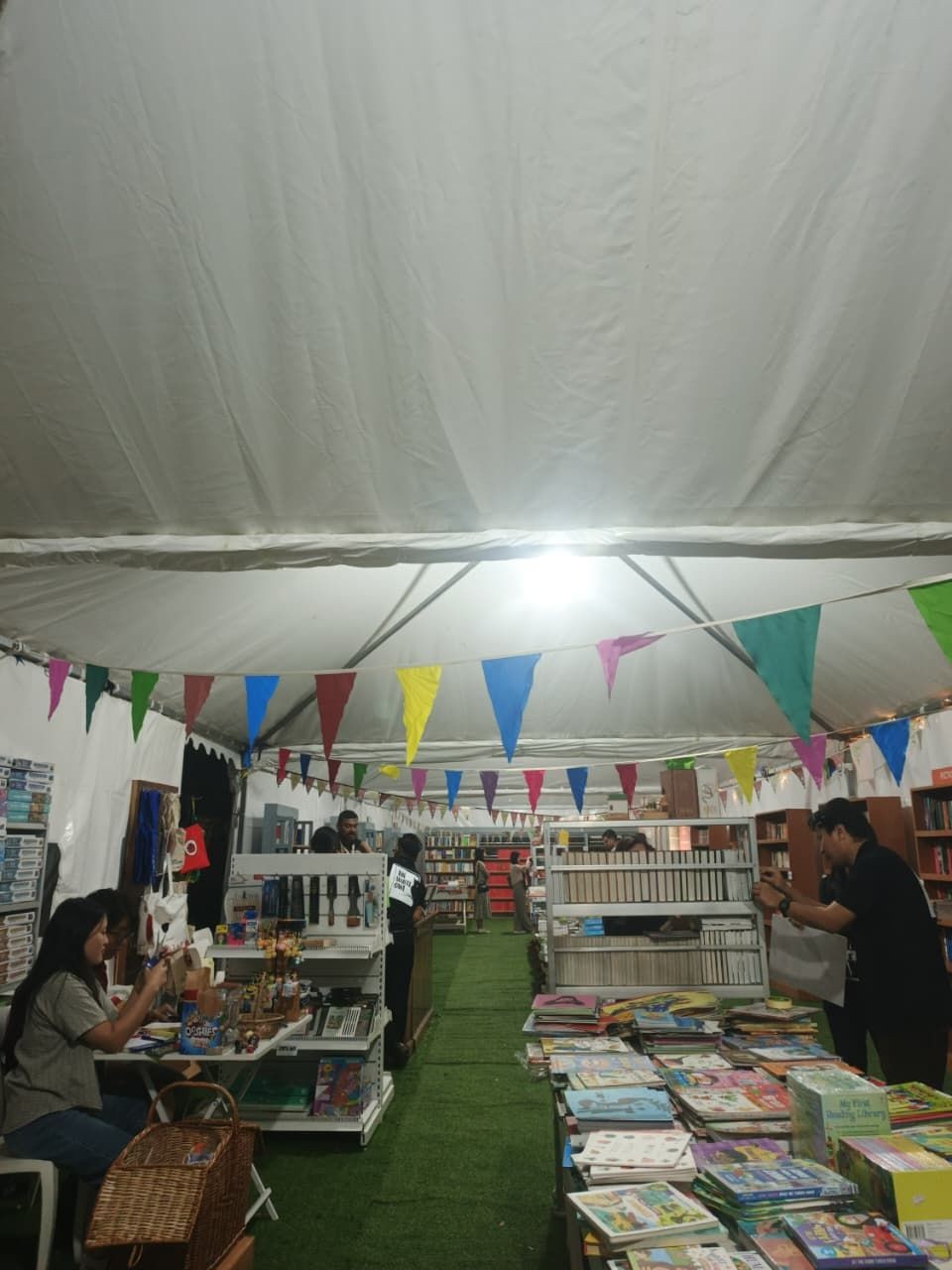
Attendees inspect a one of the book stall during the inaugural day of the The White Owl Literature Festival at Zone Naithu at the Park in Chümoukedima on February 5. (Morung Photo)
White Owl Literature Festival begins ‘Celebrating Stories, Inspiring Minds’
Morung Express News
Chümoukedima | February 5
At a time when attention spans are shrinking and images often overpower ideas, the third edition of the White Owl Literature Festival and Book Fair commenced on February 5 with a renewed call to return to stories, dialogue and critical thinking.
The three-day festival, being held at Townhall, Zone Naithu at the Park, Chümoukedima under the theme Celebrating Stories, Inspiring Minds, will conclude on February 7.
Addressing the inaugural as the chief guest, Nagaland Legislative Assembly (NLA) Speaker Sharingain Longkumer underscored the importance of stories and critical thinking in an image-driven digital age.
Quoting a school director, he said people must learn to distinguish truth from falsehood and thanked those who are nurturing a passion for writing and reading in the digital world.
Calling the festival a “beautiful dream,” Longkumer lauded the organisers for investing time and energy in building a meaningful literary platform and expressed hope that the initiative would reach the farthest corners of Nagaland and the country.
Welcoming participants from across India and Japan, he said Nagaland and India are lands of rich diversity that can be better understood through shared stories.
He urged continued engagement with literature beyond the festival and cautioned against excessive reliance on mobile phones, particularly among children.
Admitting his own limited understanding of the digital world, he encouraged young people to read books, poems and stories, describing literature as a meaningful way to learn and engage with society.
Festival Director Viketuno Rio said literary festivals provide a rare public and communal space where readers meet storytellers, content creators and opinion leaders face to face, going beyond the solitary act of reading.
The festival aims to nurture a culture of reading, create opportunities for readers to engage with both established and emerging authors, and encourage deeper thinking, self-reflection and respect for diversity, she said.
At a time when reading is steadily declining along with empathy and peace of mind, Rio invited participants to embark on a shared journey of listening, thinking and dialogue over the next two days.
The Director further noted that since its first edition, the festival has evolved by closely listening to its audience and shaping its themes and sessions around their interests and questions
The current edition features a diverse lineup of authors, writers, educators, artists and cultural voices from Nagaland, across India and abroad.
Rio said the organisers were especially honoured to welcome Toshiyuki and Hitomi Onodera, along with delegates from Connect Asia led by CEO Rafael Raimo from Japan.
With anime and manga gaining popularity across India, their presence was described as a highlight of the festival.
‘Reader, welcome home’ sets tone
Highlighting the festival’s social commitment, Rio noted that the second edition of the ‘Run for Persons with Disabilities’ was held on January 31 with 200 participants, including runners with visual, hearing, intellectual and multiple disabilities.
She also announced “Stories by the Secret Fire”, a session featuring storytellers from four districts of Nagaland sharing ancient oral traditions. Citing her favourite book Reader, Come Home, she welcomed the audience with the line, “Reader, welcome home.”
In her keynote address, Press Club of India President Sangeeta Barooah Pisharory recalled that the festival was formally instituted in February 2024 at the same venue and aimed to celebrate literature in one of India’s farthest regions by connecting local readers with a mix of national and regional authors.
She noted the festival’s distinctive design elements, including entrances featuring replicas of book covers and book spines.
Now in its third edition, the festival has successfully established a new literary space in the Northeast, Pisharory said, congratulating the organisers.
Citing British philosopher and author AC Raine, she said literary festivals serve as vital platforms for dialogue and exchange of ideas and also contribute to local economies by promoting tourism, crafts, food and businesses, drawing parallels with the Jaipur Literature Festival.