Morung Express News
Dimapur | March 21
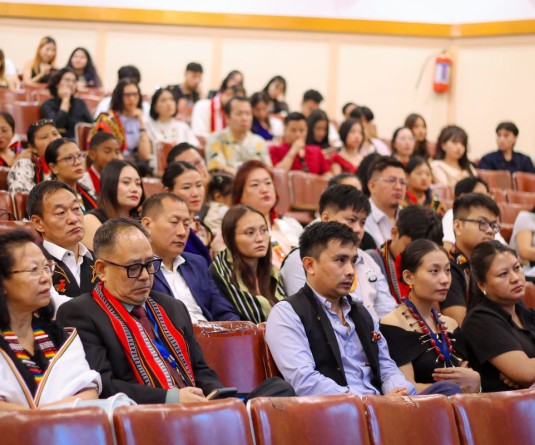
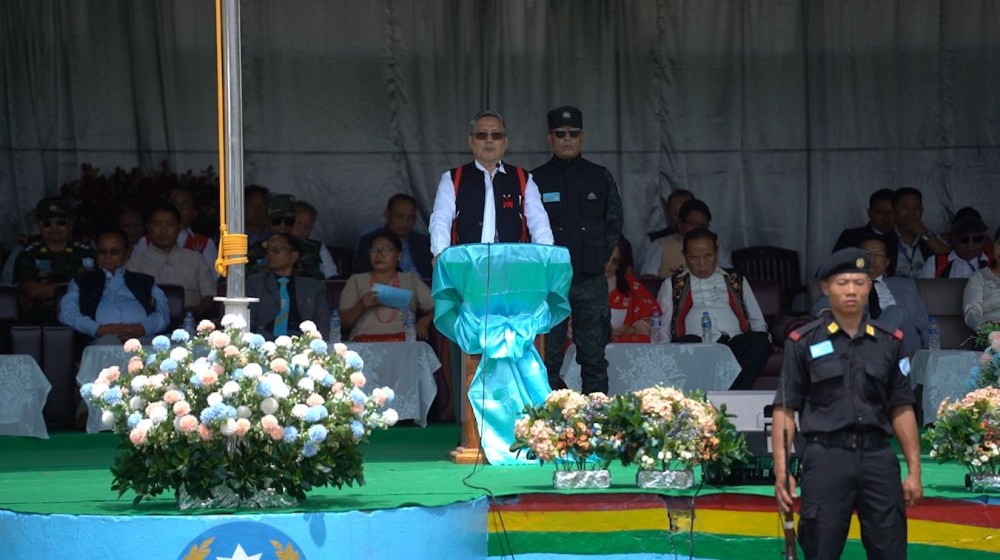
The NSCN (IM) reiterated its long-standing position regarding sovereignty within the ongoing political negotiations with the Government of India (GoI). The NSCN (IM) marked its 47th Republic Day at the Council Headquarters, Hebron, on March 21.
In the Presidential speech, Vice President Tongmeth Konyak, on behalf of President Q Tuccu, cited the 1929 memorandum to the Simon Commission to support its claim that the right to self-determination remains fundamental to the Naga political narrative. While stating that the memorandum’s message was clear, he said, “This petition has been recorded in history as a landmark memorandum and regarded as the cornerstone of the Naga political movement to safeguard the historical and sovereign rights of the Nagas.”
The 16-Point Agreement of 1960 and 1975 Shillong Accord were described “un-mandated” arrangements, and betrayal, that failed to address the real aspirations of the movement. It said that the 16-Point Agreement was an “attempt to internalize the Naga issue by making it a domestic issue” of the GoI. According to the address, these past accords rather created deep division within the Naga society instead of establishing peace.
Regarding the ongoing peace process, the NSCN (IM) accused the GoI of breaching trust concerning the 2015 Framework Agreement. While the agreement was initially recognised as a “breakthrough,” it claimed that New Delhi’s attitude began to change in subsequent years. It termed the perceived shift in attitude as a “violation of the spirit of political agreement” and a move from "legality as reflected in Framework Agreement to opportunism."
The speech also raised concerns regarding the situation in Manipur, alleging the security forces of colluding with other ethnic groups. It said that the alleged collusion should be exposed globally on grounds of what it termed as “open defiance of what has been agreed upon” in the peace process.
Solution based on FA
Neingulo Krome, Secretary General of the Naga People’s Movement for Human Rights (NPMHR), and General (retired) VS Atem asserted that any final political settlement must be based on the Framework Agreement of August 3, 2015, which recognises shared sovereignty as the basis for a peaceful solution.
Krome, who was the guest of honour, stated that the 2015 Agreement explicitly acknowledged Naga sovereignty regarding internal affairs. Krome argued that rather than waiting for New Delhi to act, the Naga people should take the lead. He said, “It is clearly mentioned that Nagaland for all its internal affairs will be sovereign… It is for us to exercise the Framework Agreement.”
Since the 1997 Ceasfire and the subsequent political dialogue, he said that in other parts of the world, “six struggling peoples have become independent” while the Naga issue drags on “going round and round.”
He defended what he said were critics questioning a perceived Naga tendency to ignore internecine violence among the Nagas. However, he claimed that the GoI distorts newspaper reports of NPMHR’s statements against factional violence, and leveraging it in international platforms to present Nagas as responsible for their own deaths, while portraying security forces as peacekeepers.
He further condemned what he described as “social media heroes,” who criticise the movement from the comfort of their homes. If the ceasefire were to fail, he said that these critics should be send to the frontline.
General (Retired) VS Atem, Deputy Ato Kilonser, reaffirmed that the Framework Agreement recognised “Shared Sovereignty,” a concept he stated New Delhi has already accepted. “The Indian government has recognized this. We must hold them to it,” Atem said. However, he expressed dissatisfaction with was termed as “delay tactic,” alleging that the former GoI representative AK Mishra did not make “a single step forward” in five years.
He made a distinction between the Naga issue and the status of Kashmir. He held that unlike Kashmir, the Nagas never signed an “Instrument of Accession,” and therefore the “Kashmir model” cannot be applied to them. He warned that the NSCN (IM) would not accept any “imposed” or “convenient” solution resembling the 16-Point Agreement or the 1975 Shillong Accord, which he regarded as “betrayals.”
Atem further directed a message to the Generation Z. “I want to speak to the "Gen Z,” the youngsters. The future is yours. But are you prepared?”
A call to Naga unity was the overarching message conveyed by the Naga civil society organisations. The Naga Hoho was represented by its President, Sulanthung Lotha; Naga Council Dimapur by its President, GK Rengma; Naga Students’ Federation by its President, Mteisuiding Heraang. The Global Naga Forum was represented by a member, Kilentola.