

Officials and participants during the training programme on Scientific Beekeeping commenced at the project site of the School of Agricultural Sciences, Nagaland University on February 9.
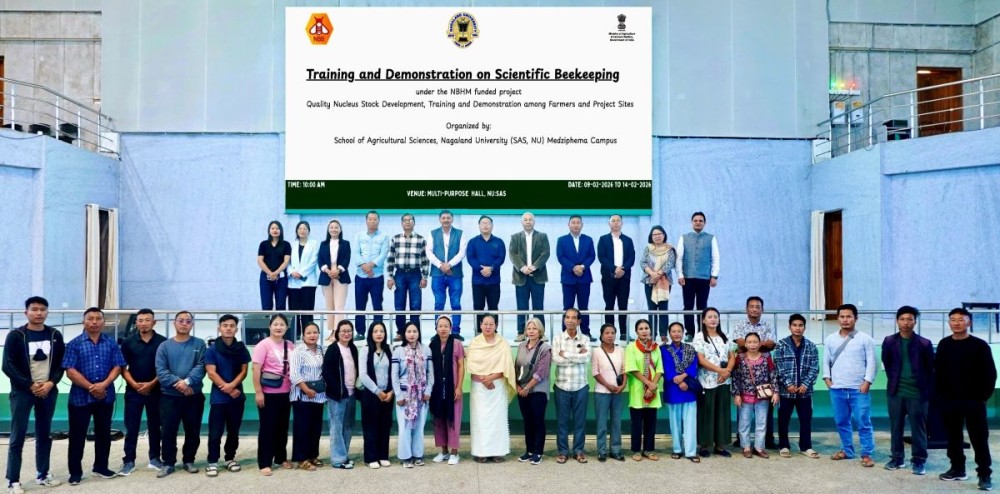
Medziphema, February 11 (MExN): A seven-day training programme on Scientific Beekeeping commenced at the project site of the School of Agricultural Sciences, Nagaland University on February 9. It will continue till February 15.
The programme is being attended by 25 participants drawn from Noklak, Sirhima and Medziphema villages, with the objective of strengthening skills, enhancing ecological awareness and promoting sustainable livelihood opportunities through scientific apiculture.
The inaugural programme was graced by Obed Quinker, Chairman, Nagaland Beekeeping and Honey Mission (NBHM) as the special guest.
Addressing the participants, Quinker emphasised that the importance of bees goes far beyond honey production, highlighting their critical role in ecology and biodiversity conservation. He underlined NBHM’s increasing focus on promoting native bee species, particularly Apis cerana and stressed the urgent need for scientific data generation in Nagaland, noting that the state presently lacks adequate empirical data on beekeeping and pollinators.
He further stated that as a development agency, NBHM is keen to collaborate closely with SAS, Nagaland University, particularly in research, documentation and field-based interventions.
The Pro Vice-Chancellor of Nagaland University, Medziphema Campus, Prof Dipak Sinha highlighted that SAS, Nagaland University, as the only agricultural institution in the state, is contributing significantly to the overall development of agriculture not only through teaching but also through research and development, supported by its various AICRP centres, institutional projects and individual research initiatives.
Prof Dipak emphasised the need to formalize such initiatives into certificate-based skill development courses to enhance employability and entrepreneurship among rural youth.
Prof Pauline Alila, Dean, School of Agricultural Sciences, Nagaland University, lauded the participating farmers for their keen interest, enthusiasm and willingness to learn, stating that farmers remain the driving force of the rural economy. She noted that such training programmes derive their real strength from active farmer participation, as their openness to new knowledge and practices determines the success of agricultural innovations.
She further highlighted the role of bees in pollination, agricultural productivity and ecosystem sustainability, emphasizing that strengthening farmers’ understanding of apiculture directly contributes to resilient and sustainable farming systems.
The training programme is being implemented under the leadership of Dr Mary N Odyuo, Associate Professor and Principal Investigator (PI) and Dr Avinash Chauhan, Co-Principal Investigator (Co-PI). The programme combines classroom sessions with hands-on practical exposure to scientific beekeeping practices, with special emphasis on native bee species, colony management and ecological perspectives.
It was also informed that a similar seven-day scientific beekeeping training programme was successfully completed earlier at Hekeshe Village from February 2 to 8, reflecting the project’s continued outreach across different locations in the state. The ongoing training at SAS, Nagaland University is expected to strengthen local capacities, promote data-driven apiculture practices and support sustainable livelihoods while reinforcing the ecological importance of bees in agriculture.
.jpg)

.jpg)
