PCI President Sangeeta Barooah Pisharoty speaking in Kohima on January 20.
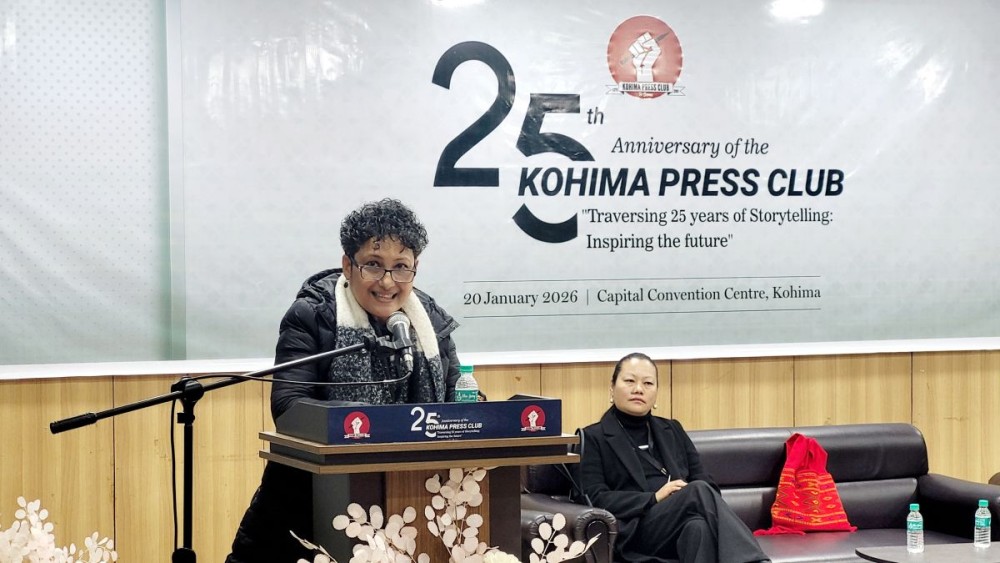
Raises issues of legal curbs, financial stress and newsroom pressures at KPC silver jubilee
Morung Express News
Kohima | January 20
Senior journalist and President of the Press Club of India (PCI), Sangeeta Barooah Pisharoty, on Monday highlighted a range of concerns over the growing challenges confronting journalism in India, while urging both journalists and the public to actively support independent media.
Gracing the Kohima Press Club (KPC)’s silver jubilee celebration as the guest of honour and reflecting on her three decades in journalism, she said she could strongly relate to discussions on how storytelling and news dissemination have evolved over the years, particularly with technology now dominating newsrooms.
She expressed happiness at seeing a large gathering of journalists under one roof and congratulated the KPC on reaching the milestone.
Noting the presence of several prominent journalists from across the North-East, many of whom she described as friends, Pisharoty observed that this reflected the KPC’s effort to mark its 25 years in a “pivoting” manner by widening the circle of deliberations and engagement beyond Nagaland.
While acknowledging that 25 years may seem short, she noted that it also represents a significant journey in a profession that has never been easy.
“It’s not news for us. It’s never been easy. The journey has been fraught with many challenges, even though we are a democracy,” she stated.
Meanwhile, expressing concern over what she described as a steady downward spiral in journalism in India over the past few decades, she attributed this largely to the “faulty financial model of practising journalism in India.”
‘Public interest is our only interest’
While journalists are meant to keep democracy vibrant by holding the government of the day accountable, Pisharoty remarked with concern, “We have failed to do the most basic thing that would have kept the spine of media houses intact and thereby journalism.”
She further observed that the line between journalism and public relations has increasingly blurred in recent years, with media houses often serving business or political interests rather than citizens.
This, she said, stems from the growing ownership of media by politicians and their families, calling it a “serious conflict of interest.”
In this context, the PCI President underscored that the press remains the fourth pillar of democracy and that journalists derive their authority solely from the public, with a clear duty to hold governments accountable in the public interest.
“Our energies lie only and only with the public. Public interest is our only interest. And to do our work effectively, we have to ask questions to the powers that be, to the government of the day. That’s our job. We have nothing personal there,” she reminded journalists.
Concerns over DPDP Act and dilution of RTI
Raising alarm over recent legal developments, Pisharoty flagged the Digital Personal Data Protection (DPDP) Act, cautioning that the removal of journalistic exemptions poses a serious threat to investigative reporting. Citing examples, she warned that in the absence of such safeguards, journalists could be compelled to seek consent from those accused of wrongdoing before publishing investigative reports.
The PCI chief also pointed to the dilution of the Right to Information (RTI) Act, a key tool for accessing authentic information, noting that restrictions imposed in the name of privacy present a major challenge by further eroding transparency and accountability.
Another major concern, she said, is technology, including artificial intelligence, particularly its impact on newsroom jobs. She also highlighted the growing number of cases being filed against journalists, observing that reporters are often left unsupported by their employers.
Despite what she described as a grim scenario, Pisharoty appealed for stronger support for independent media, not only by reading and sharing their stories, but also by financing and subscribing to them.
Right to work without pressure
Meanwhile, asserting her role as PCI President, Pisharoty said safeguarding journalists’ right to work without pressure would be her top priority.
She also outlined key initiatives planned by the PCI, including setting up a legal cell to assist journalists facing cases, conducting free workshops on technology and digital security, and forming a federation of elected press clubs across the country.
In this regard, she invited press clubs in Nagaland to join the proposed federation.
Reflecting on becoming the first woman president of the PCI in its 68-year history, Pisharoty acknowledged the milestone but noted that the North-East has long been ahead in breaking gender barriers, citing women who have led press clubs and served as editors and editor-owners.
In this context, she lauded male colleagues in the region for supporting women journalists who, she said, helped break glass ceilings much earlier than the country’s largest press club.
She further urged the fraternity to continue setting an example of hope, resilience and integrity in journalism.