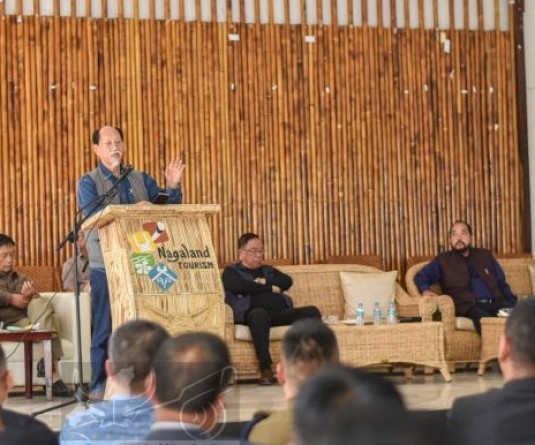
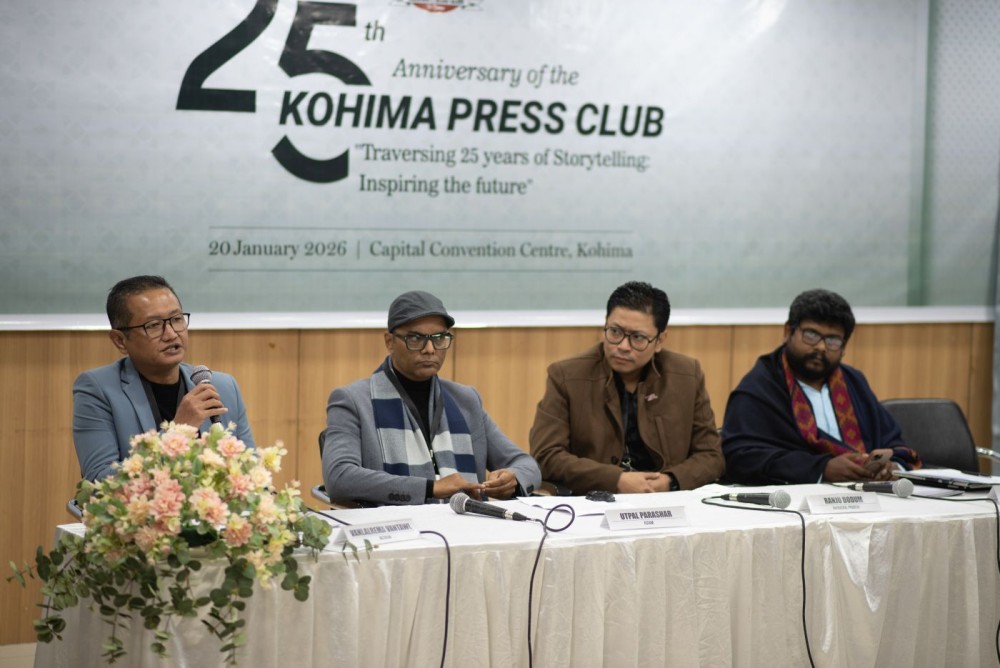
The speakers at the Northeast Media Conclave which was held as part of the 25th Anniversary of the Kohima Press Club at Capital Convention Centre, Kohima on January 20.
Morung Express news
Kohima | January 22
Peace journalism in the Northeast remains a debatable subject, with discussions often centering on stereotypes and how narratives are projected by both regional and national media.
Opening the discussion for a session on ‘Journalism as peace work: Navigating divides, building bridges and a stronger media ecosystem for the Northeast,’ media professional Dhiren A Sandokpam from Manipur highlighted the complex nature of conflicts in the region.
Speaking at the Northeast Media Conclave on ‘Reimagining Truth: Northeast Journalism for a changing world,’ Sandokpam noted that issues in the Northeast are not merely internal conflicts. He said they have acquired vertical and horizontal dimensions, involving cross-border dynamics, inter-state disputes, and ethnic complexities, among other factors.
This media conclave was part of the 25th Anniversary of the Kohima Press Club held at Capital Convention Centre, Kohima on January 20.
The need to understand the nuances and contours of violence in Northeast and where the Journalism play a role in the process of peacekeeping was the point of discussion.
Vanlalrema Vantawi, from Mizoram asserted that journalism as peace work presently plays a pivotal and relevant role for a state like Mizoram where journalism has not had the opportunity to play its role in peace work for many decades. Vantawi cited the instance of reporting the truth by exploring and studying the truth, rather than letting perception thrive in areas where it should not be. He further noted how local reporters can play credible role in dismissing misreporting and misinformation. The speaker also called for unity among reporters in the Northeast.
Utpal Parashar from Assam dwelt on how the region itself is diverse and complex in nature, with issues ranging from border disputes, internal issues, identity issues and minor issues that escalate. He maintained that journalists’ work is not to work for peace but to report what's happening by maintaining due diligence and noted that peace work is largely a concept.
As far as peace work is concerned, he suggested going to the ground, reading history and getting views of neutral experts to put issues in perspectives. Parashar suggested not to report with preconceived notions, or fall for fake narratives or AI narratives, and added that it is now very important for journalists to be equipped with fact-finding tools.
Meanwhile Ranju Dodum from Arunachal Pradesh remarked on the extent of issues and how it is reported or told evolve. On the question of 'factual reporting,' he contested that truth differs in perspective depending on who the reporter is. Leaving aside mathematical facts, Dodum noted that social facts at the same time differ in context. He posed whether reporting the fact or conceptualizing the story contributes or attempts in peace work or carry its ramifications.
Debraj Deb from Tripura underscored how reporting should be factual and professional, balancing the story, stressing that the 5W1Hs model is not enough. He stressed on the need to remove regional and cultural bridges; and report as 'reporters.' Regarding the North East, Deb opined that politics of representation is something that cannot be changed by peacekeeping. With the traditional media being overtaken by digital media, Deb noted that the future of Journalism will be decided by judgement.
He pointed to the need for more trained journalists on the ground while comparing how most media houses are short of people. He added that ‘remote controlled journalism’ from one particular centre does a lot of harm. In the era of technology and digital platforms, he called upon journalists to ponder whether they are writing for their readers or for the algorithm.
Meanwhile, the moderator, Sandokpam, suggested that journalists need to provide basic accurate and nuanced information, both moral and ethically consciously applied by themselves, so as to enable a space for dissent and dialogue in the phase of horizontal and vertical conflicts, layered with violence over the years.
He asked whether journalists help share stories that can deescalate situations that go out of control and navigate pressures by operating independently as impartial observers or share cross borders, interstate, inter ethnic at the level of content generation and ownership.