Data based on proceedings before the Supreme Court on January 6, 2026. Status as of 13.05.2025.
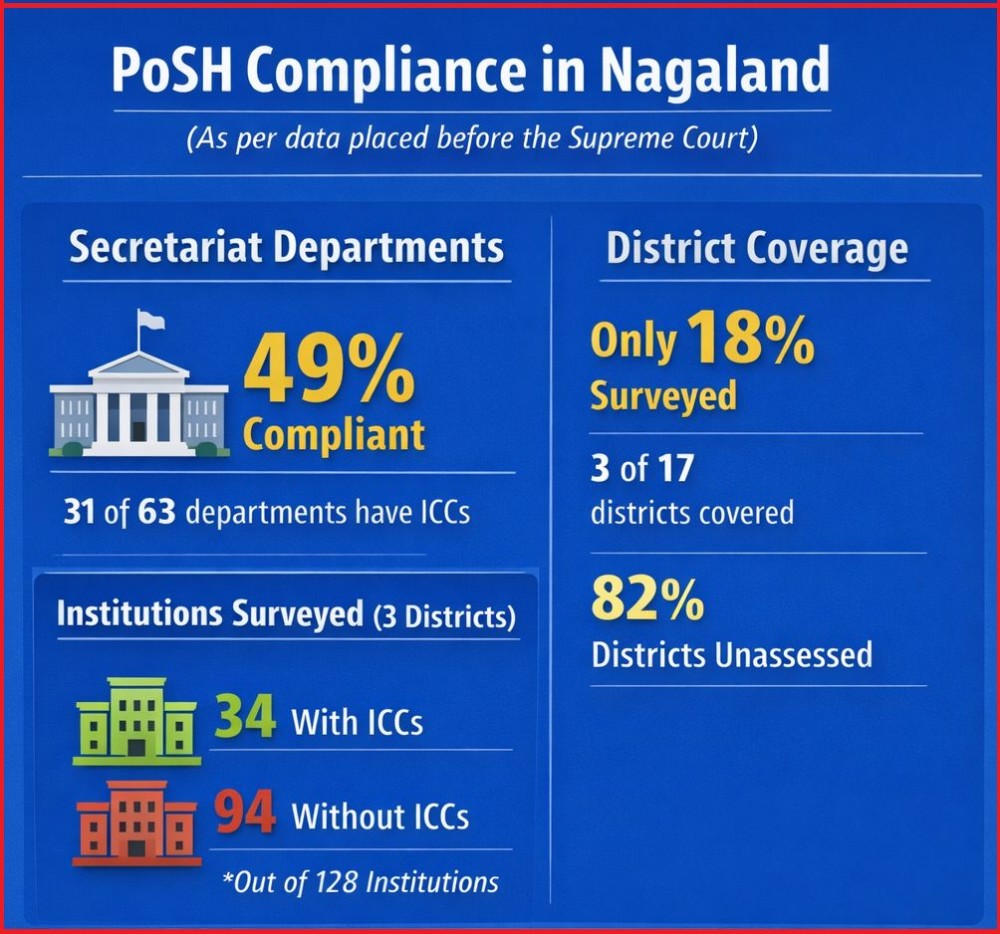
• Just 49% of Nagaland Secretariat departments have constituted ICCs
• Over 82% of districts remain unassessed for PoSH compliance
Morung Express News
Dimapur | January 11
Data placed before the Supreme Court has indicated limited compliance by Nagaland in implementing the provisions of the Sexual Harassment of Women at Workplace (Prevention, Prohibition and Redressal) Act, 2013, particularly with regard to the constitution of Internal Complaints Committees (ICCs) and the conduct of district-level surveys.
As per the status report placed before the Supreme Court by the Amicus Curiae on January 6, over 50% of government departments in the Nagaland State Secretariat are yet to comply with the Act. Only 31 out of 63 departments (49%) have constituted and notified ICCs, it highlighted.
Further, district-level coverage remains extremely limited, with over 82% of districts in Nagaland yet to be assessed for PoSH compliance. Surveys have been conducted in only three out of the State’s 17 districts. The survey of private establishments in the State also remains incomplete.
Moreover, in the districts assessed, ICCs were found to be constituted in only 34 out of 128 institutions, while 94 institutions were functioning without ICCs.
It remains unclear whether coverage has improved since the status report, which appears to reflect the position as of May 13, 2025, according to an order issued by Justices B V Nagarathna and Ujjal Bhuyan after hearing matters relating to the nationwide implementation of the PoSH Act on January 6. The same Bench had, in August 2025, directed district-wise surveys on the constitution of ICCs.
Court seeks uniform compliance across States
At the national level, the Court reviewed a comprehensive status report detailing compliance by States and Union Territories (UTs) on key parameters, including the appointment of District Officers, constitution of Local Complaints Committees, designation of Nodal Officers, and formation of ICCs in government and private establishments.
The Court recorded that while District Officers and Local Complaints Committees have been appointed by all States and UTs, including Nagaland, several States and UTs have yet to appoint Nodal Officers at all required levels, as mandated under Section 6(2) of the PoSH Act. It directed all States and UTs to ensure the immediate appointment of Nodal Officers in every block, taluka, tehsil, ward and municipality, wherever this had not been done.
The Bench also expressed concern over the lack of clarity regarding the constitution of ICCs in government instrumentalities, public sector undertakings and government companies at both the State and Central levels. The Union of India was directed to file a detailed status report indicating compliance in Central Government bodies and to share survey data collected by States with the Centre.
Emphasising transparency and accessibility, the Court further directed the Ministry of Women and Child Development to widely publicise details of the She-Box online complaint mechanism through print and electronic media within three weeks.
States and UTs were also asked to submit complete and verifiable survey data, cautioning that mere assertions of having conducted surveys without supporting material would not suffice.
The apex court adjourned the matter by four weeks to enable compliance with its directions and responses to the Amicus’ status report, and listed the case for further hearing on February 10.
As per reports, on the same day, a bench headed by Chief Justice of India (CJI) Surya Kant called for a status report from all high courts on whether Gender Sensitisation and Internal Complaints Committee (GSICC) have been constituted by all high courts, district or sub-divisional courts, tribunals, bar associations and other allied courts.