

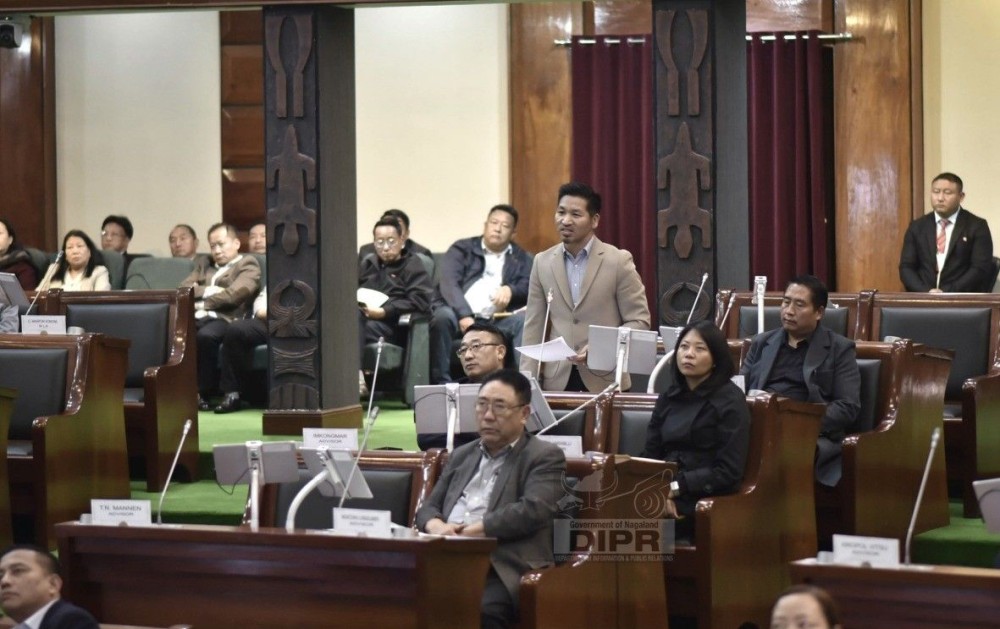
Advisor for Social Welfare, Wangpang Konyak speaking during the Eighth Session of the 14th Nagaland Legislative Assembly at NLA Hall, Kohima on March 10 (DIPR Photo)
Our Correspondent
Kohima | March 10
Nagaland Social Welfare Advisor, Wangpang Konyak said that MSMEs serve as the primary drivers of employment, income generation and economic stability, adding that it can contribute decisively to building a resilient and inclusive economic foundation for Nagaland.
He was speaking at the ongoing 8th Session of the 14th Nagaland Legislative Assembly (NLA) in Kohima on March 10.
Stating that Nagaland does not have any presence of heavy industries, manufacturing hubs and the state economy is largely driven by small traders, Agro-based enterprises, handloom and handicrafts, bamboo and forest based products, food processing units, Transport and services businesses etc, he said “our economy fundamentally depends on the strength, sustainability and growth of MSMEs.”
With absence of private corporate and large industries, the only source lies with the MSMEs for employment opportunities, he said adding that MSMEs promotes self-employment, entrepreneurship, skill based income and innovation among the youth. “In fact MSMEs encourage young people to create job, reduce unemployment and migration to other states,” he said.
“MSMEs enable food processing of fruits and spices, packaging of organic products, bamboo furniture manufacturing, meat processing units, spice grinding and branding. When vale addition happens, farmers earn more, rural income increase and villages become economically vibrant. MSMEs therefore act as a bridge between agriculture and industry,” he said.
Stating that the rich cultural heritage, shawls, traditional designs, bamboo crafts, wood carvings and indigenous products are not just cultural symbols but economic assets too, he said “The MSMEs transform traditional skills into commercial opportunities.”
“When we promote handloom and handicrafts through organised enterprises, we preserve our heritage, create income for artisans and promote Nagaland globally,” Konyak said.
He maintained that the growth of MSMEs can be supported through supportive policies, financial support, infrastructure development and skill training. “For true sustainable economic growth to come, we have to empower MSMEs,” he said adding “When effectively supported and scaled through MSMEs, I believe they can transform subsistence-based rural economies into vibrant, self-reliant models of growth.”
.jpg)
.jpg)
.jpg)
