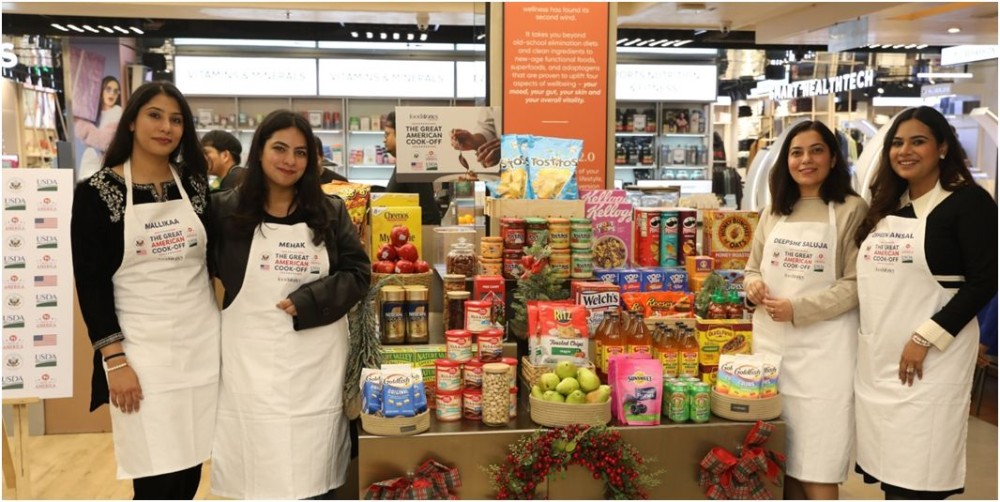
At the retail cook-off at Food Stories, four participants created original dishes using U.S. ingredients, showcasing how American agricultural products fit naturally into Indian kitchens. (Photograph by Imtiaz Imam)
From ingredients training to retail shelves, American agricultural products are finding new roles across Indian kitchens and markets
Charvi Arora
SPAN Magazine, U.S. Embassy New Delhi
Food choices shape more than what ends up on the plate. In India, they increasingly reflect how chefs and consumers think about reliability, sourcing, and performance in the kitchen. Questions of where ingredients come from, how they behave when cooked, and whether they deliver reliable results are shaping everyday decisions.
That shift is visible in Indian kitchens, where familiar techniques are now paired with new accents. American ingredients, long present in Indian markets, are being seen in a new light. Cranberries simmer in orange juice. Pecans fold easily into paneer. Duck crisps slowly in its own fat. Together, these combinations point to a broader story, one in which culinary choices also shape markets and trade relationships.
Through two culinary initiatives, the Taste of America ingredients training at the American Community Support Association (ACSA) and a U.S. food cook-off at Food Stories, a retail outlet in New Delhi, the U.S. Embassy showcased how American agricultural products fit naturally into Indian kitchens. Led by the U.S. Department of Agriculture (USDA), these initiatives aimed to do more than inspire recipes. They focused on expanding markets, building professional confidence, and supporting long-term economic growth for U.S. farmers and exporters.
Training the table
The Taste of America ingredients training brought together ACSA members, hospitality students, and food and beverage professionals for hands-on cooking paired with guidance on sourcing, storage, and preparation. Chef Neha Deepak Shah, who led the training, says the session was designed to go beyond recipes, using U.S. agricultural products already available across Delhi-NCR.
“The session focused on building a deeper understanding of these ingredients, their unique characteristics, and how to incorporate them thoughtfully into both everyday and professional kitchen applications,” she says.
The menu blended familiar Indian formats with American inputs. For example, paneer tikka was reimagined with U.S. cranberries and pecans. Samosas featured Oregon hazelnuts. Duck and turkey were presented using techniques familiar to Indian kitchens.
“What truly stood out was the remarkable consistency and reliability in quality across every ingredient,” Shah adds. “They give chefs and home cooks the confidence to experiment and innovate while delivering consistent, high-quality results.”
Sayan Dowari, a hospitality student, called the session “an eye opener.” “I got to know about different American flavors, nuts, and berries,” he says. “I can use those berries as an infusion as well.”
Another participant, Mansanjam Singh Bhatia, a bartender and student at the CII Institute of Hospitality, emphasized reliability. “For me, what matters is consistency,” he explains. “U.S. ingredients mean we get the same size, same shape, and same taste throughout the year. Quality and consistency make our job much easier.”
Cooking for consumers
At the retail cook-off at Food Stories, four participants created original dishes using U.S. ingredients in front of an audience of chefs, buyers, and consumers. The format allowed them to test how these ingredients perform in Indian-inspired cooking.
Osheen Bansal drew on Kashmiri flavors for her Noor-e-Kashmir zaffrani pulao, using U.S. cranberries as a central element. “Before today, I was somewhat familiar with cranberries but had mostly seen them used in desserts and beverages,” she says.
Mallika Banati’s winning creation, cranberry-glazed turkey with pecan pilaf and pistachio butter, placed American pecans at the center of the dish. What stood out to her was the flexibility of American pecans. “How versatile they can be, lending themselves to both sweet and savory preparations, from curries to pies,” she notes, adding that U.S. cranberries were “the key ingredient providing that oomph.”
For Mehak Asif, the cook-off marked her first experience cooking turkey. Her dish, a stuffed turkey roulade with a pecan-walnut sauce and cranberry accents, paired U.S. poultry with nuts and fruit.
Deepshe Saluja took a plant-forward approach with chickpea kebabs, using U.S. chickpeas alongside pistachios, walnuts, blueberries, and cranberries. “What surprised me most was how versatile the berries were,” she says. When paired with Indian spices, she explains, they “shifted from a typically sweet ingredient to something sharp, savory, and deeply flavorful.” Saluja adds that the berry gel “works beautifully as a modern alternative to tamarind chutney.”
Chef Ajay Chopra, who moderated the cook-off, explains why U.S. products work well in India. “The exciting part of working with U.S. ingredients is the versatility, the counter-seasonality, and the high quality,” he says.
“If I’m cutting a classic Red Delicious apple, it’s juicy, it’s crunchy, and it delivers on its promise. If it’s an American pistachio, the grading is so perfect that every pistachio is a similar size.”
Why scale matters
Behind the scenes, scale and safety drive sourcing decisions. Sumit Saran, a longtime promoter of American foods in India, explains why chefs trust U.S. products.
“There are three big pillars: quality, food safety, and consistency of supply,” he says. “U.S. products are USDA certified. What is available to a customer in the United States is exactly what reaches a customer in India.”
This matters in a large market. “We can start small,” he adds. “But once demand increases, the United States has the capacity and consistency to meet that demand.”
Those numbers are already visible. “Cranberry imports were around 60 to 70 tons five years ago,” Saran says. “In 2025, we touched 5,000 tons.” He adds, “Washington apples are the gold standard. Imports today are close to 500,000 tons.”
Retail proof
Indian brands are responding to this demand for high-quality produce. Dinika Bhatia, founder of the snacking brand Nutty Gritties, shares how U.S. ingredients drive growth. “About 35 to 40 tons per month of what we consume is U.S. ingredients,” she says. “The growth of U.S. ingredients is 40 percent.”
She ties this directly to standards, pointing to “the quality, the consistency, the crunch, and the flavor.” Her experience studying and visiting processing plants in the United States reinforced that trust. “The standardization, the mechanization, the quality control, and the hygiene are the best I’ve seen,” Bhatia explains.
This confidence is translating into demand. Pecans, once unfamiliar, are now among her fastest-growing products. “Last month, we saw growth of 100 percent in pecans,” she says.
As more chefs, retailers, and consumers work with these ingredients, familiarity is turning into confidence. What begins as experimentation in kitchens is translating into steady demand, reliable supply chains, and long-term commercial relationships. In that sense, the story of American ingredients in India is not only about flavor or technique, but about how everyday food choices quietly support trade, growth, and shared economic interests.