A. Botoking
Kohima | May 26
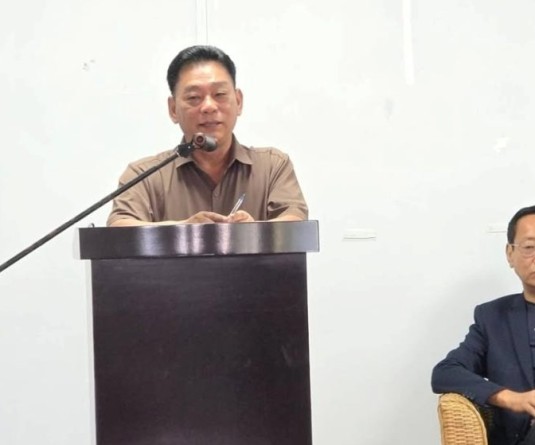
The State Level Bankers’ Committee Meeting was held today at Hotel Japfu under the aegis of the State Bank of India. A host of dignitaries took part in the meeting which included Chief Minister Neiphiu Rio, the Chief Secretary Lalhuma, the Joint Secretary to the Government of India (Banking) Ram Muivah and the Finance Commissioner H.K. Khulu. The representatives of 14 banks also took part in the meeting.
Emphasizing on the traditional banking system of the Nagas and the potential of VDBs, the Nagaland government today urged the banks to re-orient its method of financing and shift focus from urban to rural investment. The meeting also discussed ways to work out the possible role of banks in generating 25,000 employment opportunities for the youths of the State, in line with the Prime Minister’s Package.
Rio told the bankers that keeping in mind the style of banking system adopted by the Nagas since time immemorial, and with the changing time, the concepts of banking needs to be re-oriented to suit the people. “The concept of modern banking is fairly new to the Nagas, however, the basic concept of banking has been practiced from time immemorial”, Rio said. Adding that banking practice suitable for metros may not be suitable for a State like Nagaland.
“As such, I appeal to the bankers to device some unique or even unconventional approach to popularize banking culture in rural areas of Nagaland”, Rio stated. The Chief Minister also called upon the RBI, which is the regulatory authority, to direct the bank to open new branches in un-banked blocks, while assuring that the State government can be taken into confidence whenever any new banks are to be opened. Unless this is done, the State will not be able to bring equitable development to the people, Rio added.
Considering the peculiar problems of the State, Rio also suggested adopting various innovative methods to facilitate credit flow. As a part of this innovation, the State government has brought in the idea of appointing the VDBs to act as financial intermediaries. The State will allocate a budgetary support of Rs 5 crores for this venture in the current financial year 2006-07, Rio informed. The Chief Minister also told the Bankers of the social responsibilities that the banks owe to the people, and said that profit motive should not be the main guiding force, but the desire to help the people and develop the area should also be the key factor.
R. Muivah pointed out that the Government of India is strongly focusing on the Self Help Groups (SHG) which has proven successful in the South Indian states such as Tamil Nadu and Karnataka. So far, there are only 1000 SHGs in Nagaland and the aim is to set up additional 2000 SHGs by the end of the year 2007. He said that the loan recovery for the SHGs in Nagaland is an excellent 99%. NABARD, the Government Agencies, the banks and the NGOs will all have to play vital roles in the success of SHGs in Nagaland, Muivah said. He also informed that NABARD has already started the process of sensitizing the bank officials on SHGs and is currently training various SHGs intensively and extensively. He also advocated the opening up of satellite branches in the remote areas to cater to the needs of the people.
In his address, Chief Secretary Lalhuma stressed on the need for an approach that leads to the balanced development of the State. He said that 2006 – 07 has been announced as the “Year of the Farmer” by the government and queried what the banks are proposing to do to boost the economy in Nagaland as 80% of Nagaland remains predominantly rural. He stated that 21 blocks and 421 villages are yet to be covered in Nagaland by the banks and the present economic scenario is far from good. Thus, he stressed on the need for the banks to focus on rural investments rather than concentrate only on the safe urban investments. He assured that the government is ready to extend full co-operation to the banks in the recovery of loans.
Lalhuma said that banks will have to go beyond the stage of passing mere resolutions but also translate them into action in the rural areas of Nagaland. This, he believed, can be achieved by introducing different norms and modalities to suit the institutions in Nagaland.
A number of other issues were discussed in the meeting. The bankers on their part stressed on the law and order problem in rural areas which has been a major impediment in the setting up of their branches in these remote corners. The banks unanimously stated that the recovery of loans is just as important as the sanction/disbursement of loans. Due to the low recovery of loans, the output and input of credit facilities in Nagaland has been adversely affected. They agreed that the Village Development Boards (VDB) would be the right agency to facilitate the recovery of loans in the rural areas and also stressed on the need to set up the Dobashi Courts.