Tianaro Aier
Dimapur | August 8
For centuries, the indigenous communities around the globe have mostly carried their history, ecology and worldview through spoken word, song, ritual and performance. Memory itself was the “living archive.” But as modernization and globalization reshape traditional ways of life at an unprecedented pace, reliance on oral transmission alone has left these rich cultural legacies increasingly fragile. Now, educators and community leaders in various places, including Nagaland are turning to digital documentation as a safeguard against cultural removal, creating open-access archives designed to ensure ancestral wisdom endures for generations yet unborn.
“When an indigenous language or oral tradition disappears, we do not just lose words; we lose unique ecological wisdom, medicinal knowledge, traditional governance models, and artistic expressions,” said Dr Hewasa L Khing, principal of Tetso College in Chümoukedima. “For the community, this leads to a profound loss of identity and rootlessness.”
Dr Hewasa spoke to this writer about the urgency of preservation efforts in a region home to scores of distinct tribes and languages, many of which are endangered. She emphasised that “if we do not actively document these traditions—through audio, video, and written archives—we face risks of losing this important cultural knowledge,” adding the disappearance of indigenous languages and oral traditions would also mean the loss of ecological wisdom, medicinal practices, traditional governance systems and artistic expressions developed over generations.
Archives as ‘dynamic living resources’
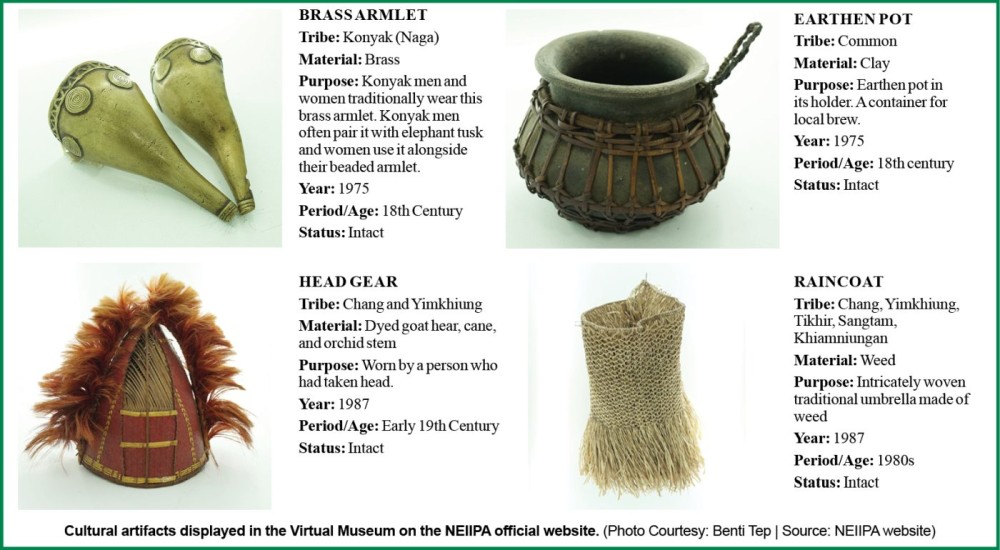
In 2023, Tetso College launched the North East India Indigenous Peoples Archive (NEIIPA), an open digital repository that stores linguistic and cultural materials of Northeast India and “to collaborate with indigenous communities in preserving and sharing their cultural heritage.”
The initiative was founded by Dr Hewasa and Kuvlo Lorin, director of Tetso College. Recently, the institution has also opened the Research & Indigenous Knowledge Center (RIKC), a formal academic platform for scholars and students.
While NEIIPA functions as an open platform where communities across the Northeast can contribute photographs, oral histories, videos and other cultural materials, RIKC provides an academic space for scholars and students to undertake research on indigenous heritage.
They serve as a bridge between urgent, grass-roots preservation and long-term academic research. “Together, they create a sustainable ecosystem where community effort meets academic excellence, laying the foundation for future generations of researchers to explore and celebrate North East indigenous identity,” she said.
“Archives are dynamic living resources,” she said. “Every time a story or practice is revisited and shared, it is simultaneously remembered and reinvented for the current era. Archives ensure that while our culture evolves with time, its foundational truth remains intact.”
She said indigenous knowledge archives are critical for cultural survival because they anchor young people in their identity. “You cannot erase someone's roots when those roots are documented and accessible,” she said.
From an educational standpoint, Dr Hewasa added, these archives democratize knowledge by moving indigenous history out of the margins and into classrooms. “They allow communities to tell their own stories from their own perspectives rather than being interpreted by outsiders,” she said. “They accelerate knowledge sharing, foster research, and instill pride in native heritage.”
Youth as custodians of heritage
At Tetso College, indigenous knowledge and community engagement are core to the institution’s “identity,” a commitment reflected in its Vision 2030 document launched during the International Leading Together Dialogues in 2023.
Dr Hewasa said student involvement in NEIIPA and RIKC has proven instrumental in bridging generational divides. She acknowledged the immense socio-economic pressures facing today’s youth, which often draw focus away from traditional roots. Yet, she noted, young people are also the community’s greatest asset.
“They are tech-savvy, creative, and capable of reimagining how culture is preserved and transmitted,” she said.
Projects like NEIIPA invite young people across the Northeast to become active custodians of their heritage by contributing, digitizing and sharing content. “When students engage with elders to capture oral histories,” Dr Hewasa said “the generational gap narrows almost instantly.”
She drew a parallel to ongoing high-profile global movements, including the repatriation dialogue between the Pitt Rivers Museum in the United Kingdom and Nagaland, led by the group Recover, Restore and Decolonise (RRaD). That effort, she said, has sparked crucial conversations about heritage and ownership among the region’s youth.
“Ultimately, you cannot build a meaningful future without knowing where you come from,” she said. “By involving students in NEIIPA and RIKC, we transform cultural preservation from an abstract duty into an empowering journey of self-discovery.”
The archives, she added, lay the foundation for future generations of researchers to explore and celebrate Northeast India’s indigenous identity, not as a relic of the past, but as a living, evolving inheritance.
Culture preservation a shared duty
Wasa Lorin, a college student and one of the first batch of interns at the NEIIPA, has underscored the urgent need to document oral traditions before they fade away.
“Much of our indigenous knowledge is passed down orally and is at the risk of being endangered as older generations pass away and younger generations adopt modern lifestyles,” Lorin said.
She emphasised that proper documentation serves a dual purpose — preserving cultural identity while ensuring traditional knowledge remains accessible to future generations.
According to her, initiatives such as NEIIPA offer students and young people a unique platform to engage with indigenous cultures while simultaneously building practical skills in documentation and digital archiving. “It also helps young people become aware of their roots,” she added.
Reflecting on her personal journey with the archive, Lorin said the experience gave her a deeper appreciation of her own cultural heritage.
“I came to understand that preserving indigenous knowledge is a shared responsibility and not just the role of elders and researchers,” she stated.
She expressed hope that the archive would inspire generations to come to take pride in their culture and work to preserve it for years ahead.
The writer is currently a B.A fifth-semester student in the Department of Mass Communication at Tetso College, Chümoukedima. This report is part of her one-month internship at The Morung Express.