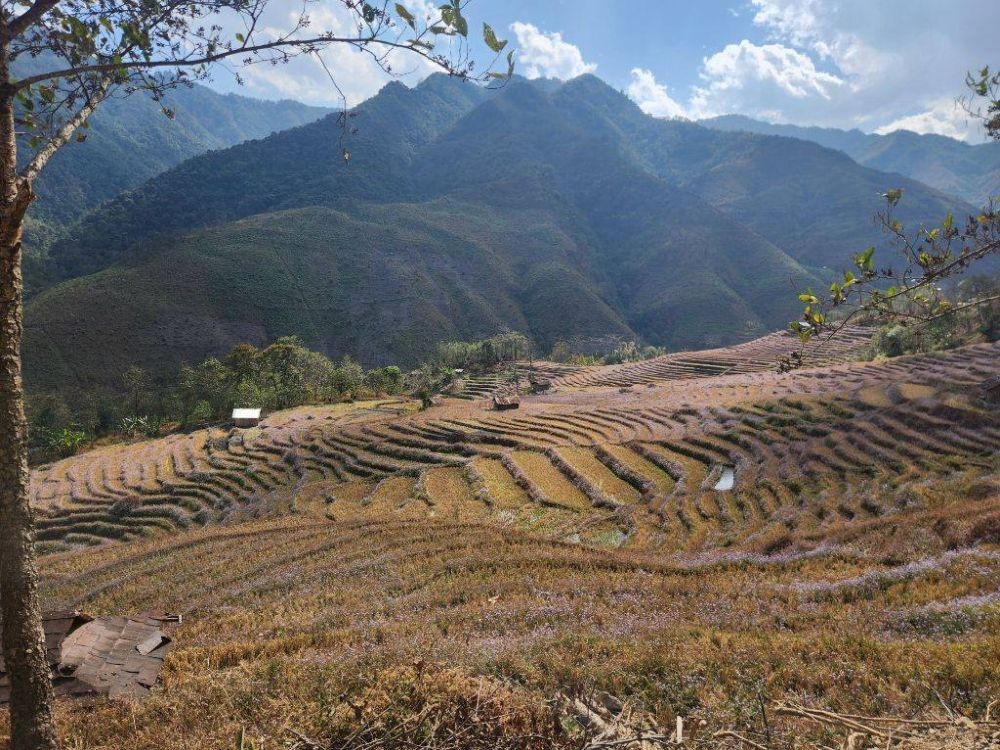
Terrace paddy fields in the mountain slopes of Shamator District.
Kohima, January 17 (MExN): The Highland Institute, Kohima will launch a significant report titled “Traditional Ecological Knowledge and Climate Resilience in Eastern Nagaland” on January 19 in Kohima. The report presents the findings of the Earthkeepers Project, a three-year collaborative research initiative that worked with Indigenous communities along the sensitive Indo–Myanmar border.
Supported by the International Development Research Centre (IDRC) of Canada, the project documented how communities in Noklak and Meluri districts understand and respond to climate change through close relationships with land, forests, farming cycles, and water sources.
The report shows that climate change is experienced locally through variations in crop yields, delayed monsoons, unpredictable rainfall, and water scarcity, rather than as an abstract global phenomenon, stated a press release received here.
“The Earthkeepers Project has demonstrated that Indigenous knowledge is not a marginal resource, but a foundation for climate resilience, cultural continuity, and socially grounded responses to environmental change in Eastern Nagaland and beyond,” said Dr Viketoulie Pienyu, Board Member of The Highland Institute.
A critical finding of the report underscores the role of border politics in amplifying vulnerability. It notes that restrictions on movement and access to ancestral land have intensified climate-related challenges in a region where livelihoods depend on mobility and shared ecological systems. At the same time, Indigenous institutions—such as collective farming practices, hunting regulations, and ritual life—continue to support environmental stewardship and adaptation.
“Through the Earthkeepers Project, IDRC/K4DM sought to engage the Indo–Myanmar border region at a critical moment of change—where Myanmar is facing profound turmoil and India is charting a path toward growth and prosperity—by advancing research on land, environment, and agriculture that could strengthen livelihoods and build pathways to sustainable development in all of Nagaland,” said Edgard Rodriguez of IDRC, Canada. He added, “The project combined rigorous research with capacity building for young Indo–Myanmar scholars, nurturing a new generation of researchers and change-makers committed to collaboration for a more resilient and hopeful future.”
Tümüzo Katiry, a member of the Earthkeepers team, shared a personal reflection on the project's impact. “I am deeply grateful to IDRC Canada and The Highland Institute for this opportunity. Through the Earthkeepers Project, I learned directly from elders whose knowledge has too often been pushed aside. Hearing their stories has stayed with me, and it has strengthened my sense of responsibility to carry these voices forward and ensure they are not lost.”
The report calls for climate and development policies that recognise Indigenous knowledge systems, account for borderland realities, and support community-led approaches to conservation and adaptation in Eastern Nagaland.
The International Development Research Centre (IDRC) is a key part of Canada’s foreign affairs and development efforts, supporting research and innovation in and alongside developing regions to address global challenges.
The Knowledge for Democracy Myanmar (K4DM) Initiative, jointly supported by Global Affairs Canada and IDRC, aims to strengthen Myanmar's internal capacity for evidence-based public policy.
The Highland Institute, established in 2013 and registered in Nagaland, is an independent research centre focusing on socio-political, cultural, historical, environmental, and developmental issues in Highland Asia, emphasising rigorous and ethically collaborative research.