Chizokho Vero
Kohima | April 30
A research project on “Cultural history, ethnography and physical characteristic of the Nagas of Nagaland” has been launched by department of art & culture in association with Anthropological Society of Nagaland (ASN) at a grand function held here this evening at the State Library Conference Hall.
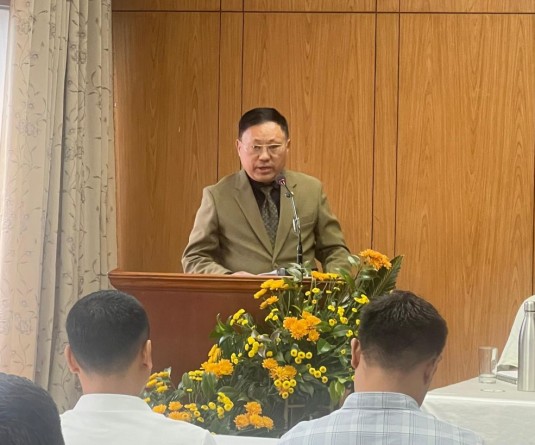
Speaking on the occasion, Khekiye Sumi, commissioner and secretary, art & culture and tourism regretted that the department of art & culture has failed to do such work despite 40 years of its existence.
He said a time has come to wake up and give serious attention on research work with special reference to history, the past and understanding of the various subject matters.
Giving a brief introduction on the project, Dr. Anungla Aier, chairman, ASN, spoke about the lack of scientific data on the cultural history -ethno-archaeological as well as systematic study of the oral traditions.
Dr. Aier stressed on the need to have a comprehensive analysis of the cultural history and the symbolism of value system embedded in their rich cultural traditions.
She also regretted that no comprehensive study has been carried out to estimate the relative variations and homogeneity of physical characters that determine the racial affinity of the Nagas to the Mongoloid stock.
Dr. Aier said that the primary aim of the research project is to fill the lacuna and generate a body of information on the subject. The project is to explore the ethnography of festivals and symbolism of the ritual ceremonies, the chairman said.
It also aims at archaeological exploration, excavate potential sites of ancient settlement, evaluate and date the cultural human remains in order to determine the age and the cultural stage, and to identify distinct metric and no-metric traits to determine the racial affinity of the Nagas with the Mongoloid population.
The study will comprises of three phases- short term, mid-term and long term perspectives, she said adding that the current work will cover Kohima and Phek districts and Chungliyimti site. The process of data collection for the other areas of research will start by May.
Dr. Aier also announced that its future plan “is to collect all relevant baseline data for all tribal communities, identify further archaeologically potential sites for excavation and carry out the subsequent mid and long term objectives.”
Dr. Tiatoshi also gave a brief account of archaeological investigation at Chungliyimti site.
Alem Longkumer, additional director, art and culture chaired the function while vote of thanks was proposed by Kevineinuo P. Meru, director, art & culture.
Morung Express News