KOHIMA, Jan 25 (MExN): A year of experiment has enabled the State Information Commission to detect certain loopholes, not in the RTI Act provisions, but in the approach of information seekers, and government departments while implementing it.
Although the introduction of RTI has seen unprecedented response in the state, many are grappling to know as to how exactly the Act should be put to use. Worse, even the knowledgeable strata are also complicating its ‘user friendly’ procedures by resorting to sophisticated and expensive ways, lamented Chief Information Commissioner, P Talitemjen. For instance, he said, the provision of the Act allows information seekers to use simplest method, which include just a small application on a plain paper in layman language, name and address, and list of information sought along with Rs 10. Interestingly, people use highly expensive materials and sophisticated legal terminology while applying to obtain information from departments, Talitemjen disclosed.
The CIC said that some of the major problems being encounterd by information seekers included non-availability of PIOs’ list, frequent transfer, retirement, promotion of PIOs etc., which hamper the smooth implementation of the Act.
“All PIOs are expected to be conversant with the affairs of the concern department and also maintain proper records”, Talitemjen said, while adding that people should not be looking for PIOs for a week or two, but should be available in the office any time.
Under the Act, people can obtain information dating back to 20 years. PIOs can be penalized by the commission for not replying or for providing wrong or half/suppressed information. The penalty could be up to Rs 25,000 after the expiry of 30 days or others think fit by the Commission. Talitemjen also said that PIOs are responsible even to write application for illiterate citizens if they desire information, and provide the same.
Non-production of departmental manuals by many departments is also posing another problem against smooth implementation. Talitemjen said out of 62 PIOs listed, only three departments – Chief Election Office, Rural Development and Information and Public Relations – have submitted their manuals till date.
However, he said departments can submit theirs in phases, if it finds difficult in preparing at once. Even for appealing to the commission, in case of PIOs’ failure to answer in time or provide wrong or half/suppressed information, a simple application on plain paper with proper name address of the would suffice, he said.
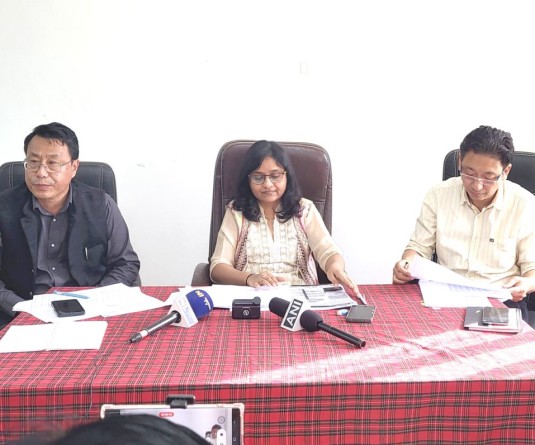
“We cannot allow anyone to abuse. Nor there is a short cut. It involve rules, but it is simple and use-friendly”, CIC told Media persons an interactions at his new office chamber. Talitemjen also cautioned against use of RTI for personal vendetta or confrontation. He also said that although RTI has very good and ideal provisions, it doesn’t mean absolute license to obtain information.
He added that the Commission is a neutral body with government departments on one side and people on the other; as such it cannot incite or instigate anyone to seek particular information.
The CIC opined that e-governance, like video-conferencing and launching of an own website would play a crucial role in proper implementation of RTI. He disclosed the Commission’s website is in the offing, while it will also start working on video-conferencing facilities, especially for remote areas, although it is to take time.
Meanwhile, the first hearing was conducted by the Commission on Wednesday after a lapse of one year. The appeal was made by the Regional Fenta Trade union against the state Forest Department. CIC said the Commission will continue to conduct hearing frequently depending on the receipt of complaints from the people. Till date the commission has received only one appeal, however, there are many others who wants to make appeal to the Commission but are reluctant as they are still confused as to how to go about it.