ICAR-NRC on Mithun, Medziphema, in collaboration with KVK Phek-Porba and the Office of the Chief Veterinary Officer, Phek, conducted an FMD vaccination camp at Porba village on July 25, 2025. (Photo Courtesy: ICAR Nagaland)
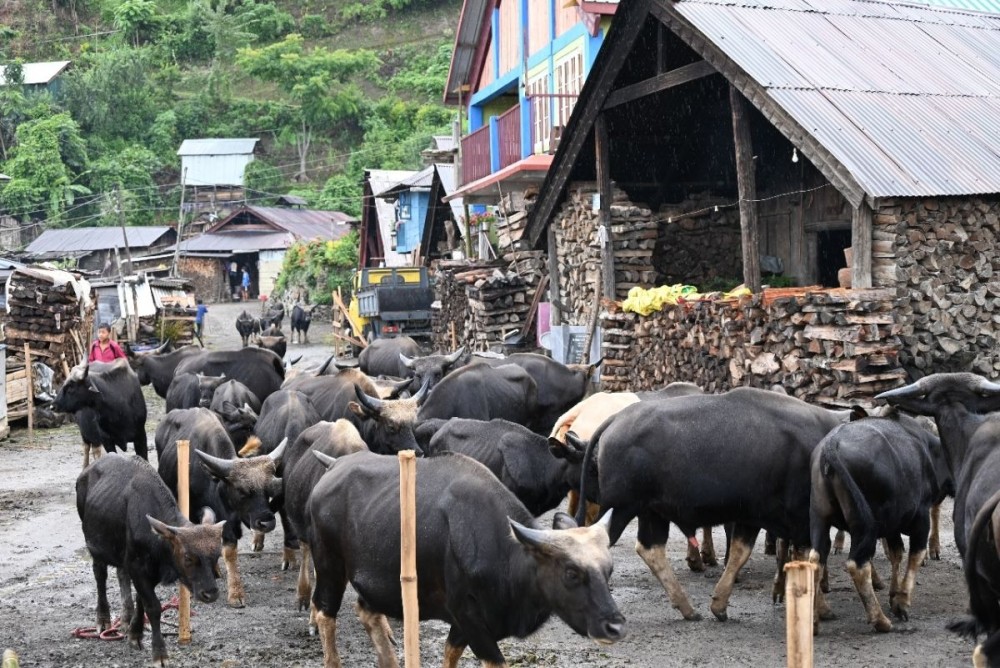
Porba (Phek), January 13 (MExN): A community-led, semi-intensive farming model has revived Mithun (Bos frontalis) husbandry in Porba village here, transforming it into a resilient enterprise after a devastating disease outbreak nearly wiped out the culturally significant bovine population.
Traditionally reared under free-range conditions, Mithun farming in this Chakhesang Naga village faced severe threats from shrinking forests, predation and diseases. Porba, located about 60 kilometres from Kohima, saw the Mithun (Bos frontalis) population plummet from over 400 animals to just 60 following a devastating Foot-and-Mouth Disease (FMD) outbreak in 2015-2016.
Only 10 households continued rearing, and the future of Mithun farming in the village looked uncertain, stated a report compiled by the ICAR–National Research Centre on Mithun, Medziphema, Nagaland team.
To address this crisis, ICAR–National Research Centre on Mithun, Medziphema, in collaboration with Krishi Vigyan Kendra, Phek, introduced a semi-intensive Mithun farming model in 2017.
The approach integrated scientific inputs with traditional practices, focusing on construction of night shelters with CGI roofing and barbed wire enclosures to protect animals from predators and weather. Common grazing land divided into three blocks, each used for 3 months to ensure biomass regeneration and reduce parasite load, and biannual FMD vaccination, routine deworming, and six-monthly health camps.
It also introduced superior breeding bulls, culling of unproductive males, and emphasis on calf care and mineral supplementation. The ‘Porbami Mithun Farmers’ Cooperative Society’ was formed to oversee collective grazing, maintain herd-books, and enforce bylaws. Extensive farmer training through exposure visits and field schools ensured widespread adoption.
Project sees herd growth
The results, tracked from 2016 to 2025, demonstrate a transformative impact. The Mithun herd has rebounded impressively from approximately 60 to about 240 animals. Active farmer participation skyrocketed, with 48 households now engaged compared to the initial 10.
Notably, no major disease outbreaks have been reported since 2016 and the annual calving reached 20-25 and stable sales of 15-20 animals per year. Market prices reflect the improved health and management, with female calves now fetching between Rs 50,000 to 70,000 and prime adult males commanding Rs 1.5 to 2.0 lakh.
Beyond herd recovery, the semi-intensive system also reduced calf mortality, improved animal condition, and enhanced price stability in the market.
The cooperative model strengthened governance, ensured accountability, and enabled collective marketing. Regular shifting of herds between grazing blocks also improved rangeland recovery and reduced parasite cycles. The demand for Mithun meat, valued for its leanness and cultural significance, remains steady, ensuring sustainable income for farmers.
The recovery model
Scientists involved in the project highlighted that semi-intensive Mithun farming can restore herds after catastrophic losses, expand household participation, and create a resilient rural enterprise. With supportive policy frameworks, it can be replicated across other Mithun-rearing regions of Northeast India.
For scaling this success across other Mithun-rearing states in Northeast India, key policy recommendations have been proposed. These include Mithun-specific components in the National Livestock Mission (NLM); development of region-specific breeding policies; expansion of livestock insurance and credit facilities; support for cold-chain and traceability infrastructure for Mithun meat; and community forest agreements for sustainable rotational grazing.