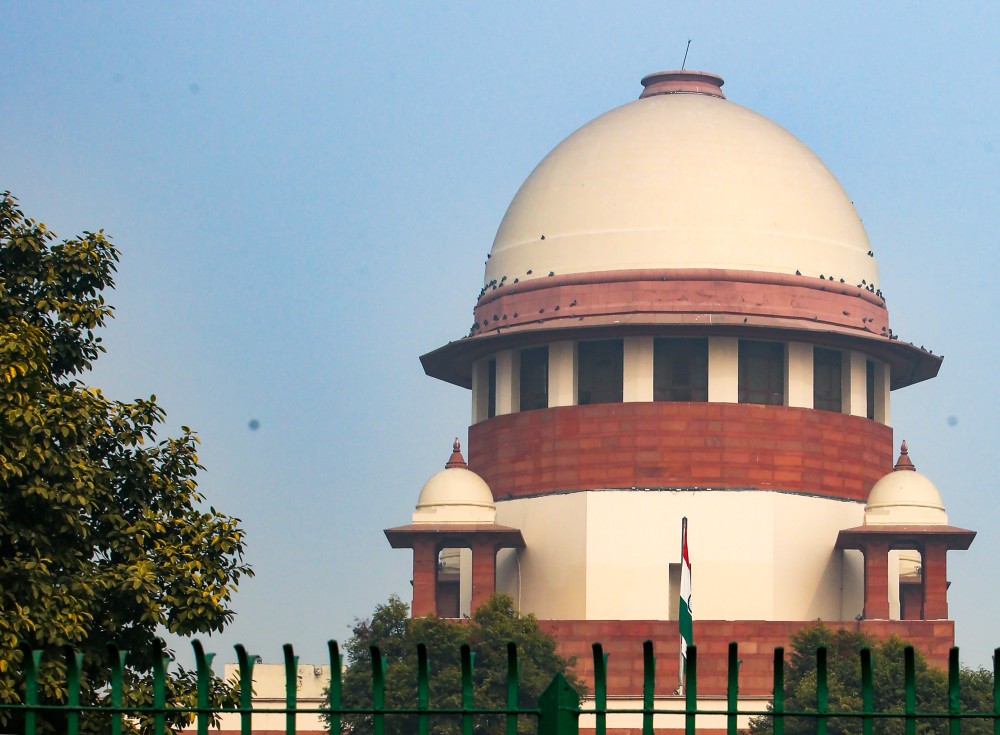
Supreme Court of India. (IANS Photo)
New Delhi, August 25 (IANS): The Centre had told the Supreme Court that the raw caste data collected during the Socio Economic and Caste Census (SECC) 2011 is riddled with inaccuracies, including instances where enumerators recorded numbers or symbols instead of caste names, making the data unreliable for determining reservation or other official purposes.
In a reply affidavit filed in September 2021 in a writ petition by the Maharashtra government seeking disclosure of the SECC-2011 raw caste data of Other Backward Classes (OBCs), the Union Ministry of Social Justice and Empowerment said there was no registry of castes prepared before the 2011 exercise, which contributed to inconsistencies in the data.
The Centre had said that "in several hundred cases, the caste column mentions about number or symbol against caste names", adding that there was no registry of caste prepared prior to the conduct of the 2011 Census.
"It would have been ideal for the Registry of Castes that there should have been given a drop down menu for selection of the castes which could have made some consistent data available which can be relied upon," the affidavit said.
The Centre had submitted that the caste data collected under the SECC-2011 was never made official because of "technical flaws" noticed in the raw caste and tribe data, which rendered it unusable for official population-related purposes.
According to the affidavit, the data contained nearly 130 crore records and was initially stored in thousands of separate MS Excel sheets. The government said the data had to be transferred into a relational database management system to enable state-wise, district-wise and caste-wise analysis.
The Centre had said the analysis of the SECC data for Maharashtra showed that out of a total population of around 10.3 crore, 1.17 crore people, or 11.12 per cent, were recorded as having "No caste", while as many as 4,28,677 castes were enumerated.
In contrast, the affidavit highlighted that the existing published lists of Scheduled Tribes, Scheduled Castes and OBCs in Maharashtra together contain only 494 entries -- 47 STs, 59 SCs and 388 OBCs.
The Centre had said this wide disparity demonstrated the problems with the raw caste data.
"Considering the aforesaid, it is apparent that the caste enumeration in SECC 2011 was fraught with mistakes and inaccuracies," the affidavit said.
It further stated that more than 99 per cent of the castes enumerated in Maharashtra had a population of less than 100 people.
The Centre cited several reasons for the discrepancies, including different spellings of the same caste by enumerators. It gave the example of "Mappilas" in the Malabar region of Kerala, saying the caste had been spelt in 40 different ways by different enumerators, resulting in the recording of 40 separate castes.
Similarly, the affidavit said names such as "Pawar" and "Powar" could require grouping based on phonetic similarity, while only "Powar" was listed as an OBC.
The government had also pointed out that in several cases households had either refused to disclose their caste or the enumerator was unable to determine it, resulting in entries such as "X" in the caste column.
It said that the absence of a pre-existing registry of castes made the exercise particularly vulnerable to such inconsistencies.
"There was no registry of caste prepared prior to the conduct of 2011 Census," the Centre said, stressing that a standardised registry or a drop-down mechanism could have helped produce more consistent data.
The affidavit further said that caste names were sometimes replaced by numbers or symbols, while people also used clan, gotra, sub-caste, caste names, titles and synonyms interchangeably.
The Centre consequently maintained that the available caste data could not form the basis for reservation in admissions, employment or elections to local authorities.
"For the above referred various reasons either due to the mistakes committed by the enumerators, inherent flaws in the manner of conducting census and several such other factors, there is no reliable or dependable castes-based census data available which can be the basis of any constitutional or statutory exercise like reservations in admission, promotion or local body elections," it said.
The Maharashtra government had approached the Supreme Court seeking, among other reliefs, disclosure of the SECC-2011 raw caste data concerning OBCs, or permission to collect empirical data regarding OBCs within the state.
However, the Centre also disputed Maharashtra's reliance on the Supreme Court's 2021 judgment in Vikas Kishanrao Gawali vs State of Maharashtra, saying the judgment did not specifically direct disclosure of the raw SECC-2011 caste data.
It said the Gawali case concerned reservations exceeding 50 per cent in certain Zilla Parishads and Panchayat Samitis and that the SECC-2011 data was neither the subject matter of that petition nor had the Supreme Court adjudicated upon the infirmities in the data or directed its disclosure.
The Centre also referred to an earlier Supreme Court judgment concerning a plea for caste-wise enumeration, asserting that courts cannot direct the executive to conduct a census in a particular manner.
It relied on the top court's 2014 judgment setting aside a Madras High Court direction for conducting a caste-wise census, which had observed that "it is not within the domain of the Court to legislate" and that courts should exercise restraint in matters of policy.
The Centre also maintained that collecting OBC data through the Census posed significant administrative and operational challenges because of the existence of separate Central and State OBC lists and the large number of caste, sub-caste, clan and gotra names.
It said that the SECC-2011 exercise had itself produced more than 46 lakh different caste names nationally, which had not been classified or categorised into the appropriate caste or backward-class categories.
The affidavit concluded that the enumeration of OBCs/BCCs has historically been "administratively extremely complex" and that the infirmities in the SECC-2011 data made it unusable for official purposes.
The Centre had urged the Supreme Court to dismiss Maharashtra's writ petition, contending that the reliefs sought would amount to interference with a policy decision of the Union government. The Supreme Court ultimately dismissed the petition filed by the Maharashtra government.