Kewe Mero hands over the money to Bendangla’s father at her residence in Diphupar following the donation drive.
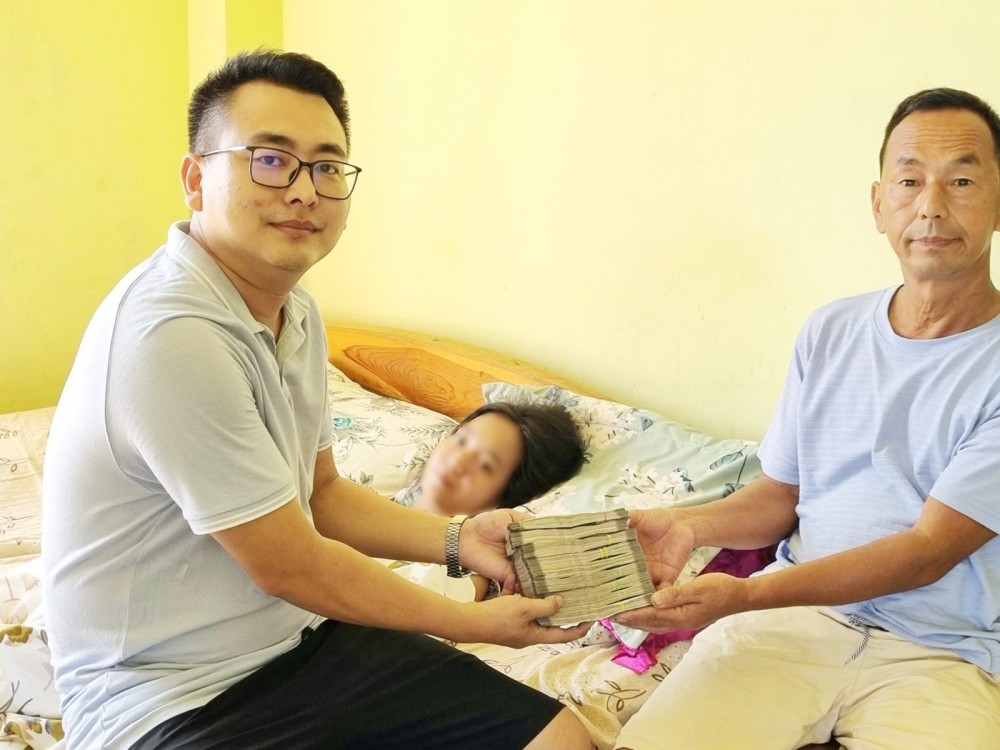
Unable to afford her scheduled lupus follow-up, the campaign is helping take her back to Guwahati on August 11
H Anguvi Chishi
Dimapur | August 9
What began with a phone call from the struggling parents of a young lupus patient has turned into a six-day demonstration of how social media can mobilise compassion, with more than Rs 4.66 lakh raised for her treatment.
Dimapur-based part-time content creator and YouTuber Kewe Mero said Bendangla’s family contacted him after getting his number through someone they knew. Her parents explained her prolonged battle with lupus and the financial difficulties they were facing.
Her father, a church caretaker, told Mero that the family was struggling to meet the expenses of her treatment and humbly sought his help in raising funds through his YouTube channel.
Initially, Bendangla’s parents sent Mero her medical reports and photographs. He told them he would consider the request and get back to them within two or three days. When they contacted him again, he decided to visit Bendangla personally to understand her condition and circumstances.
During the visit, her parents explained the difficulties they had faced in taking her to Apollo Excelcare Hospital in Guwahati, where she has been undergoing treatment for lupus. Doctors had advised regular follow-up visits every three months.
The family had previously managed to take her for routine treatment but, due to financial difficulties, could not attend her scheduled follow-up in February and had been unable to return since.
“After seeing her condition and understanding what the family had been going through, I felt that I should step forward and use my platform to help raise funds for her treatment,” Mero told The Morung Express in a text interview.
A campaign beyond financial contributions
The campaign was launched on August 1 without any specific fundraising target.
Mero said he and the family prayed together before starting the appeal and left the outcome in God’s hands. He had also told Bendangla’s family that he could not guarantee how much would be raised and that they should be grateful for whatever amount came in.
Within hours of the appeal being published on YouTube, however, the response began to exceed expectations.
People started sharing the appeal, contributing whatever they could and reaching out to express concern. Support came from different parts of Nagaland as well as Arunachal Pradesh, Mizoram, Assam, Manipur and Meghalaya.
Some donors were personally known to Mero, but most were strangers who responded after seeing the appeal. Many had never met Bendangla or Mero.
The campaign soon grew beyond financial contributions. People prayed for Bendangla, widely shared the video, expressed concern about her condition and suggested doctors, hospitals and other places where she could seek treatment.
“It made me realise that the campaign had grown beyond just raising funds. It had become a collective effort by many people who genuinely wanted to see Bendangla get better,” Mero said.
Among the gestures that touched him most were those from a student who donated from their scholarship and three children who contributed from their own savings.
For Mero, the amount donated mattered less than the sacrifice and sincerity behind each contribution.
“These gestures deeply moved me because they showed that people were willing to give whatever they could, regardless of their age or financial situation,” he said.
When the campaign crossed Rs 4 lakh, Mero said his first reaction was to thank God. He was overwhelmed by the way people had come together and said the experience demonstrated the compassion and generosity within the community.
It also showed him the power of social media when used for a meaningful purpose.
Giving back to the community
Mero has undertaken several medical fundraisers in the past, although medical fundraising is not the main focus of his content. His work largely revolves around commentary, covering people’s stories and creating awareness about social issues.
Coming from a sociological background, he said he has always wanted to give something back to society.
With more than 200,000 subscribers on YouTube and over 16,000 followers on Instagram, Mero said he views his digital following as a responsibility rather than merely a number.
“If I have a platform that can reach thousands of people, I believe I should use it for something meaningful whenever I have the opportunity,” he said.
One earlier fundraiser that affected him deeply was for Imlisang, a three-year-old leukemia patient whose parents were daily wage earners. Mero said the child’s situation particularly affected him because he has “always had a soft spot for children”.
That campaign raised Rs13,14,059 in just four days, an experience he described as deeply emotional and one of the fundraisers closest to his heart.
Mero said he takes verification seriously before appealing for donations. Whenever possible, he personally visits patients and their families, speaks to them and verifies their circumstances instead of relying only on medical reports or documents.
He also examines available medical reports and treatment details, saying that seeking people’s trust and hard-earned money comes with a responsibility to ensure the case is genuine and the funds are used for the stated purpose.
His experiences with fundraising have strengthened his belief in the kindness and humanity still present in society. He said he has repeatedly seen people help complete strangers, sometimes giving whatever little they can afford.
“A contribution may seem small individually, but when hundreds or thousands of people come together, it can become something life-changing,” he said.
Response crossed generations
Mero believes young people play a major role in spreading such appeals because of their strong presence and connectivity on social media. But the response has crossed generations, with Gen Z, Millennials and older people participating by donating, sharing appeals, offering prayers or advice, or simply expressing concern.
He believes young people can turn a single appeal into a larger movement when their digital influence is used for a good cause.
According to Bendangla’s parents, her last visit to Apollo Excelcare Hospital was in November 2025. Her next follow-up was due in February, but financial difficulties prevented the family from making the trip.
With the funds raised through the campaign, the family plans to take Bendangla to Guwahati on August 11 for treatment and medical follow-up. The money will help meet expenses for treatment, consultations, medicines and travel.
Platform for compassion, solidarity and hope
For Mero, however, Rs4.66 lakh is far more than a fundraising figure.
“It represents people coming together for a common cause, showing love, compassion and solidarity for someone in need,” he said.
For a family that had been struggling and feeling helpless, the campaign has brought renewed hope.
“Sometimes, when people are going through difficult circumstances, knowing that others care and are willing to stand beside them can give them the strength to keep going,” Mero said.
The six-day campaign, he said, reminded him that humanity remains very much alive and that social media can be more than entertainment or opinions — it can be a platform for compassion, solidarity and hope.